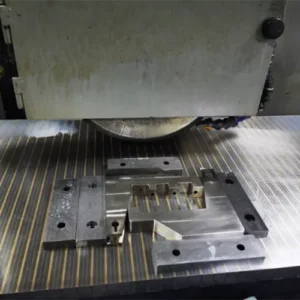

Bronze vs copper are two types of metals frequently used in daily life. Brass is favored by manufacturers of energy and industrial components due to its good electrical conductivity, while bronze is valued for its corrosion resistance. However, most people tend to confuse these two metals. Below, we will describe and compare bronze vs copper from multiple perspectives, hoping to help copper/bronze machining engineers and those interested in them.
What is Bronze
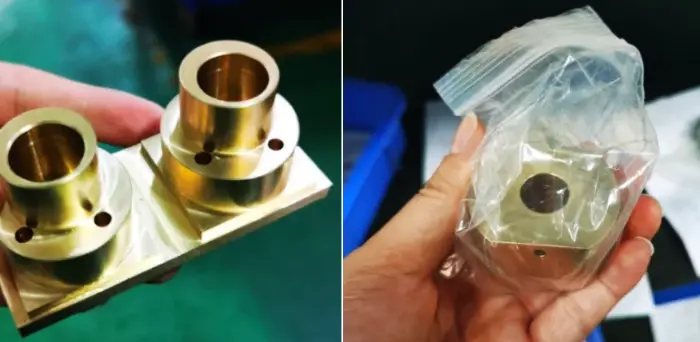
Bronze is a copper-tin alloy composed mainly of copper and tin, with other elements such as zinc and lead included. When newly made, bronze has a light golden-yellow color, slightly lighter than brass, with excellent luster. Bronze features a low melting point, high hardness, and strong corrosion resistance, and is commonly used to manufacture mechanical parts, musical instruments, and sculptures.
What is Copper
Copper is also called red copper. Due to its high Cu content, it appears red or purplish-red, and is also known as purple copper. It has good ductility and electrical conductivity. Because copper oxidizes easily, the black oxide layer formed on its surface can effectively prevent oxygen and moisture in the air from further penetrating and reacting with the internal copper, giving it strong corrosion resistance. It is commonly used to manufacture wires, pipes, and other components.
Differences Between Bronze and Copper
Composition Differences Between Bronze and Copper
Bronze: Bronze is an alloy of copper and tin, typically containing about 90% copper and 10% tin, along with small amounts of zinc and lead. This composition gives bronze high strength and good corrosion resistance.
Copper: Copper is pure copper, usually containing 99% or more copper with no significant alloying elements. Therefore, it retains all the fundamental properties of pure copper.
Physical Properties Comparison of Bronze and Copper
In terms of density and weight, bronze has a density of about 7.5 g/cm³, while copper has a density of 8.9 g/cm³. For the same volume, pure copper is significantly heavier than bronze.
The melting point of bronze is 800–900°C, which is lower than that of copper (about 1083°C). This difference is caused by the tin content—the higher the tin content, the lower the melting point.
The hardness of bronze ranges from 150–250 HB, increasing with higher tin content. Copper, on the other hand, is relatively soft, with a hardness of only 35–50 HB.
In terms of ductility, materials can vary greatly under different processing conditions.
For example, annealed copper has an elongation of 30–45%, while cold-worked copper has an elongation of 4–6%.
However, due to the variety of alloy compositions, bronze has a wide range of elongation. Ordinary tin bronze has an elongation of 8–15% in the annealed state, while phosphor bronze can reach up to 50% after annealing.
The impact toughness of bronze varies depending on alloy composition. Special bronzes such as aluminum bronze (not less than 45 J/cm³) have better impact resistance than pure copper due to higher strength and toughness; ordinary tin bronze is similar or slightly lower. Pure copper has an impact toughness of about 60 J/cm³. Although it has good plasticity, it deforms easily and is not suitable for load-bearing structural components.
Thermal Properties Comparison of Bronze and Copper
Thermal Conductivity:
Pure copper has a thermal conductivity as high as 401 W/(m·K), allowing heat to transfer very quickly. It is suitable for radiators, heat exchangers, and cookware requiring rapid heating and cooling. In contrast, bronze has a thermal conductivity of about 26–110 W/(m·K) (depending on alloy composition such as tin or aluminum). Due to alloying elements hindering electron heat transfer, its thermal conductivity is only 1/4 to 1/10 that of pure copper.
Effect of High Temperature on Strength:
Although copper has excellent thermal conductivity, its strength decreases significantly as temperature rises, making it prone to creep (slow deformation). Bronze, however, benefits from added elements that significantly improve its high-temperature strength, maintaining hardness and resistance to deformation, and is widely used in gears and bearings.
Thermal Expansion:
Pure copper has a relatively high coefficient of thermal expansion, resulting in noticeable dimensional changes when heated. Bronze (especially special alloys like iron bronze) has a lower thermal expansion coefficient and better dimensional stability, making it more suitable for high-precision components.
Electrical Conductivity Comparison of Bronze and Copper
Pure copper has a high copper content (usually ≥99.9%) and a well-ordered crystal lattice structure, allowing electrons to flow with minimal resistance. Therefore, it has excellent electrical conductivity, with a conductivity of about 5.8 × 10⁷ S/m.
Bronze, as an alloy of copper with tin, zinc, lead, aluminum, and other elements, has a disrupted crystal lattice structure due to these additional elements, increasing resistance to electron flow. As a result, its electrical conductivity is significantly lower than that of pure copper, with conductivity ranging from approximately 0.6 × 10⁷ to 1.7 × 10⁷ S/m.

How to Distinguish Bronze and Copper
Bronze vs copper color appearance:
Pure copper (red copper) and bronze differ significantly in appearance, especially when considering the color of bronze vs copper. Pure copper typically appears rose-red or purplish-red, with a warm, soft luster. Even after oxidation, it tends to remain reddish-brown. In contrast, bronze—due to alloying elements such as tin—has a darker tone, often ranging from yellow-brown to greenish-brown. Its metallic luster appears “harder” and sometimes carries a cooler visual tone.
In terms of oxidation characteristics, the two also differ, which further highlights the distinction between bronze color vs copper color. Pure copper initially darkens on the surface, forming a black or dark brown oxide film, and may develop patina only after long-term exposure. Bronze, however, more readily forms a dense and stable green corrosion layer (commonly known as bronze patina), featuring rich coloration and distinct layering. This naturally formed patina is often regarded as an important and desirable characteristic of bronze.
Test Hardness and Scratches:
Copper is relatively soft, so it can be lightly scratched with a knife or hard object such as a stone, leaving visible marks; bronze, due to the addition of tin, is harder and its surface is not easily scratched by sharp objects like knives.
Listen to the Sound:
Copper (red copper) produces a dull sound when struck, not crisp, with a short resonance. Bronze plates produce a clear and loud sound when struck, with a long-lasting resonance. This is also why ancient chime bells were mostly made of bronze.
Look at Usage Scenarios:
Copper is often used to make wires, water pipes, and radiators. Bronze, due to its better wear resistance, is mainly used to make bearings, gears, sculptures, musical instruments, and antique-style bronze decorative items.
Warm Reminder:
It is sometimes difficult to achieve 100% accuracy based on appearance alone, especially for modern imitations that have been electroplated or artificially aged. For precise identification, it is recommended to use professional instruments (such as spectral analysis).
Types of Alloys
With the continuous expansion of advanced industrial fields, materials need to meet different environmental requirements and stability demands. Therefore, additional metal mineral elements are often added to bronze and copper in solid solution states. Below are examples of their derived alloys.
Types of Bronze Alloys
Tin Bronze: Composed mainly of copper and tin, often containing zinc and lead, including C90300, C90500, C91300. It has excellent wear resistance, high strength, and good corrosion resistance in atmospheric and freshwater environments, along with good machinability. It is widely used for manufacturing bearings, bushings, gears, and valve components under high-load conditions.
Aluminum Bronze: Based on copper with about 9%–11% aluminum added, with common grades such as C95400, C95500. It features very high strength and hardness, excellent wear resistance, and stable performance at high temperatures, making it suitable for pump bodies, valve parts, high-strength gears, and heavy-duty wear-resistant structural components.
Beryllium Bronze: Contains about 2% beryllium in a copper base, such as C17200. This alloy is an ultra-high-strength material with excellent elastic limit, fatigue resistance, and good electrical conductivity. It can be further strengthened through heat treatment and is commonly used in precision springs, electrical connectors, and aerospace critical structural components.
Types of Copper Alloys
Free-Cutting Copper Alloys: By adding elements such as lead (Pb), tellurium (Te), or antimony (Sb) (e.g., C14500, C14700, C36000), machinability is significantly improved, making chips easier to break, thereby increasing processing efficiency and achieving better surface finish. Widely used in precision screws, watch components, and electronic connectors.
Damping Copper Alloys: Represented by high-manganese copper alloys (such as Mn-Cu damping alloys), these materials have excellent vibration absorption and noise reduction properties, effectively attenuating mechanical vibration and noise. They are commonly used in precision instrument bases, ship propellers, and high-end audio equipment requiring superior damping performance.
Shapes of Bronze and Copper Materials
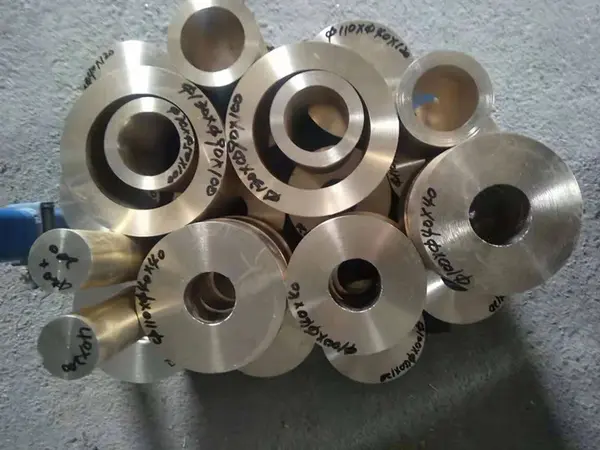
After removing impurities at high temperatures and uniformly mixing with other metal elements and minerals, bronze and copper materials are cooled and then processed through stretching, casting, forging, laser cutting, and other methods to form the desired shapes, facilitating subsequent processing and reducing unnecessary steps. Common forms include:
Bars: Copper and copper alloy bars (such as tin bronze, aluminum bronze, beryllium bronze, brass, and T2 copper) are typically used as machining blanks. They are formed through extrusion and drawing processes and then machined by поворот и фрезерование into various shafts, fasteners, and conductive components, widely used in bolts, valve stems, electrodes, and structural parts.
Plates and Strips: Copper plates and strips (such as phosphor bronze strips, brass H96/H80, and oxygen-free copper plates) are mainly produced through hot rolling and cold rolling processes. Cold rolling improves precision and surface quality. They are then formed by stamping and shearing, commonly used in heat sinks, spring sheets, sealing components, and architectural decoration and roofing materials.
Pipes: Copper and copper alloy pipes (such as TP2 deoxidized copper, naval brass, and aluminum bronze) have excellent corrosion resistance, pressure resistance, and thermal conductivity. They are typically produced by drawing, extrusion, or welding processes and further processed by bending to form complex piping systems, widely used in heat exchangers, condensation systems, water supply pipelines, and industrial fluid transport systems.
Wires and Busbars: Copper wires and busbars (such as bare copper wire, silver-plated copper wire, and beryllium bronze wire) are mainly produced through drawing processes, combined with stranding and electroplating to enhance performance. They are used in power transmission, cable manufacturing, and high-frequency signal transmission. Copper busbars are widely used in substation equipment and high-current bus systems.
Отливки: For copper alloy parts with complex structures (such as high-lead tin bronze C932, aluminum bronze, and cast brass), processes like sand casting, centrifugal casting, or precision casting are typically used. These methods enable complex shapes and good surface quality, with typical applications including bearings, gears, valve bodies, pump housings, marine propellers, and artistic castings.
Bronze vs Copper Surface Finish
Copper and bronze, as classic metal materials, are widely used due to their excellent electrical conductivity, thermal conductivity, and mechanical properties. Their unique color and texture also make them important elements in design. Through mechanical surface treatments such as polishing, brushing, sandblasting, hammering, and texturing, their appearance and tactile feel can be altered, achieving effects ranging from high gloss to matte, and from smooth to rough.
Chemical and electrochemical treatments, such as oxidation aging, plating, and protective coating or painting, can change the surface composition or form protective films, thereby improving corrosion resistance and decorative effects. Combined with specialized functional treatments and process selection, copper and bronze can present diverse appearances to meet industrial and design requirements.
Bronze vs copper application parts
Bronze:
Bronze is an alloy material with relatively high hardness and corrosion resistance, possessing an elegant and timeless aesthetic.
In ancient times, bronze was mainly used to make wheels, drinking and cooking utensils, as well as statues and sculptures. Modern archaeology has also uncovered ancient Chinese bronze artifacts such as wine vessels (zun), cooking and steaming utensils, and decorative bronze sculptures, all of which carry certain cultural significance.
In daily life, if we observe carefully, we can also find that some furniture accessories use bronze materials, such as bronze lighting fixtures, lamp base support rods, bronze door handles, and cabinet handle decorations, all of which enhance a classic and rustic design style.
Some high-end vintage-style restaurants also customize bronze tableware such as knives, forks, goblets, and plates as part of their dining identity, attracting customers to visit, dine, and take photos.
In watches, bronze is often used for cases, bezels, crowns, buckles, and straps. Due to its corrosion resistance and its ability to form a unique oxidized patina, it has become a signature material for vintage-style watches. It not only meets structural strength requirements but also develops a personalized color over time with wear.
In jewelry design, bronze is commonly used to create decorative pieces such as rings, pendants, bracelets, earrings, and brooches. With its warm, retro metallic tone and good casting properties, it is ideal for creating aged and vintage-style jewelry, balancing texture with unique changes during wear.
Copper:
Due to its high copper content and the dense, stable nature of copper oxide, copper is also widely used in daily life.
Thanks to its excellent electrical and thermal conductivity, copper is widely used to manufacture busbars, terminals, electrical contacts, motor coils, wires and cables, and lead frames for integrated circuits.
Taking advantage of its corrosion resistance, ease of welding, and good sealing properties, copper is often processed into pipes, plumbing fittings such as connectors, elbows, tees, valve cores, faucets, and shower components.
Copper’s high thermal conductivity makes it a common material for heat dissipation and cooling components such as radiators, heat sinks, air conditioner condensers and evaporators, refrigeration copper tubes, and heat exchangers.
Copper can also be used to make jewelry bases such as ring blanks, earring components, and pendant settings, as well as parts like ear pins, clasps, jump rings, spacer beads, and bead caps. After gold or silver plating, it becomes a cost-effective jewelry material and can also be used to create vintage or ethnic-style accessories. Compared to bronze jewelry, copper jewelry may lack a heavy, antique feel, but this can be compensated for through various surface treatments and customization options.
Copper and copper alloys also exhibit excellent wear resistance and anti-friction properties. They are commonly used to manufacture mechanical components such as bushings, sleeves, nuts and bolts, worm gears, sliding bearings, and conductive inserts for molds, making them suitable for various transmission and support structures in machinery.
How Weldo can help
Weldo machining provides high-quality Обработка на станках с ЧПУ, wire cutting, aluminum extrusion, sheet metal processing, and other process support. We have more than ten years of material supply chain experience, along with professional factory management systems and inspection teams, ensuring smooth operation from prototype processing to mass production, guaranteeing tolerance standards and stable shipping arrangements. As your professional copper machining service provider, we are confident in meeting every challenge. If you are interested, please связаться с мы.