
Aluminum alloy is one of the most widely used metal materials in CNC machining, sheet metal fabrication, aerospace structural parts, automotive lightweight parts, industrial equipment components, and electronic product housings. In actual material selection, 5052, 6061, 7075, and 2A21 are several aluminum alloy grades most often compared.
Although they all belong to aluminum alloys, there are obvious differences in strength, hardness, ductility, corrosion resistance, weldability, and machining difficulty. For aluminum machining, material selection not only affects part performance, but also directly affects machining efficiency, tool life, surface quality, and the overall manufacturing cost of the project.
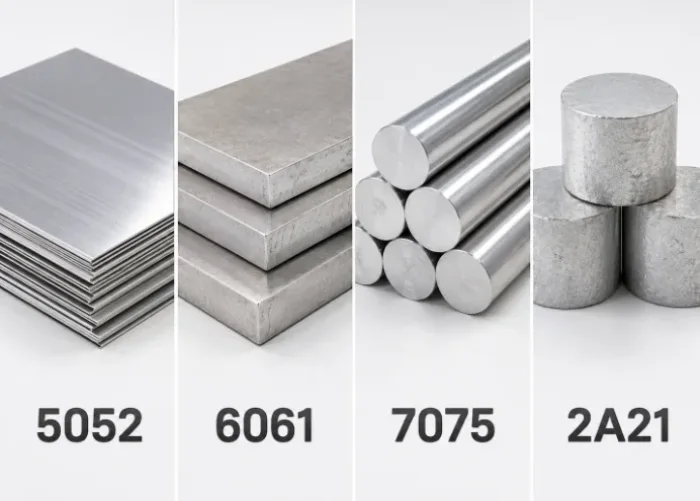
Overview of 5052, 6061, 7075, and 2A21 Aluminum
5052 belongs to the 5xxx aluminum-magnesium alloy series and is a typical rust-resistant aluminum material. Its corrosion resistance, weldability, and forming performance are excellent, so it is widely used in ships, fuel tanks, automotive panels, architectural decoration, electronic equipment housings, and other fields.
6061 belongs to the 6xxx aluminum-magnesium-silicon alloy series and is one of the most widely used structural aluminum alloys. In the 6061-T6 temper, it combines good strength, corrosion resistance, machinability, and anodizing results, so it has become one of the most common general-purpose materials in CNC machining.
7075 belongs to the 7xxx aluminum-zinc-magnesium-copper alloy series and is also often called 7075 aircraft aluminum. Its strength is much higher than that of 5052 and 6061, making it an important material for aerospace, high-performance mechanical parts, and lightweight structural parts, but its corrosion resistance and weldability are relatively weak.
2A21 belongs to the 2xxx aluminum-copper alloy series and has relatively high strength and good load-bearing capacity. It is often used for aerospace structural parts, high-strength mechanical parts, and engineering equipment components. Because its copper content is relatively high, its corrosion resistance is usually lower than that of 5052 and 6061, so it needs to be used together with appropriate surface treatment processes.
Chemical Compositions of 5052 vs 6061 vs 7075 vs 2A21 Aluminum
| Element Content (%) | 5052 | 6061 | 7075 | 2A21 | Element Function |
| Al | Balance | Balance | Balance | Balance | Base metal, lightweight and thermal conductivity |
| Mg | 2.2-2.8 | 0.8-1.2 | 2.1-2.9 | ≤0.05 | Improves strength, corrosion resistance, and weldability |
| Si | ≤0.25 | 0.4-0.8 | ≤0.40 | ≤0.50 | Improves casting performance and heat-treatment strengthening effect |
| Zn | ≤0.10 | ≤0.25 | 5.1-6.1 | ≤0.10 | Greatly improves strength; the main strengthening element in 7075 |
| Cu | ≤0.10 | 0.15-0.40 | 1.2-2.0 | 3.5-4.5 | Improves strength and heat resistance, but reduces corrosion resistance |
| Mn | ≤0.10 | ≤0.15 | ≤0.30 | 0.4-1.0 | Improves fatigue strength and high-temperature stability |
| Cr | 0.15-0.35 | 0.04-0.35 | 0.18-0.28 | ≤0.10 | Improves stress-corrosion resistance and microstructural stability |
| Fe | ≤0.40 | ≤0.70 | ≤0.50 | ≤0.50 | Impurity element; excessive content reduces plasticity |
| Ti | – | ≤0.15 | ≤0.20 | ≤0.15 | Refines grains and improves material stability |
Part of the chemical composition and material performance data above is referenced from MatWeb and AZoM.
The Role of Mechanical Performance Parameters in Aluminum Alloy Machining
To help you better understand the later comparison of parameter content, I consulted the material engineers at weldo machining. The following are the meanings/functions of the mechanical performance parameters that are relatively difficult to understand.
- Tensile strength: Determines the material’s ability to withstand tensile loads.
- Yield strength: Determines the maximum stress the material can withstand before permanent deformation occurs.
- Elongation: Reflects the material’s plasticity and forming ability.
- Hardness: Affects wear resistance, tool wear, and machining difficulty.
- Elastic modulus: Determines structural rigidity and dimensional stability.
- Density: Affects product weight and the effect of lightweight design.
- Corrosion resistance: Determines the service life of the material in humid, salt-spray, and chemical environments.
- Machinability: Directly affects material processing efficiency, surface quality, and manufacturing cost.
Comparison of Mechanical Performance Parameters: 5052 vs 6061 vs 7075 vs 2A21
By collecting material performance parameter comparisons from Wikipedia and our material suppliers, the physical and chemical performance parameters of the four aluminum alloy materials are listed:
| Performance Parameter | 5052 | 6061 | 7075 | 2A21 |
| Common Temper | H32 | T6 | T6/T651 | Heat-Treated Temper |
| Tensile Strength | Approx. 210-260 MPa | Approx. 290-320 MPa | Approx. 500-570 MPa | Approx. 390-480 MPa |
| Yield Strength | Approx. 130-200 MPa | Approx. 240-276 MPa | Approx. 430-505 MPa | Approx. 260-300 MPa |
| Elongation | Approx. 10%-18% | Approx. 8%-17% | Approx. 8%-11% | Approx. 10%-15% |
| Hardness | Approx. HB 60 | Approx. HB 95 | Approx. HB 150 | Approx. HB 100-120 |
| Elastic Modulus | Approx. 70 GPa | Approx. 69 GPa | Approx. 71 GPa | Approx. 70-72 GPa |
| Density | Approx. 2.68 g/cm³ | Approx. 2.70 g/cm³ | Approx. 2.81 g/cm³ | Approx. 2.78 g/cm³ |
| CNC Machinability | Average; relatively soft and prone to sticking to the tool | Excellent; stable chip evacuation | Good; relatively high tool wear | Good; cutting heat needs attention |
| Corrosion Resistance | Excellent | Good | Poor | Average |
| Electrical Conductivity | Relatively Good | Relatively Good | Relatively Low | Average |
| Thermal Conductivity | Relatively Good | Good | Relatively Low | Relatively Low |
| Typical Machining Applications | Sheet metal parts, housings, fuel tanks, marine parts | Structural parts, frames, mechanical parts | Aerospace parts, high-strength fixtures | Load-bearing parts, aerospace structural parts |
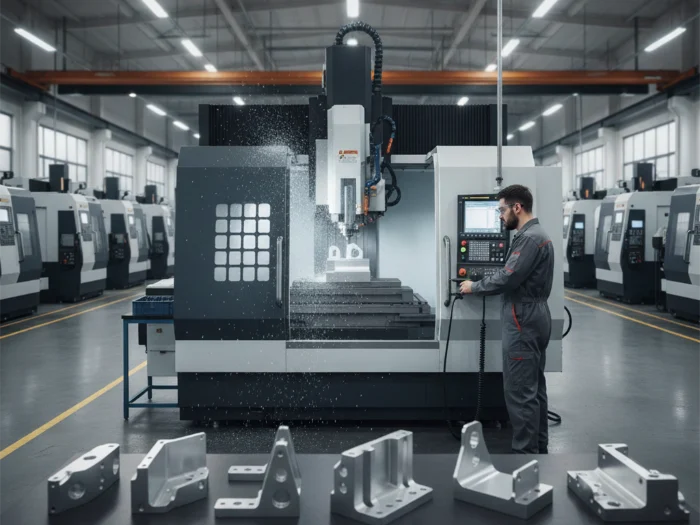
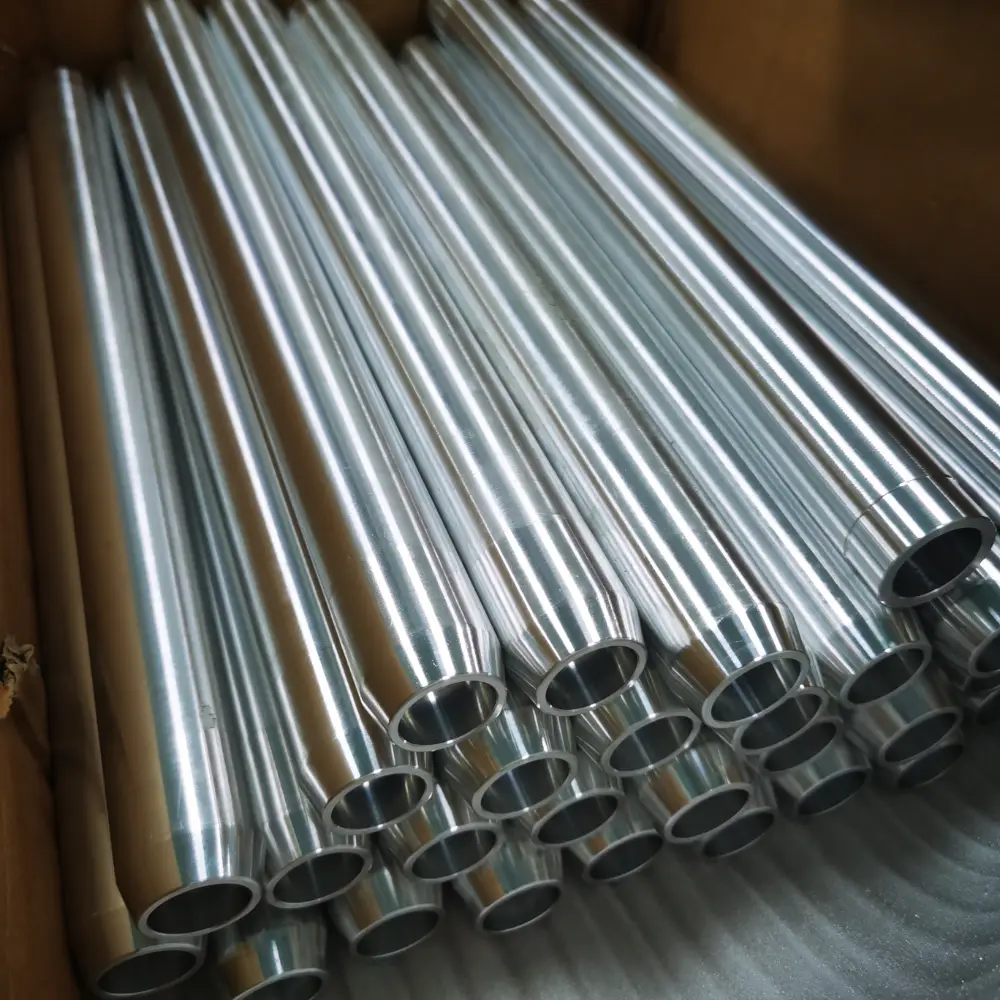
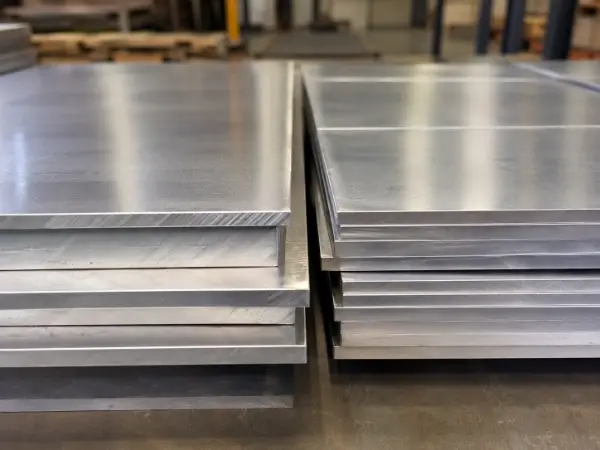
5052 Aluminum Machining: Suitable for Corrosion Resistance and Sheet Metal Forming
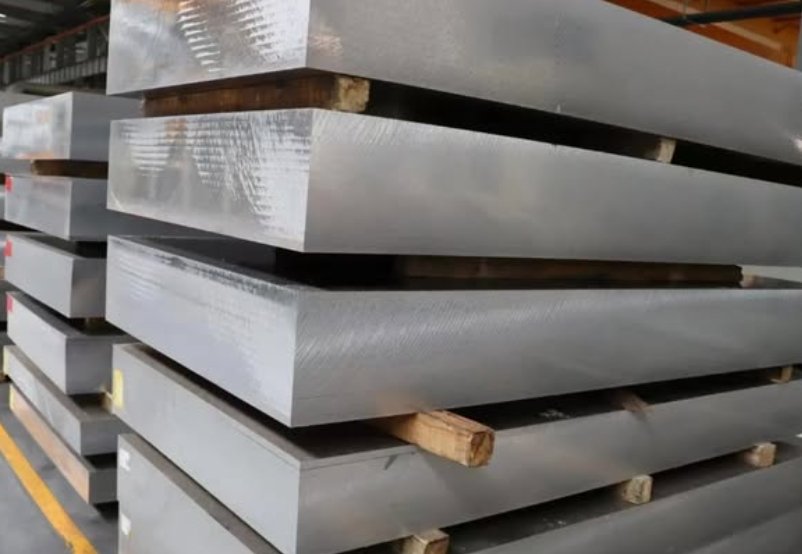
The biggest advantages of 5052 aluminum alloy are its corrosion resistance and excellent forming performance. Because it has a relatively high magnesium content and does not rely on copper strengthening, it is especially suitable for marine environments, chemical equipment, and sheet metal parts that require complex bending and stamping.
Because the material is relatively soft, tool sticking and burr problems can easily occur during CNC machining, so sharp cutting tools and relatively high cutting speeds are recommended for machining.
Applications and Surface Treatments of 5052 Aluminum Alloy
For 5052 aluminum to meet the needs of stable use, decoration, and functionality under different environments and working conditions, the parts need surface treatment.
1. Anodizing
It is usually used for 5052 aluminum alloy parts after machining is completed. After cleaning, degreasing, and surface activation, a dense oxide film is formed on the surface of the part through an electrochemical reaction, giving the aluminum part better corrosion resistance and wear resistance. Typical application parts include electronic equipment housings, instrument panels, automotive interior parts, decorative panels, and building curtain wall accessories.
2. Sandblasting
Sandblasting uses sand particles or glass beads to uniformly impact the surface of machined 5052 aluminum alloy workpieces. It removes slight surface oxide layers, burrs, and machining marks, forming a fine matte effect on the part surface. It can improve the adhesion of subsequent anodizing or spraying.
It is mainly used for electronic housings, control panels, mechanical housings, decorative cover plates, and automotive interior parts.
3. Brushing
Using abrasive belts, brushing wheels, and other tools, the surface of 5052 aluminum parts is ground along a fixed direction to form continuous and fine linear textures, highlighting the metallic texture of the aluminum alloy. It improves the decorative effect, enhances the product texture, and weakens slight scratches.
It is commonly used for home appliance panels, electronic housings, automotive decorative strips, architectural decorative panels, and nameplate panels.
4. Powder Coating
Powder coating is usually used for 5052 aluminum alloy accessories after sheet metal forming, welding, or machining is completed. After the part surface is cleaned, degreased, and pretreated, powder coating is attached by electrostatic spraying and then cured at high temperature to form a protective coating. It can significantly improve weather resistance, corrosion resistance, and long-term protection capability, while providing a wide range of color options.
It is mainly applied to building curtain walls, outdoor decorative panels, equipment housings, automotive parts, and outdoor structural parts.
5. Chemical Passivation
It is suitable for 5052 aluminum alloy machined parts that need to maintain electrical conductivity and dimensional accuracy. Through a chemical conversion reaction, a thin and uniform protective film is formed on the part surface, with little impact on workpiece dimensions. It can significantly enhance corrosion resistance.
It is commonly used for electronic equipment housings, grounding parts, electrical connectors, communication equipment components, and precision sheet metal parts.
6061 Aluminum Machining: The Most Balanced Overall Performance
6061 is one of the most common aluminum alloys for CNC machining. It combines good strength, corrosion resistance, weldability, and machinability, so it is widely used in mechanical manufacturing and industrial equipment fields.
In the 6061-T6 temper, it has relatively high strength while maintaining good cutting performance and anodizing results, making it an ideal choice for structural part machining.

Surface Treatments and Applications of 6061 Aluminum Alloy
1. Anodizing
After machined 6061 aluminum alloy parts are cleaned, degreased, and surface-activated, an oxide film is formed on the part surface through an electrochemical reaction. This can improve corrosion resistance, surface hardness, and decorative effect, and it can also provide natural color, black, orange, or other color decoration according to requirements. This type of process mainly appears on CNC housings, mechanical panels, aluminum alloy brackets, instrument accessories, and electronic equipment structural parts.
2. Hard Anodizing
Hard anodizing is suitable for 6061 aluminum parts with higher requirements for wear resistance and surface strength. This process forms a thicker and harder oxide film on the part surface, which can significantly improve wear resistance and service life. It is suitable for functional parts that withstand friction or repeated assembly, such as mechanical sliders, guide rail accessories, fixtures, equipment components, and milled parts.
3. Sandblasting
Fine sand particles or glass beads are used to uniformly impact 6061 aluminum parts, improving surface quality and uniformity and forming a fine matte effect. This treatment is also often used as a pretreatment before anodizing or spraying, helping to improve the adhesion of subsequent coatings.
It is mainly used for CNC housings, control panels, mechanical covers, instrument housings, and aluminum alloy decorative parts.
4. Powder Coating
Powder coating is usually used for aluminum profiles, frame structural parts, or machined 6061 aluminum alloy accessories. Electrostatic spraying is performed on the part surface so that the powder coating adheres to the surface, and then it is cured at high temperature to form a more stable coating. It can improve weather resistance, corrosion resistance, and appearance consistency, while providing multiple color options.
It is mainly applied to aluminum profile frames, equipment housings, industrial brackets, protective covers, and outdoor structural parts.
5. Chemical Passivation
On 6061 aluminum alloy parts. Through a chemical conversion reaction, a thin and uniform protective film is formed, with relatively little impact on workpiece dimensions. At the same time, it can improve corrosion resistance and maintain a certain degree of electrical conductivity. It is commonly used for electronic equipment accessories, grounding parts, electrical connectors, communication equipment components, and precision CNC machined parts.
7075 Aluminum Machining: Suitable for High-Strength and Lightweight Parts
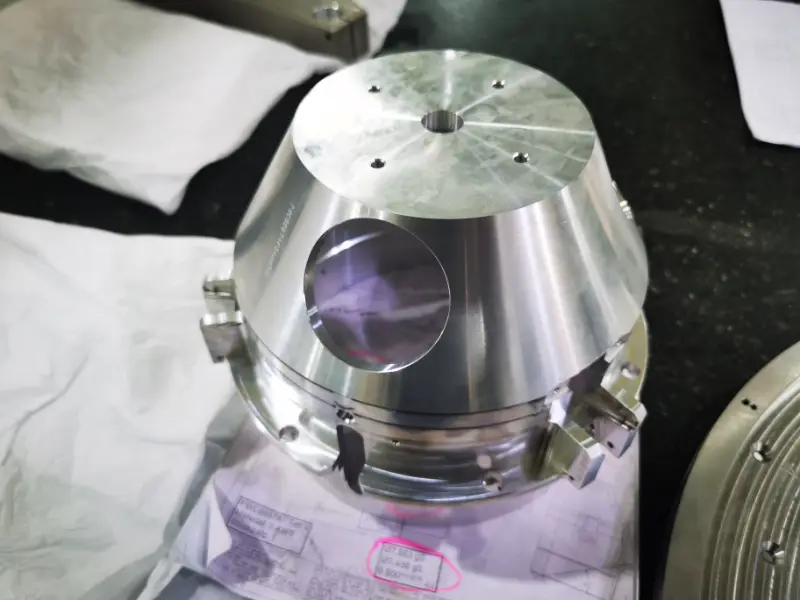
7075 aluminum alloy is known for its extremely high strength and is an important material for aerospace and high-performance mechanical parts.
Its strength is close to that of some steels while maintaining a relatively low density, so it is especially suitable for lightweight design. However, because its corrosion resistance and weldability are weak, additional surface treatments and mechanical connection methods are usually required.
Applications and Surface Treatments of 7075 Aluminum Alloy
1. Hard Anodizing
Hard anodizing is often used for 7075 aluminum alloy parts after machining is completed. Through an electrochemical reaction, a relatively thick and hard oxide film is formed on the part surface, which can significantly improve surface hardness, wear resistance, and corrosion resistance. Typical application parts include aerospace structural parts, precision fixtures, mechanical connectors, sports equipment accessories, and high-strength CNC machined parts.
2. Chemical Conversion Coating
Chemical conversion coating is suitable for 7075 aluminum alloy machined parts that require corrosion protection while maintaining electrical conductivity. Through a chemical reaction, a thin and uniform protective film is formed on the part surface, with little impact on dimensions, making it suitable for precision assembly parts. It is commonly used for aircraft structural parts, electronic equipment support parts, grounding parts, connectors, and precision machined parts.
3. Nickel Plating
Nickel plating deposits a nickel layer on the surface of 7075 aluminum alloy parts to enhance surface wear resistance, corrosion resistance, and fatigue-protection capability. This process is suitable for parts with higher requirements for surface strength and long-term service life. It is mainly used for high-strength fixtures, mechanical transmission components, connectors, tooling parts, and wear-resistant structural parts.
4. PTFE Coating
PTFE coating is often used for 7075 aluminum alloy parts that need to reduce friction and improve motion performance. This coating can reduce surface friction resistance and improve the sliding performance and wear resistance of parts. It is mainly applied to sliding components, sports equipment accessories, bicycle parts, guide parts, and lightweight mechanical components.
5. Painting
Painting is usually used for machined 7075 aluminum alloy appearance parts or structural parts. After the part surface is cleaned and pretreated, a paint layer is sprayed on, which can provide additional corrosion protection while achieving color identification and appearance decoration effects.
It is commonly used for aircraft structural parts, sports equipment parts, bicycle frames, golf club components, and appearance decorative parts.
2A21 Aluminum Machining: Suitable for Load-Bearing Structures and High-Strength Parts
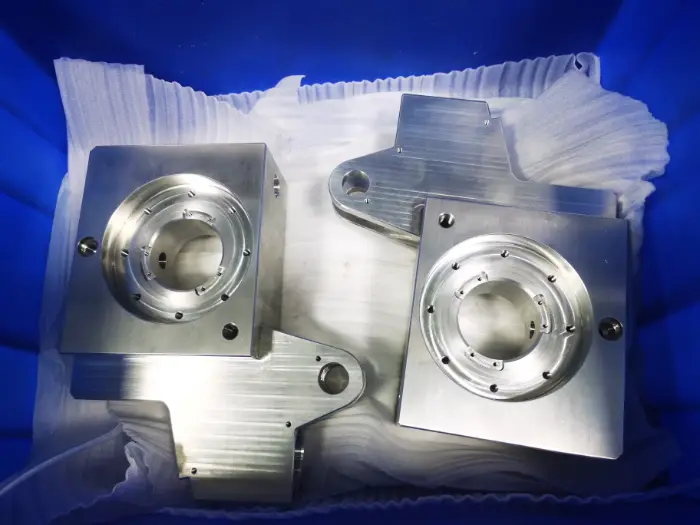
2A21 aluminum alloy has relatively high strength and good load-bearing capacity, and it is often machined into aerospace structural parts, load-bearing brackets, mechanical connectors, and engineering equipment parts. Because its copper content is relatively high, its corrosion resistance is relatively average, so surface treatment is usually required before and after machining, forming, or assembly to improve corrosion protection performance and long-term stable use.
1. Anodizing
Anodizing is often used for 2A21 aluminum alloy parts after machining is completed. Typical application parts include aerospace frame structures, load-bearing brackets, mechanical connectors, high-strength mounting seats, and engineering equipment structural parts.
2. Alclad Treatment
It is used for 2A21 aluminum alloy plates or formed parts. By cladding a layer of pure aluminum or aluminum alloy with better corrosion resistance on the surface of the base material, the overall corrosion-protection capability of the material is improved. This process is mostly used before plate processing or during the forming stage, and it is suitable for structural parts with higher corrosion-resistance requirements. It is mainly used for aircraft skins, aircraft frame parts, thin-sheet structural parts, load-bearing panels, and engineering equipment covers.
3. Chemical Passivation
Chemical passivation is suitable for 2A21 aluminum alloy machined parts that need to maintain dimensional accuracy. It improves the corrosion resistance of the part surface.
It is commonly used for mechanical connectors, mounting seats, precision brackets, aerospace accessories, and engineering equipment structural parts.
4. Electrophoretic Coating
Electrophoretic coating is usually used for 2A21 aluminum alloy parts. After the parts are cleaned, degreased, and pretreated, the coating is uniformly deposited on the surface under the action of an electric field, and then cured to form a dense coating, which can enhance weather resistance and long-term protection capability.
It is mainly applied to engineering equipment structural parts, load-bearing brackets, mechanical housings, mounting plates, vehicle parts, and aerospace auxiliary structural parts.
5. Painting
2A21 aluminum alloy structural parts and appearance parts after painting. It improves corrosion-protection performance and improves appearance effects and color identification capability. It is commonly used for aerospace structural parts, engineering machinery parts, high-strength mounting seats, equipment brackets, and exposed load-bearing parts.
Material Recommendations for Different Machining Scenarios
Perhaps you also have production needs for related accessories. See whether the material selections for several types of accessories that our company has often machined before in the table below can solve your concerns.
| Component | Recommended Material |
| Ships, fuel tanks, chemical equipment | 5052 |
| CNC structural parts, equipment frames | 6061 |
| Aerospace parts, high-strength fixtures | 7075 |
| Load-bearing structural parts, aerospace frames | 2A21 |
5052 vs 6061 vs 7075 vs 2A21: How to Choose the Right Material?
- If the project requires excellent corrosion resistance, weldability, and bending performance, choose 5052 first.
- If balanced overall performance, convenient machining, and reasonable cost are needed, choose 6061 first.
- If extremely high strength and lightweight design are needed, choose 7075 first.
- If high-strength load-bearing structural parts and aerospace applications are needed, 2A21 can be considered.
Conclusion
In aluminum machining, there is no absolute superiority or inferiority among 5052, 6061, 7075, and 2A21. The key lies in the specific application requirements, use environment, and budget.
For CNC machining projects, reasonably selecting aluminum alloy materials can not only improve product performance and avoid situations where the material standard is too high, but also reduce machining costs, reduce tool wear, and improve the overall reliability and service life of the product. If you also want to learn more related aluminum alloy machining knowledge, or want to understand the development cost budget for your project, you can leave a message for our Weldo machining customer service staff.
FAQ
Which material cost is the highest among 5052 vs 6061 vs 2A21 vs 7075 aluminum?
Among the four aluminum alloys, the raw material costs of 5052 and 6061 are relatively low. Among them, 6061 has broader supply and more stable overall cost; the cost of 2A21 is usually higher than that of 5052 and 6061, and because its corrosion resistance is weaker, subsequent protective treatment costs may increase;
7075 has the highest cost, mainly affected by high-strength performance, material grade, and machining requirements. Therefore, from the perspective of cost, the overall ranking is usually: 5052≈6061 < 2A21 < 7075.
How are the CNC machining costs of 5052 vs 6061 vs 2A21 vs 7075 aluminum?
The CNC machining costs of the four materials are mainly affected by material hardness, cutting performance, tool wear, machining efficiency, and yield rate. Overall, 6061 has the lowest CNC machining cost, with good cutting performance, stable material, and low tool loss, making it suitable for batch machining; the cost of 5052 is slightly higher than that of 6061 because the material is relatively soft, is prone to sticking to the tool, and is also more likely to deform when machining thin-walled parts;
What machining processes do 5052, 6061, 2A21, and 7075 aluminum support?
5052, 6061, 7075, and 2A21 can all undergo cutting, drilling, tapping, CNC machining, and surface treatment, but the applicable processes each have their own emphasis.
5052 is more suitable for sheet metal forming, bending, and welding;
6061 has the strongest machining adaptability and is suitable for CNC, extrusion, welding, and structural part machining;
7075 is mainly used for high-strength CNC precision machining and is not suitable for complex welding and large-scale forming;
2A21 is suitable for machining load-bearing structural parts, connectors, and mounting seats, and it usually needs to be used together with anti-corrosion surface treatment.