Custom sheet metal fabrication
Custom Sheet Metal Parts

Sheet Metal Fabrication Services

From laser cutting and CNC bending to welding, assembly and finishing, Weldo supports sheet metal prototypes and production parts from your drawings.

Cutting ReferenceUp to ±0.1 mm*
Bending LengthUp to 3100 mm*
Project SupportPrototype to Production
SteelStainless SteelAluminumCopperTitanium
Upload Drawings for a Quote

*Capability depends on material, thickness, geometry, tooling, datum strategy and inspection method.

Cut · Form · Join · Finish

What Is Sheet Metal Fabrication?

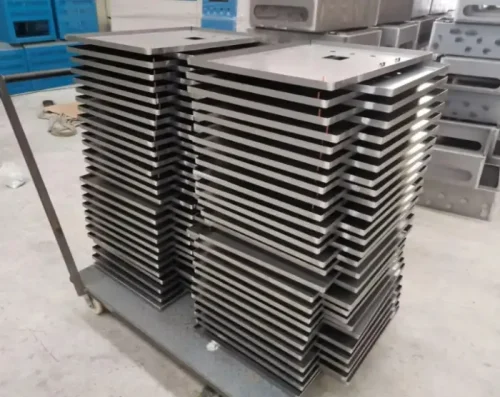
Sheet metal fabrication converts flat metal stock into functional parts through cutting, forming, joining and finishing. The process is suited to brackets, housings, frames, panels and complete assemblies.

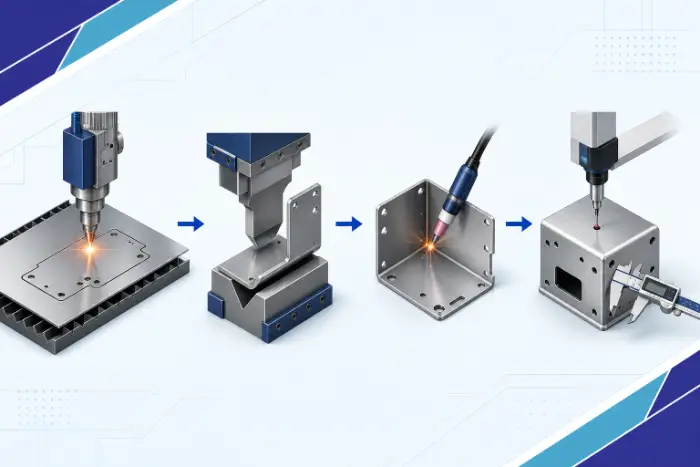
Sheet metal fabrication process

Laser Cutting

Cuts profiles, holes and complex contours with a narrow kerf and repeatable positioning.

Punching

Efficient for repeated holes, louvers, slots and formed features in production quantities.

CNC Bending

Forms flanges and enclosures while controlling bend radius, direction and springback.

Welding & Riveting

Joins fabricated components using a process selected for material, strength and appearance.

Assembly

Adds fasteners, inserts, hinges and subcomponents before final inspection and packing.

Structural welding requirements, where applicable, should be defined on the drawing. See the retained AWS D1.1 reference.

Material Selection

Materials for Sheet Metal Fabrication

Select the grade by strength, formability, corrosion exposure, conductivity, finish and documentation—not metal family alone.

MaterialCommon GradesKey ConsiderationTypical Uses
Cold-Rolled SteelSPCCGood formability and paintabilityCabinets, housings, brackets
Structural SteelQ235 / A36Strength and economical fabricationFrames, supports, bases
Stainless Steel304 / 316 / 430Corrosion resistance; finish varies by gradeMedical, marine, kitchen equipment
Aluminum3003 / 5052 / 6061Lightweight; grade-dependent bendabilityCovers, panels, electronics
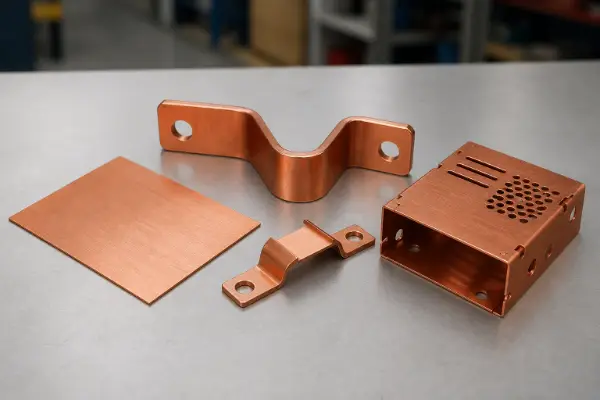
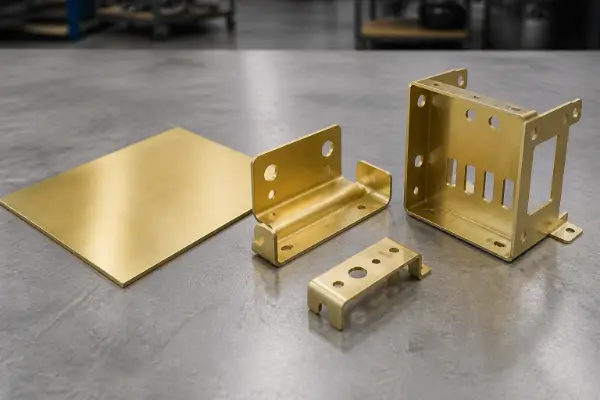
Copper & BrassProject-specificElectrical or decorative performanceBusbars, shields, trim
TitaniumProject-specificHigh strength-to-weight and corrosion resistanceDemanding specialty components

Mechanical values and corrosion performance vary with exact specification, temper, thickness, weld condition and surface treatment.

Drawing-Based Review

Sheet Metal Fabrication Capabilities

Critical tolerances should be assigned only where function requires them; all capability is confirmed against the drawing and process route.

Laser cutting referenceUp to ±0.1 mm for suitable parts
Positioning referenceUp to ±0.03 mm under controlled conditions
Maximum bend lengthUp to 3100 mm
Bend angle referenceUp to ±0.1° under qualified conditions
Minimum bend radiusNormally at least material thickness; grade and temper dependent
Supported materialsSteel, stainless steel, aluminum, copper and selected titanium alloys

Laser Cutting

Complex contours, slots, holes and nested profiles.

CNC Bending

Controlled flanges, angles and enclosure forms.

Joining

Welding, riveting, fasteners and inserted hardware.

Finishing

Coating, plating, brushing and passivation as specified.

Send Your Sheet Metal Drawing
Design for Fabrication

Sheet Metal Design Guidelines

Simple DFM decisions reduce distortion, tooling changes, rework and inspection ambiguity.

Use Consistent Thickness

Keep one thickness where possible to simplify stock, tooling and inspection.

Define Inside Bend Radius

Match radius to grade, thickness and tool opening; avoid an automatic 1:1 assumption.

Respect Hole-to-Bend Distance

Move holes away from bend zones or add relief to limit distortion.

Add Bend Relief

Relief at intersecting flanges helps prevent tearing and unwanted material buildup.

Control Welding Heat

Use suitable joint design, sequence, fixturing and intermittent welds where functional.

Specify Datums and Finish

Identify inspection datums, cosmetic faces, grain direction and coating exclusions.

Cutting AccuracyStable fixturing and calibrated equipment
Forming AccuracyTool condition, thickness and springback
Weld QualityJoint, parameter and consumable control
Finish AdhesionCompatible preparation and coating process
Protection and Appearance

Surface Finishes for Sheet Metal Parts

The finish should match the base metal, exposure, appearance, electrical needs and required coating thickness.

Powder Coating

Durable colored coating for cabinets, frames and outdoor or indoor parts.

Anodizing

Protective and decorative oxide finish for suitable aluminum alloys.

Passivation

Chemical treatment used to improve the corrosion performance of stainless steel.

Plating

Zinc, nickel or other metallic coatings selected for corrosion, wear or conductivity.

Brushing & Polishing

Directional or smooth cosmetic surfaces for visible metal components.

Blasting

Uniform matte texture and surface preparation before compatible downstream finishes.

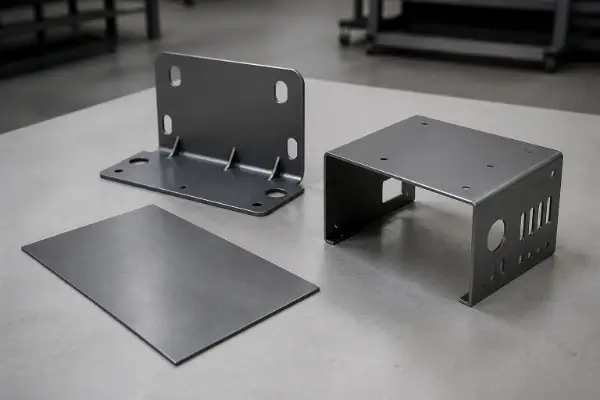
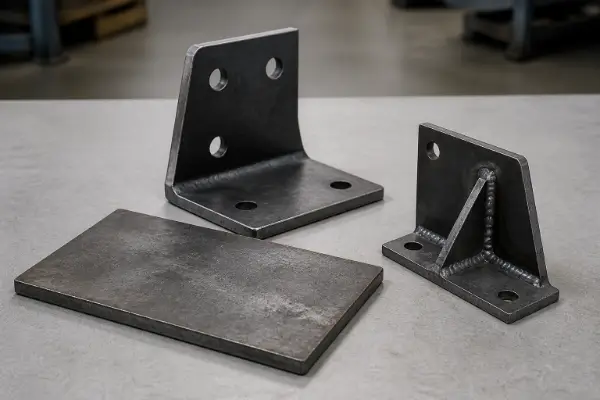
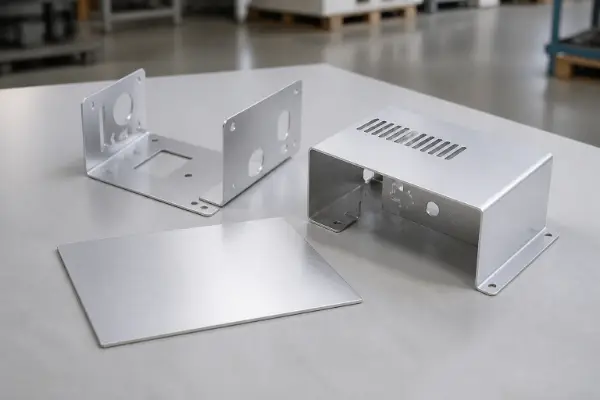
Finished aluminum sheet metal part
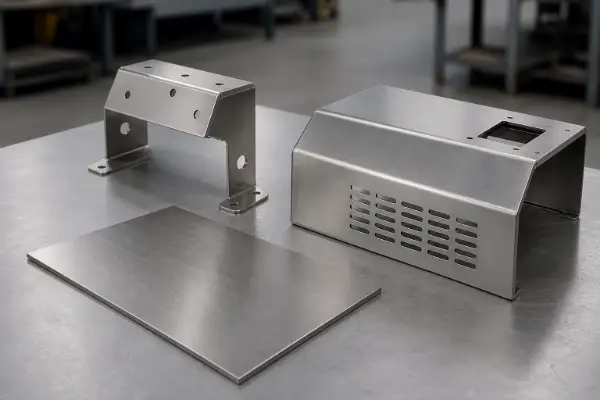
Finished stainless steel sheet metal part
Finished steel sheet metal part
Explore Surface Finishing Options
From Enclosures to Frames

Sheet Metal Fabrication Applications

Fabricated sheet metal combines low part weight, structural efficiency and scalable production across many industries.

Automotive & Transport

Brackets, battery enclosures, guards and lightweight panels.

Electronics

Cabinets, shields, chassis, panels and heat-management components.

Medical Equipment

Frames, carts and housings with defined cleanability and finish.

Architecture

Cladding, trims, brackets and fabricated structural details.

Industrial Equipment

Machine guards, control boxes, covers, trays and support frames.

Energy & Communications

Racks, electrical enclosures, busbar parts and mounting hardware.

Complex Flat ProfilesIntegrated BendsLightweight StructuresRepeatable AssembliesBroad Finish Options
Sheet Metal FAQ

Frequently Asked Questions

Concise guidance on bending, welding, coating, structural design, cost and quotation files.

How can stainless steel welding distortion be reduced?

Use balanced joint design, controlled heat input, proper sequence and secure fixturing; confirm any stress-relief process against the grade and application.

Why can aluminum crack during bending?

Low-ductility tempers, a small bend radius and unfavorable grain direction increase risk. Select a bend-friendly grade or temper and review radius and tooling.

How can coating adhesion be improved?

Remove oil and oxide, use a compatible conversion or blasting process, then control coating thickness, cure and handling.

How should a long sheet metal frame be stabilized?

Use sections, ribs, gussets and cross-members based on load and allowable deflection; verify critical structures by engineering analysis.

How can sheet metal fabrication cost be controlled?

Standardize thickness, reduce setups and special tooling, simplify bends and welds, and design parts for efficient nesting.

What files should be supplied for quotation?

Send STEP or native 3D data plus a dimensioned PDF or DWG/DXF identifying material, thickness, finish, quantity, tolerances and cosmetic faces.

Start Your Sheet Metal Project

Upload the 3D model and drawing with material, thickness, finish, quantity and critical dimensions.

Upload Sheet Metal Files
Upload FilesSTEP plus PDF, DWG or DXF
Define RequirementsMaterial, thickness, finish and quantity
Review and QuoteDFM, process route and inspection plan