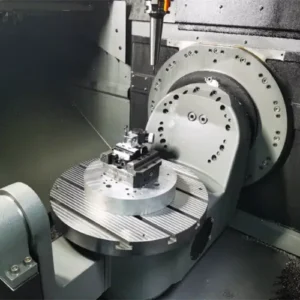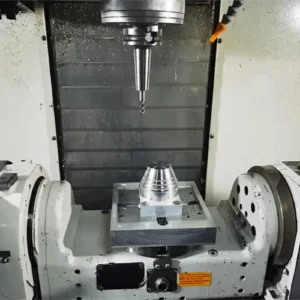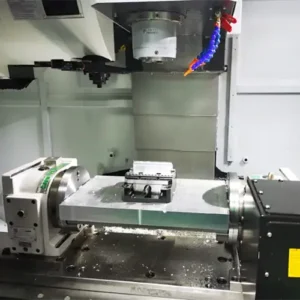
CNC 5 axis machining price is a key concern for engineers and purchasing teams working with complex, high-precision components. While five-axis machining offers unmatched flexibility and accuracy, it also involves higher equipment, programming, and operational costs compared to traditional machining methods.
This article explains what drives 5 axis machining price, typical cost ranges, how to reduce five-axis machining cost, and how combining five-axis machining with 3-axis machining and EDM can significantly improve cost efficiency.
What Determines CNC 5 Axis Machining Price?
5 axis machining price is influenced by multiple technical and operational factors rather than a single rate. Understanding these elements helps evaluate whether five-axis machining is justified for a given part.
Key contributors to 5 axis machining price include:
- Machine hourly rate
- CAM programming complexity
- Number of setups and fixtures
- Material type and removal rate
- Tolerance and surface finish requirements
- Part geometry and accessibility
Because five-axis machines integrate multiple motions simultaneously, CNC 5 axis machining price reflects both capability and efficiency.
Typical CNC 5 Axis Machining Price Ranges
Although pricing varies by region and supplier, 5 axis machining price generally falls within the following ranges:
- Machine hourly rate: $90–180 per hour
- Prototype parts: $250–800 per part
- High-complexity components: $800–2,000+ per part
Compared with 3-axis machining, CNC 5 axis machining price is higher per hour, but often lower per finished part when multiple setups are eliminated.
Why CNC 5 Axis Machining Price Is Higher Than 3-Axis
CNC 5 axis machining price exceeds 3-axis machining due to:
- Higher capital cost of five-axis machines
- More advanced CAM software and programming time
- Skilled operator requirements
- Increased maintenance and calibration needs
However, 5 axis machining price must be evaluated against total manufacturing cost, not just hourly rates.

How CNC 5 Axis Machining Reduces Total Cost
Despite a higher CNC 5 axis machining price per hour, overall production cost may be lower.
Fewer Setups
Five-axis machining often completes a part in one setup, reducing labor and fixture cost.
Shorter Tool Lengths
Improved tool engagement increases cutting efficiency and tool life.
Reduced Rework
Better accuracy lowers scrap rates and inspection effort.
When these benefits are considered, 5 axis machining price can be economically justified for complex parts.
How to Lower CNC 5 Axis Machining Price
Reducing CNC 5 axis machining price requires strategic process planning rather than sacrificing quality.
Use 3-Axis Machining for Roughing
Cost Impact: 15–30% reduction
- Perform bulk material removal on 3-axis machines
- Reserve CNC 5 axis machining for complex finishing features
This hybrid approach significantly reduces 5 axis machining price by minimizing expensive machine time.
Optimize Part Orientation
Cost Impact: 10–20% reduction
- Design parts to allow better tool access
- Avoid unnecessary undercuts
- Reduce extreme tilt angles
Improved accessibility shortens machining time and lowers CNC 5 axis machining price.
Relax Non-Critical Tolerances
Cost Impact: 10–25% reduction
- Tight tolerances increase cycle time and inspection effort
- Apply precision only where functionally required
Tolerance optimization directly affects CNC 5 axis machining price.
Reduce CAM Programming Complexity
Cost Impact: 5–15% reduction
- Simplify surface transitions
- Avoid redundant features
- Use standardized toolpaths
Efficient programming reduces both setup time and CNC 5 axis machining price.

Combining CNC 5 Axis Machining with EDM
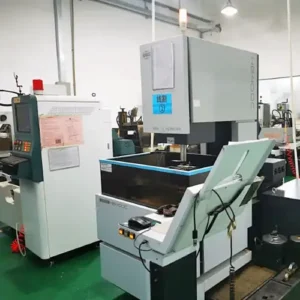
Electrical Discharge Machining (EDM) is frequently used to complement five-axis machining.
Why EDM Lowers Overall Cost
- CNC 5 axis machining handles external geometry efficiently
- EDM produces sharp internal corners and deep cavities
- Eliminates excessive five-axis tool tilting
By assigning complex internal features to EDM, manufacturers can reduce CNC 5 axis machining price and tool wear.
Practical Cost Optimization Example
A turbine-style housing required complex multi-angle surfaces and internal sharp corners. Initial processing relied entirely on five-axis machining, resulting in a high CNC 5 axis machining price.
After optimization:
- Roughing moved to 3-axis machining
- External surfaces finished with five-axis machining
- Internal corners produced using wire EDM
The revised process reduced CNC 5 axis machining price by 32% while improving dimensional consistency.

When CNC 5 Axis Machining Is Worth the Price
CNC 5 axis machining price is justified when parts require:
- Multi-face machining with tight positional accuracy
- Complex free-form surfaces
- Reduced setup and fixturing
- High surface finish consistency
For simple prismatic parts, 3-axis machining remains more cost-effective.
Choosing the Right Machining Strategy
Selecting the optimal process is essential for controlling CNC 5 axis machining price.
Best Strategy
- 3-axis machining for roughing and basic features
- CNC 5 axis machining for complex finishing
- EDM for sharp internal geometry
This integrated approach balances precision, speed, and cost.
Conclusion
CNC 5 axis machining price is higher than conventional machining, but it delivers exceptional accuracy and efficiency for complex parts. By combining five-axis machining with 3-axis machining and EDM, simplifying part design, and optimizing programming strategies, manufacturers can significantly reduce total production cost.
If you are evaluating CNC 5 axis machining price for your next project, Weldo Machining offers advanced multi-axis machining expertise, optimized process planning, and competitive pricing. Contact Weldo Machining to discuss your part requirements and receive a customized quotation.