
With the increasing demand for high precision and high efficiency in manufacturing, CNC (Computer Numerical Control) technology has become a critical support for modern industry. CNC programming, as the core technology that controls the machine tools to execute various operations, has developed significantly with advancements in technology, especially in the application of 3-axis, 4-axis, and 5-axis machines. This article will briefly explore the basic concepts of CNC programming, the differences between different machine types, applications, and programming difficulties.
Basic Concepts of CNC Coding
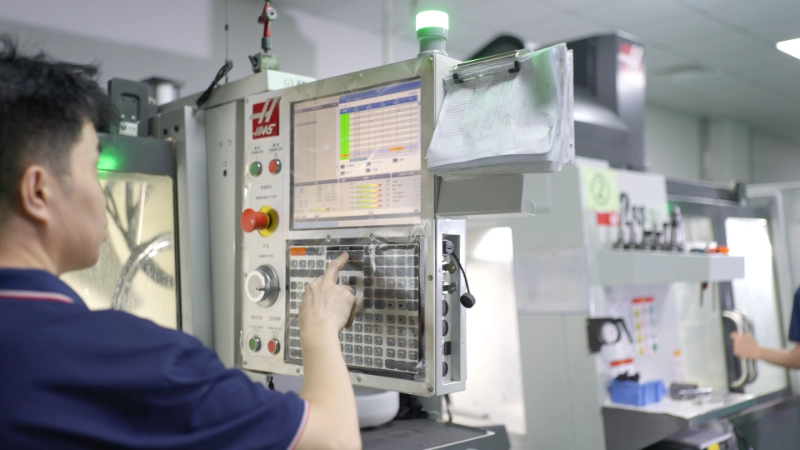
CNC Coding refers to the process of writing programs using computers to control CNC machines to perform various machining operations. The core elements include G-code, M-code, coordinate system setup, and tool path planning. Traditional manual programming has gradually been replaced by automated CAD/CAM systems, but the basic principles and processes remain the foundation of CNC coding .
The essential codes in CNC coding include:
- G-code: Used to control the movement of the machine, such as the movement of coordinates and cutting paths.
- M-code: Used to control auxiliary functions, such as turning on the coolant, machine on/off, etc.
- Coordinate System: Sets the origin of the workpiece in 3D space to precisely control the tool movement.
- Tool Path Planning: Designs the tool’s movement path based on the shape of the workpiece and processing requirements to ensure machining accuracy.
Types of CNC programming
1. Manual Programming
Manual programming is the most basic method, suitable for simple parts processing. By writing G-codes, operators manually control the machine’s actions. While simple, it has lower efficiency and higher potential for errors.
2. Macro Programming
Macro programming uses fixed programming blocks to control the CNC machine’s movements. Each block usually represents an operation step, such as moving, cutting, or pausing. Macro programming is more efficient than manual programming and reduces human errors.
3. CAD/CAM Programming
With the development of Computer-Aided Design (CAD) and Computer-Aided Manufacturing (CAM) software, CAD/CAM programming has become mainstream. Designers first create workpiece drawings in CAD software and then use CAM software to automatically generate CNC programming code. This method greatly improves programming efficiency and is better suited for complex geometries.
4. Adaptive Programming
Modern adaptive programming technologies leverage AI (Artificial Intelligence) and machine learning algorithms to adjust programming strategies dynamically based on actual production conditions. This optimizes production efficiency and part quality, marking an essential development direction for CNC programming in the future.
Differences and Similarities of 3-Axis, 4-Axis, and 5-Axis CNC programming
1. 3-Axis CNC Machines
A 3-axis machine is the most common type, usually used for simple tasks. Its name comes from its three independent motion axes: the X-axis (left-right), Y-axis (forward-backward), and Z-axis (up-down).
Similarities:
- 3-axis machines are the most basic in CNC machine types. Other machine types’ programming methods are typically extensions of the 3-axis system.
- 3-axis programming still follows the basic rules of G-code and M-code.
- It is suitable for simple 2D processing, such as flat milling.
Differences:
- The movement of a 3-axis machine is limited to a plane, and complex 3D shapes or slanted surfaces require multiple operations, leading to reduced efficiency.
- Its movement range is limited and cannot handle complex geometries or curved surfaces.
2. 4-Axis CNC Machines
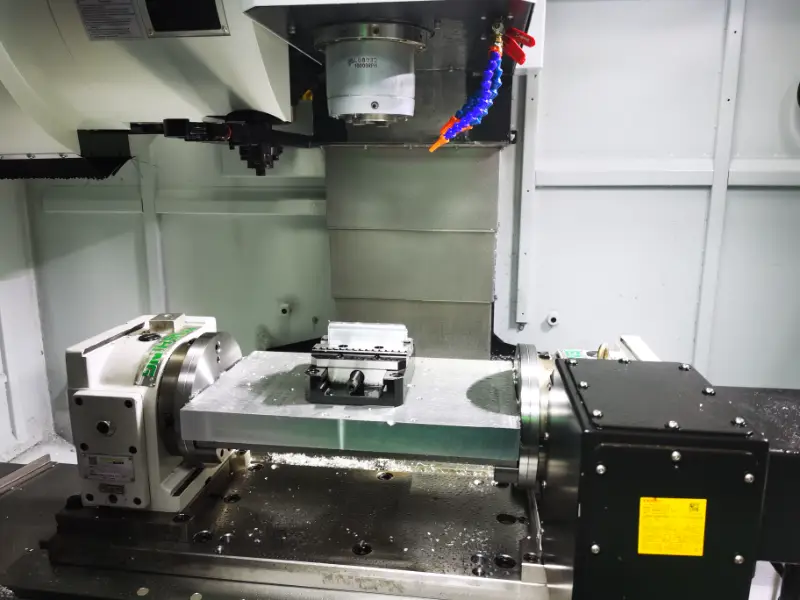
A 4-axis machine adds a rotational axis, usually around the X or Y axis, allowing for more complex machining, such as rotating parts during processing for precision work from multiple angles.
Similarities:
- A 4-axis machine still uses G-code and M-code for programming, with the basic programming structure similar to that of the 3-axis machine.
- It can perform common operations such as cutting and milling.
Differences:
- A 4-axis machine, by adding the rotational axis, can process more complex parts, reducing the need for multiple fixture setups, thereby improving accuracy and efficiency.
- It is commonly used for parts requiring rotation, such as rings or shafts, or for processing slanted surfaces.
- Programming requires consideration of the rotation angles of the workpiece, adding an extra layer of complexity.
3. 5-Axis CNC Machines
A 5-axis machine adds another rotational axis, providing multi-directional precision cutting, which is widely used for complex 3D part processing, such as in aerospace, automotive, and precision parts.
Similarities:
- A 5-axis machine uses the same basic G-code and M-code programming as the 3-axis and 4-axis machines.
- It can perform milling and turning operations.
Differences:
- A 5-axis machine offers extreme flexibility and accuracy, capable of completing complex shapes in a single setup without the need for multiple fixture adjustments.
- It can handle complex 3D curves and geometries, making it ideal for precision components like aerospace engine parts and complex molds.
- Due to its multi-directional movement, programming complexity increases significantly compared to 3-axis and 4-axis, requiring precise coordination of all axes, which demands a high level of skill from the programmer.
4. Summary of Differences
| Category | 3-Axis | 4-Axis | 5-Axis |
|---|---|---|---|
| Axes & Machining Range | Limited to flat machining | Can perform rotational machining, suited for more complex parts | Capable of complex 3D surface machining and multi-directional cutting |
| Programming Complexity | Simple, suitable for basic tasks | Adds complexity due to rotational axis, suited for moderate complexity | High complexity, requires precise coordination of multiple axes |
| Application Scope | Simple part machining | Suitable for slanted surfaces, rings, and other complex machining | Suitable for high-precision, complex-shaped parts machining |
CNC Programming Applications
CNC technology is widely applied in industries that require high precision and efficiency. Here are some typical application fields:
1. Automotive Manufacturing
The automotive industry demands extremely precise components, and CNC coding ensures that each part meets strict dimensional and tolerance requirements, especially in engine and body parts production.
2. Aerospace
Aerospace components are often complex and need to withstand extreme working environments. CNC technology ensures strength and precision while minimizing waste and improving production efficiency.
3. Medical Devices
In the production of medical equipment, CNC programming guarantees high precision and quality, especially for manufacturing precision surgical tools and implant devices.
4. Mold Manufacturing
Mold manufacturing was one of the earliest application fields for CNC technology. Through precise programming, CNC machines can produce complex molds for various industries.

Is CNC coding hard?
This is not a difficult task for a professional CNC programming operator,The difficulty of CNC programming varies depending on the machine type, the complexity of the machining task, and the programmer’s experience. Generally, CNC coding difficulty is broken down into several aspects:
1. Basic Programming Learning
For beginners, mastering basic programming for 3-axis machines is relatively simple. Writing basic machining programs with G-code and M-code, understanding coordinate systems, feed speeds, and cutting depths is feasible.
2. Advanced Programming Skills
As the complexity of the parts increases, the difficulty of programming also rises. For example, 4-axis and 5-axis programming not only involves standard coordinate systems and tool path planning but also requires considering rotational axes and complex tool movement trajectories, requiring higher mathematical ability and spatial imagination.
3. CAD/CAM-Assisted Programming
With the development of CAD and CAM software, CAD/CAM programming has become mainstream. Designers first create parts in CAD software, then use CAM software to automatically generate CNC coding code. This method greatly improves programming efficiency and handles complex geometries better.
4. Troubleshooting & Optimization
Programmers must not only write programs but also identify potential issues during machining, such as tool interference, path errors, etc., and make adjustments and optimizations. Therefore, the difficulty of CNC coding also lies in the debugging and optimization stages.

Future Trends
1. Artificial Intelligence & Automation
As artificial intelligence technology continues to develop, CNC programming will become increasingly intelligent. AI can automatically adjust parameters based on production needs, material characteristics, and processing conditions, improving machining efficiency and product quality. Automation will make CNC coding more flexible and capable of handling more complex production tasks.
2. Internet of Things (IoT) & Big Data Analytics
CNC machines can implement remote monitoring and data transmission through IoT technology, allowing factories to track production status in real-time and optimize based on data. Big data analytics will help companies better predict equipment failures, improve production efficiency, and reduce downtime.
3. Green Manufacturing
Green manufacturing is one of the significant development directions in modern manufacturing. Advances in CNC coding technology will help improve material utilization, reduce energy consumption, and lower waste and emissions, thus promoting sustainable development in the manufacturing industry.
4. Additive Manufacturing (3D Printing)
While additive manufacturing (3D printing) and traditional subtractive manufacturing (like CNC machining) are fundamentally different, the combination of both will open up new production modes. Future CNC coding might integrate 3D printing technology to offer richer machining options, satisfying personalized and small-batch production needs.
7. Conclusion
CNC programming, as one of the core technologies in modern manufacturing, covers programming for machines ranging from basic 3-axis systems to complex 5-axis machines. 3-axis programming is relatively simple, while 4-axis and 5-axis programming require more advanced skills. With the development of CAD/CAM technology and the popularity of intelligent programming tools, the threshold for CNC programming is gradually lowering. However, for high-precision and complex parts processing, the challenges remain. In the future, CNC coding will embrace new opportunities in automation, intelligence, and green manufacturing.