
In CNC machining workflows, design files are the starting point of manufacturing communication. Different cnc file formats vary significantly in how they represent geometry, preserve accuracy, support interoperability, and enable downstream CAM programming. Selecting appropriate cnc file formats directly affects machining precision, programming efficiency, rework risk, and overall project lead time.
This article provides a structured overview of commonly used CNC file upload formats. It objectively analyzes the technical characteristics, advantages, and limitations of each cnc file format, and summarizes their typical applications across countries and component industries. The goal is to support informed engineering and sourcing decisions based on data and industry practice rather than marketing claims.
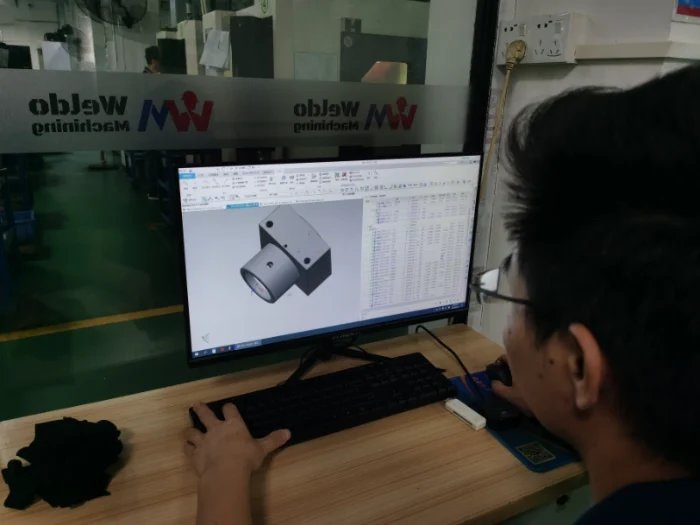
STEP (.step / .stp)
Format Overview
STEP, defined by ISO 10303, is an international standard for exchanging 3D product model data and is one of the most widely used cnc file formats in modern CNC machining.
Advantages
- Supports complete 3D solid geometry and topology
- Platform-independent and highly compatible across CAD/CAM systems
- High geometric accuracy, suitable for direct CAM programming
Limitations
- Typically does not include material, surface finish, or process metadata
- Large assemblies may increase loading time in CAM software
Typical Applications
Widely adopted in Europe and North America, particularly in aerospace, automotive components, industrial equipment, and precision structural parts.
IGES (.iges / .igs)
Format Overview
IGES is an earlier neutral data exchange format that remains supported by most CAD/CAM systems and continues to appear in certain CNC machining workflows.
Advantages
- Supports surfaces, wireframes, and 2D data
- Good compatibility with legacy CAD systems
Limitations
- Surface data may suffer from gaps or trimming errors
- Less reliable for complex solid machining
Typical Applications
Still used in parts of Asia, including Japan and Southeast Asia, especially for traditional manufacturing, molds, and relatively simple components.
Parasolid (.x_t / .x_b)
Format Overview
Parasolid is a high-precision geometric kernel format developed by Siemens and is considered an advanced cnc file format for solid modeling.
Advantages
- Very high geometric and topological accuracy
- Robust solid representation for complex machining
Limitations
- Proprietary format with a more limited software ecosystem
- CAM support may vary depending on platform
Typical Applications
Common in high-end mechanical engineering, automation equipment, and precision transmission components, especially in Europe and North America.
STL (.stl)
Format Overview
STL represents models using triangular mesh surfaces and is a mesh-based cnc file format originally developed for rapid prototyping.
Advantages
- Simple structure with very broad software support
- Easy to visualize external geometry
Limitations
- Does not contain true geometric surfaces; accuracy depends on mesh density
- No tolerance, dimension, or assembly information
Typical Applications
Suitable for shape reference and preliminary samples, but generally not recommended as the primary format for precision CNC machining.
DWG / DXF
Format Overview
DWG and DXF are 2D CAD formats commonly used to define outlines, hole patterns, and dimensional annotations.
Advantages
- Clear and accurate 2D dimension representation
- Essential cnc file formats for sheet metal and 2D cutting processes
Limitations
- No 3D geometry data
- Usually requires combination with a 3D model
Typical Applications
Widely used in China, India, and other manufacturing-intensive regions for sheet metal parts, laser cutting, and planar machining.
PDF (.pdf)
Format Overview
PDF is not a native cnc file format, but it is widely used in CNC manufacturing to transmit engineering drawings, specifications, and inspection requirements.
Advantages
- Stable, platform-independent format
- Ideal for communicating dimensions, tolerances, and technical notes
Limitations
- Cannot be used directly for CAM programming
- Geometry is not editable or reusable
Typical Applications
Used globally as a supplementary file alongside STEP or DWG, especially in international supply chains.
JPG (.jpg / .jpeg)
Format Overview
JPG is a raster image format and is not considered a valid cnc file format for machining purposes.
Advantages
- Small file size and easy to view
- Useful for visual reference and issue illustration
Limitations
- No scale, dimensions, or geometric accuracy
- Cannot support any machining or programming process
Typical Applications
Limited to visual communication, such as appearance reference or defect explanation, never as a manufacturing source file.
Comparison of CNC File Formats
| File Format | Data Type | Key Advantages | Key Limitations | Typical Countries / Industries |
|---|---|---|---|---|
| STEP | 3D Solid | High accuracy, broad compatibility | Limited manufacturing metadata | Aerospace, automotive, industrial equipment (EU/US) |
| IGES | Surface / Wireframe | Legacy compatibility | Surface reliability issues | Traditional manufacturing (Asia) |
| Parasolid | 3D Solid | Highest geometric precision | Proprietary ecosystem | High-end machinery, automation |
| STL | Mesh | Widely supported | Limited precision | Samples, shape reference |
| DWG / DXF | 2D | Clear dimensions | No 3D data | Sheet metal, planar parts |
| 2D Document | Stable, easy to share | Not machinable | Global engineering communication | |
| JPG | Image | Quick visual reference | No engineering value | Communication only |
Key Industry Observations
- STEP is the most reliable and universally accepted cnc file format for CNC machining.
- PDF and DWG/DXF are essential supporting formats to clarify design intent and tolerances.
- JPG files should only be used for reference, never as a manufacturing basis.
- In cross-border CNC projects, a combination of STEP + PDF + DWG is the most robust practice.
Conclusion
There is no single “universal” solution among cnc file formats, but there are clearly optimal choices depending on machining requirements, industry standards, and regional practices. Understanding the strengths and limitations of each cnc file format helps reduce miscommunication, machining risk, and production delays, ultimately improving delivery reliability and quality consistency.if you want know more details or get a custom parts machining quote,you can feel free to contact with us now.