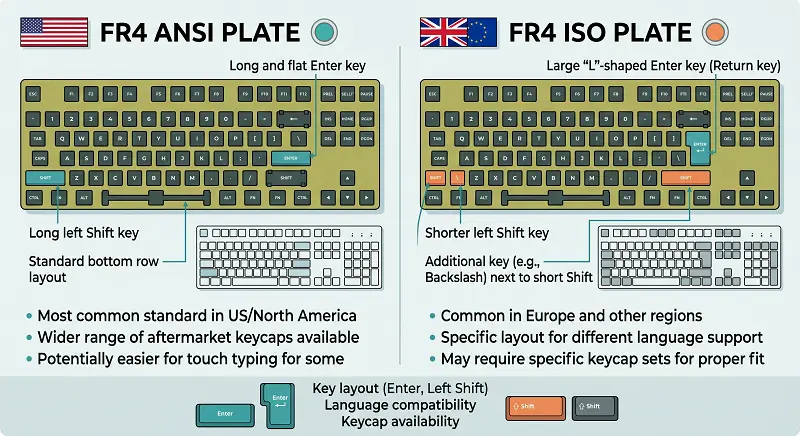
In the world of custom keyboards, the FR4 ANSI plate vs ISO plate comparison has long been at the center of enthusiast discussions, with the FR4 ANSI plate emerging as a gold standard for many builders thanks to its unique balance of flexibility, warm acoustics, and excellent value. While the FR4 ANSI plate remains the most popular choice globally, the broader debate between ANSI and ISO layouts still represents a fundamental decision that shapes your entire typing experience.
This article explores the visual differences, manufacturing processes, and market trends, with a sharp focus on how the FR4 ANSI plate stacks up against its ISO plate counterpart in real-world performance and usability.
1. What Makes the FR4 ANSI Plate Special?
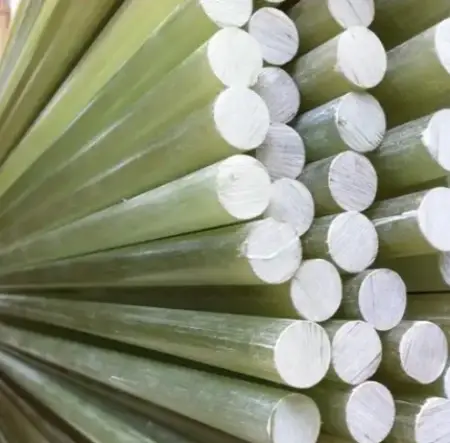
The fr4 ansi plate is made from glass-reinforced epoxy laminate—the same durable material used in PCBs.
- Sound Profile: The fr4 ansi plate sits perfectly between metals (Aluminum, Brass) and softer plastics (PC, POM). It produces a “Thocky” sound—deep, solid, and muted—which is a hallmark of high-quality custom builds.
- Typing Feel: It offers a degree of “flex” that absorbs impact. Choosing an fr4 ansi plate significantly reduces finger fatigue during long typing sessions compared to stiff metal alternatives.
2. Manufacturing & Technical Specifications
When ordering a custom fr4 ansi plate, understanding these industrial parameters will help you achieve the perfect feel.
- TG Value (Glass Transition Temperature): Common options include Mid-TG (TG150) and High-TG (TG170). A higher TG value offers better stability, though High-TG plates often feel slightly stiffer to the touch.
- Thickness Options:
- 1.5mm Standard: The industry standard for the fr4 ansi plate. It ensures that switch clips snap in securely.
- 1.2mm Thinned: Often used with shims to provide extreme “bounce,” though it requires more careful assembly.
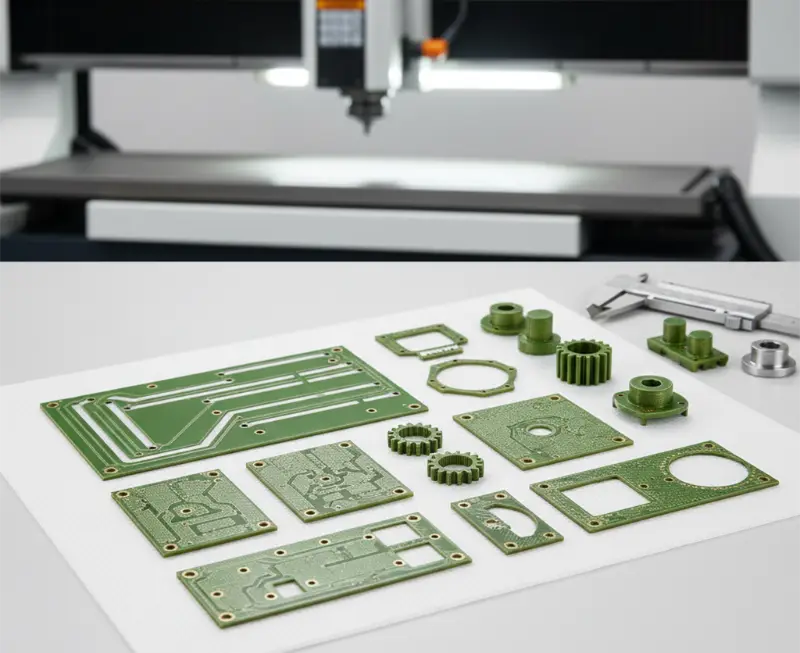
- Cutting Method: Usually performed via CNC or high-precision Laser cutting. CNC provides cleaner edges for your fr4 ansi plate, whereas laser cutting requires careful processing to avoid carbonization.
3. Premium Post-Processing for your FR4 ANSI Plate
One reason the fr4 ansi plate is so popular is that it can be treated with premium surface finishes.
- Solder Mask Colors: Beyond classic Matte Black, you can customize your fr4 ansi plate with Matte Green, Royal Blue, or even Transparent finishes.
- Gold Plating / ENIG (Electroless Nickel Immersion Gold):
- Gold Edges: Applying ENIG to the edges of an fr4 ansi plate adds a luxurious aesthetic and minor EMI shielding.
- Exposed Copper Designs: Etching gold lines or logos directly onto the fr4 ansi plate surface for branding.
- Flex Cuts: Strategically placed cutouts to further increase elasticity. While common on the fr4 ansi plate, they are especially vital for softening the feel of ISO layouts.
4. Visual Comparison: FR4 ANSI Plate vs. ISO Plate
The primary differences lie in the cutout shapes and positions required by each layout.
| Feature | FR4 ANSI Plate | FR4 ISO Plate |
|---|---|---|
| Enter Key | Horizontal Bar. A simple, clean rectangular cutout. | Inverted “L” Shape. A large, complex cutout spanning two rows. |
| Left Shift | Long Shift (2.25u). A single, symmetrical long cutout. | Short Shift (1.25u). Accompanied by an extra 1u key cutout. |
| Backslash (\) | Located directly above the Enter key. | Position varies (usually near Left Shift or Enter). |
| Visual Aesthetic | Symmetrical and minimalist. | Compact and “heavy-duty.” |
5. Pros & Cons Deep Dive
The FR4 ANSI Plate
Pros:
- Ultimate Keycap Compatibility: 99% of keycap sets support the fr4 ansi plate natively.
- Consistency: The smaller Enter key allows flex to be distributed more evenly across the fr4 ansi plate.
- Zero Learning Curve: The standard for most users, requiring no transition period.
Cons:
- Commonality: As the “standard” choice, an fr4 ansi plate might feel less “custom” than niche layouts.
The FR4 ISO Plate
Pros:
- High Recognition: The giant Enter key is iconic.
- Localization: Essential for European languages.
Cons:
- Structural Challenges: The massive Enter cutout can make the plate less rigid, requiring more tuning.
6. Market Trends & Applications
1. Mainstream Dominance
The fr4 ansi plate remains the global leader. Most “group buy” keyboards and stock parts prioritize the fr4 ansi plate, making it the safest and most versatile choice for beginners and veterans alike.
2. The “Gasket Mount” Era
In the current “soft-typing” meta, the fr4 ansi plate is the preferred pairing for Gasket Mount structures. It enhances the natural bounce of the gasket system without the harshness of aluminum.
7. Conclusion of FR4 ANSI Plate vs. ISO Plate
When choosing between an FR4 ANSI or ISO plate, the primary difference lies in the physical layout of the Enter key and the left Shift key: ANSI features a horizontal, rectangular Enter key and a long left Shift, offering better universal compatibility and a more consistent typing feel due to its symmetrical cutouts. In contrast, the ISO plate is designed for the “inverted-L” shaped Enter and a shorter left Shift to accommodate an extra key, which is essential for specific European language layouts but can result in slightly less uniform flex on an FR4 surface compared to the ANSI standard.
If you want to know more details or custom your fr4 plate ,you can contact with Weldo machining.