
Carbon steel vs stainless steel both iron-based engineering materials, but their design logic is different: carbon steel emphasizes strength and cost control, while stainless steel emphasizes corrosion resistance and long-term stability. Understanding the differences in composition, mechanical properties, processing methods, and application scenarios is the key to correct material selection in the machining manufacturing industry.
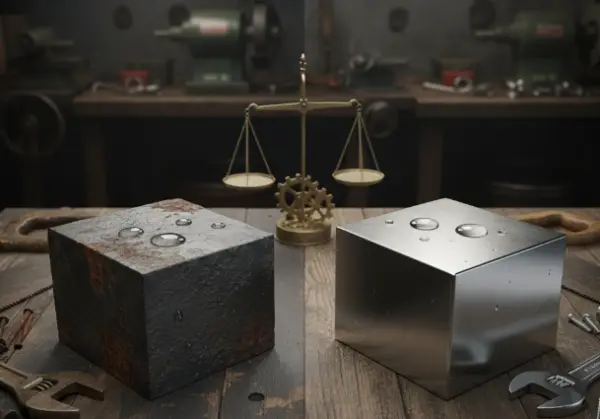
Carbon Steel vs Stainless Steel Material Nature:
1)What is Carbon Steel
Main components: Iron (Fe) + Carbon (C). Increasing carbon content will bring higher hardness/strength, but may also reduce toughness and weldability.
Common classifications: Low carbon steel / Medium carbon steel / High carbon steel.
2)What is Stainless Steel
Contains chromium (Cr) ≥10.5%, and a stable passive film (chromium oxide layer) will form on the surface, therefore it is more resistant to rust.
If there are chloride ions in the environment (seaside, salt spray, bleach), adding molybdenum (Mo) will significantly improve pitting resistance. This is why 316 is more “resistant to sea breeze” than 304.
Grade System:
Different countries/standard systems do not completely correspond one-to-one, but in engineering they can be matched according to “application + performance”.
1)Common Carbon Steel Grades (closer to component manufacturing / machining)
Low carbon steel (good machinability / good weldability)
AISI/SAE: 1018, 1020, 1215, 12L14 (free machining)
ASTM: A36 (for structural use), A105 (forgings / flanges), A106 (pipes)
Medium carbon steel (stronger, more wear-resistant, heat treatable)
AISI/SAE: 1045, 1060
Alloy structural steel (balanced strength and toughness, commonly used for shafts / high-stress parts)
AISI/SAE: 4130, 4140, 4340, 8620 (carburizing steel)
When selecting carbon steel components, many times you are not choosing the “material,” but choosing the heat treatment route: normalizing / quenching and tempering / surface carburizing / nitriding.
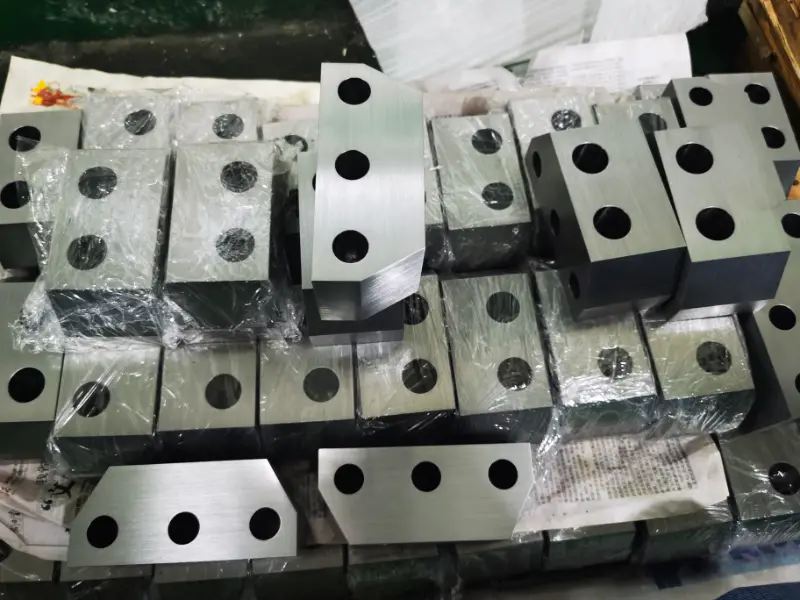
2)Common Stainless Steel Grades
Austenitic (most commonly used, strong corrosion resistance, easy work hardening)
304/304L: General-purpose type, very common in food equipment, structural parts, and housings
316/316L: More resistant to chloride pitting, more stable in seaside / chemical environments (ryerson.com)
321: Titanium stabilized, better resistance to intergranular corrosion after high-temperature welding
Ferritic (lower cost, mostly used in decoration / home appliances)
430: More magnetic, weaker corrosion resistance than 304
Martensitic (can be heat treated to harden, used for tools / wear-resistant parts)
410/420: Hardness route is more like carbon steel, but corrosion resistance is stronger than carbon steel
Precipitation hardening (high-strength stainless steel, very practical in components)
17-4PH: High strength and good dimensional stability, commonly used in aerospace / fixtures / valve components
Duplex stainless steel (strength + chloride resistance)
2205: Often used in marine engineering and chloride-containing environments as an upgraded option of 316
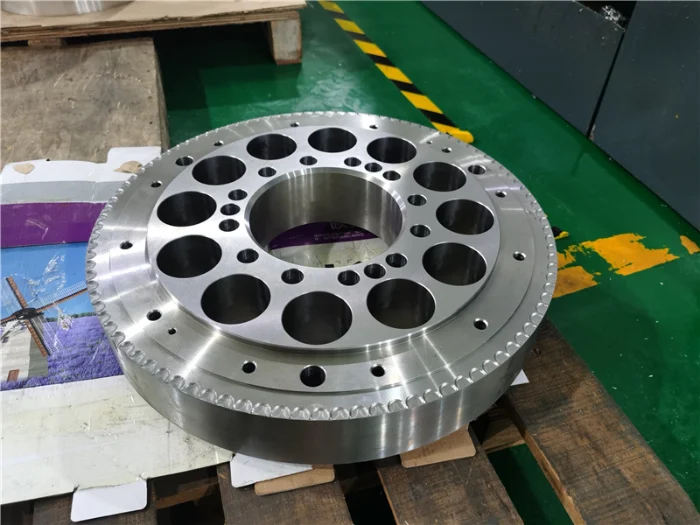
Application and Typical Components:
1)Components More Commonly Made of Carbon Steel
Transmission parts: shafts, stepped shafts, splined shafts, pin shafts, keys, coupling sleeves
Structural parts: machine frames, bases, support plates, welded frames, reinforcing ribs
Piping / pressure parts (non-strongly corrosive): flanges, pipe fittings, connectors, valve body blanks
Fasteners: bolts and nuts (usually with galvanizing / Dacromet / blackening, etc.)
Typical working conditions: indoor, dry, maintainable, coating systems allowed.
2)Components More Commonly Made of Stainless Steel (corrosion-resistant / clean / aesthetic)
Food / pharmaceutical / medical: sanitary fittings, clamps, valve bodies, cavity parts, electropolished parts
Chemical / marine / salt spray: pump housings, valve components, corrosion-resistant brackets, seaside fasteners (316 / duplex more commonly used)
Appearance parts: brushed panels, decorative parts, visible structural parts
High-cleanliness assembly: equipment covers, cleanroom accessories (often with passivation / polishing)
Processing Technology:
1)Mainstream Processing Supported by Both
CNC turning / milling / drilling / tapping / boring
Grinding (when high dimensional accuracy and surface roughness are required)
Wire cutting / Electrical Discharge Machining (EDM) (complex contours, hard material processing)
Laser cutting / waterjet cutting / stamping and bending (sheet metal parts)
Welding: MIG/MAG/TIG, laser welding (depending on structure and requirements)
Forging / casting (large batches or specific shapes)
2)Common Advantages of Carbon Steel Processing
Cutting is more “well-behaved,” tool life is usually more friendly
Rich heat treatment routes: quenching and tempering, carburizing, nitriding, etc., can achieve functional requirements
3)Common Difficulties in Stainless Steel Processing (especially 304/316)
Work hardening: the more you cut, the harder it becomes, and tool wear is faster
Poor thermal conductivity, more obvious tendency of tool sticking, narrower process window
More attention to deformation, heat-affected zone, and post-weld cleaning during welding
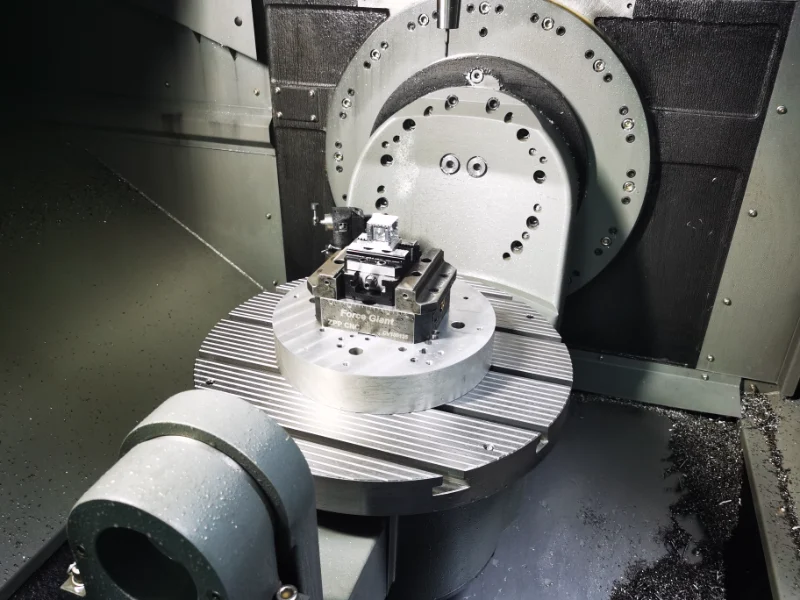
Surface Treatment Options for Components:
1)Common Surface Treatments for Carbon Steel Components
Galvanizing (electro-galvanizing / hot-dip galvanizing): general anti-rust, common for fasteners
Blackening / black oxide: low cost, small dimensional impact, often used with anti-rust oil
Phosphating (manganese / zinc system): more stable when combined with coating or lubrication
Powder coating / painting / electrophoresis (E-coat): very common for structural parts in large batches
Nickel plating / chrome plating: appearance + wear resistance (depending on requirements and cost)
Carburizing / nitriding: create a “wear-resistant surface layer,” commonly used for shafts, gears, sliding contact surfaces
2)Common Surface Treatments for Stainless Steel Components
Passivation: remove free iron and improve corrosion resistance consistency
Electropolishing: brighter and easier to clean, common in food / pharmaceutical industries
Pickling: remove weld stains / oxide scale, commonly used for welded parts
Brushing / mirror polishing / sandblasting / glass bead blasting: appearance and tactile routes
PVD/DLC: decorative color or wear resistance improvement (depending on budget and friction conditions)
Pro and Cons of Carbon Steel VS Stainless Steel:
1)Carbon Steel
Advantages
Low material cost, stable supply, high upper limit of strength/hardness (large heat treatment space), and usually lower batch machining cost
Disadvantages
Easy to rust, must rely on coating / painting / maintenance, coating damage may lead to “pitting rust spread,” in humid, salt spray, and chemical media environments, service life uncertainty is greater
2)Stainless Steel
Advantages
Strong corrosion resistance, low maintenance pressure, clean-friendly, suitable for food / medical / chemical industries, good appearance consistency (brushed, mirror, etc.)
Disadvantages
Higher material and processing cost, obvious work hardening of austenitic stainless steel, wrong grade selection (for example, still using 304 in chloride environments) may cause pitting risk (nickelinstitute.org)

Analysis of Typical Failure Cases
Material failure usually originates from improper material selection, insufficient environmental assessment, or process control errors.
I. Typical Failure Cases of Carbon Steel
Severe rusting of outdoor structural parts
Carbon steel brackets are exposed outdoors for a long time and only protected by ordinary paint.
Manifestation: local rust begins at damaged coating areas, rust spreads to surrounding areas, the cross-section gradually thins, and eventually perforation failure may occur.
Reason: carbon steel lacks corrosion-resistant elements such as chromium; coating aging or damage loses protection; long-term action of humidity, rainwater, and oxygen.
Improvement suggestion: use hot-dip galvanizing or heavy-duty anti-corrosion coating systems; upgrade to 316 stainless steel in high-humidity or coastal environments; regularly maintain coatings.
Fatigue fracture of quenched and tempered shafts
1045 or 4140 shaft parts bear long-term alternating loads.
Manifestation: micro-cracks appear on the surface, cracks expand to form typical “shell-like” fatigue fracture surfaces, and finally sudden fracture occurs.
Reason: excessive hardness from heat treatment leads to insufficient toughness; stress concentration or machining tool marks exist on the surface; shot peening strengthening was not performed.
Improvement suggestion: optimize tempering temperature; improve surface roughness; avoid sharp-angle structures; perform surface strengthening treatment when necessary.
Accelerated corrosion in welding areas
Low carbon steel welded frames were not re-treated with overall anti-corrosion after welding.
Manifestation: weld seams and heat-affected zones rust first, and the corrosion rate is significantly higher than the base material.
Reason: welding changes the microstructure; welding oxide layer not cleaned; incomplete coating coverage.
Improvement suggestion: grinding or sandblasting after welding; reapply anti-corrosion coating; ensure coating continuity.
Typical Failure Cases of Stainless Steel
304 experiences pitting in marine environments
304 stainless steel fasteners are used in seaside or chloride-containing environments.
Manifestation: small holes appear on the surface, corrosion occurs in a concentrated manner, and local strength decreases.
Reason: chloride ions destroy the passive film; 304 has limited resistance to chlorides.
Improvement suggestion: select 316 or duplex 2205; perform proper passivation treatment; avoid long-term salt accumulation.
Intergranular corrosion after welding
304 welded structural parts were not treated after welding.
Manifestation: corrosion bands appear near weld seams, and strength decreases.
Reason: high temperature during welding causes carbide precipitation; chromium content at grain boundaries decreases; passive layer is damaged.
Improvement suggestion: use low-carbon 304L version; perform pickling and passivation after welding; control welding heat input.
Stress corrosion cracking (SCC)
304 pipelines operate in high-temperature chloride-containing environments.
Manifestation: no obvious surface corrosion, but sudden cracking occurs.
Reason: combined action of tensile stress and corrosive media; austenitic structure is sensitive to SCC.
Improvement suggestion: select duplex stainless steel; reduce residual stress; improve medium environment.
Price Comparison Between Carbon Steel and Stainless Steel:
Prices are greatly affected by region, specifications (plate/bar/pipe), surface (2B/BA), and procurement volume.
1)Carbon Steel (referencing hot-rolled coil HRC index / futures quotations)
HRC Steel is approximately 1,003 USD/ton (TradingEconomics). (Trading Economics)
CME HRC index futures quotations are also around ~1,016 USD/ton (MAR 2026 contract). (Chicago Mercantile Exchange)
2)304 Stainless Steel (referencing U.S. market trading range / industry research quotations)
The lower end of 304 cold-rolled coil trading range is approximately 3,247 USD/ton (as of January 2026).
Other public market analyses have given ~1,755–2,100 USD/ton for international 304 plate/coil (large differences by region/category).
How to use the conclusion:
Looking only at material price: 304 is often 2–4 times that of carbon steel.
But in humid / salt spray / frequent cleaning scenarios, the total cost of stainless steel components may be lower (less rework, less maintenance).
Recycling Methods and Precautions for Stainless Steel and Carbon Steel
1)Carbon Steel:
Recycling method (typical process)
Classified collection → shearing/crushing → magnetic separation → enter electric arc furnace (EAF) for remelting
Precautions
Try to remove: oil stains, plastics, rubber, thick coatings
Avoid mixing in: copper and other non-ferrous metals (will affect steel performance)
High alloy steel and tool steel are best diverted separately, do not mix with ordinary carbon steel
2)Stainless Steel: Supports recycling (higher value, but more dependent on sorting)
Recycling method (key is “by grade / by series”)
Separate 300 series (nickel-containing) and 400 series (low nickel / no nickel)
Cleaning → crushing → smelting → adjust composition according to Cr/Ni/Mo
Precautions
Mixed materials will lead to uncontrollable alloy composition, recycling end usually uses XRF and other methods for identification
Welded parts are recommended to clean welding slag / oxide scale to reduce impurity burden during smelting
Chloride salt contamination (seaside parts) can be cleaned first to reduce impurity introduction
Alternative Materials for Stainless Steel and Carbon Steel:
Alternative Materials for Carbon Steel
Coated carbon steel (galvanizing / powder coating / electrophoresis): use coating to supplement corrosion resistance, cost remains low
Weathering steel: reduce coating maintenance in certain outdoor scenarios
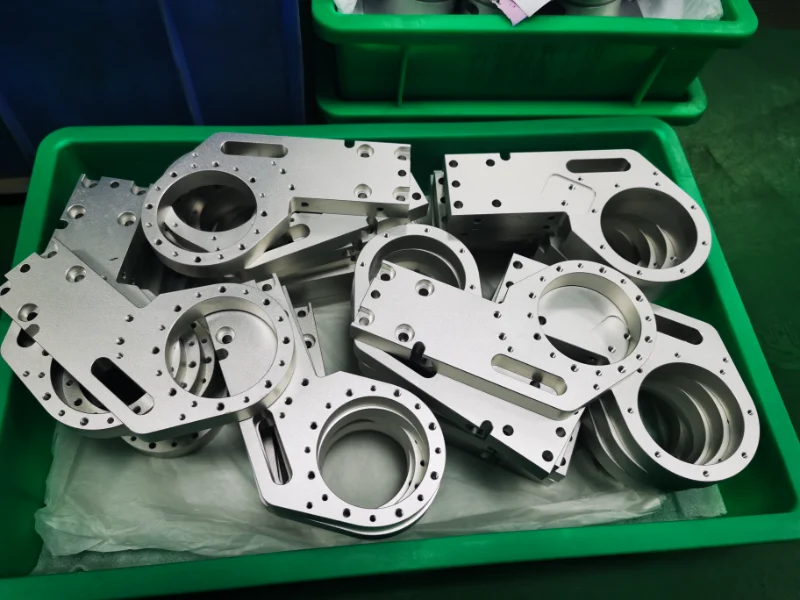
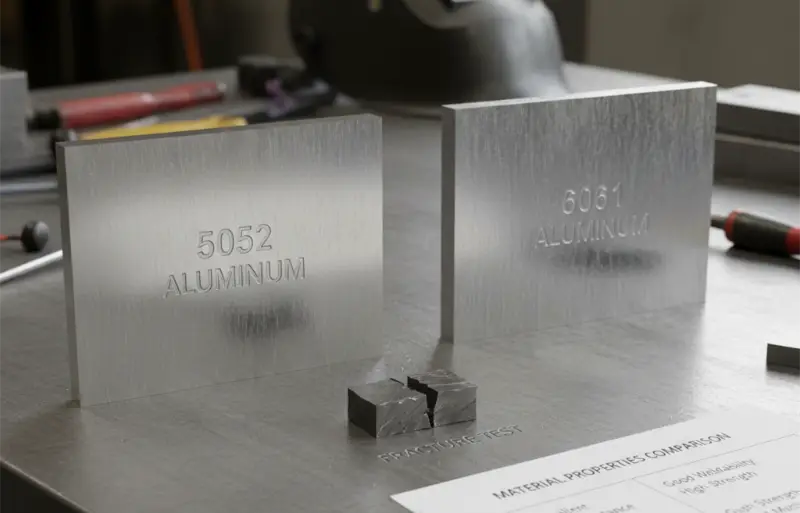
Aluminum alloy (6061/5052): lightweight, good corrosion resistance, but strength/wear resistance needs evaluation
Ductile iron: vibration damping and casting forming advantages, commonly used for base housings
Engineering plastics (POM/PA/PEEK): lightweight, chemical resistant, but strength and temperature limits differ
Alternative Materials for Stainless Steel
Duplex stainless steel 2205: higher strength and more stable chloride resistance (higher cost)
Nickel-based alloys (such as Inconel series): high-temperature / strong corrosion environments
Titanium alloy: extremely strong corrosion resistance + lightweight, but significantly higher price
Copper alloys (brass / bronze): corrosion resistant, thermally conductive, suitable for specific valve parts / bushings
High-grade coated carbon steel: use “systematic anti-corrosion” to replace “material corrosion resistance”
Quick Material Selection Suggestions
Indoor dry, cost-sensitive, maintainable → prioritize carbon steel (with galvanizing / powder coating / blackening)
Humid, salt spray, frequent cleaning, high hygiene requirements → prioritize stainless steel (304/316 + passivation / electropolishing)
High-strength shafts, wear-resistant contact surfaces → 4140/42CrMo (quenched and tempered) or 8620 (carburized)
Chloride environment (seaside / bleach) → 316/2205 is more stable, 304 has pitting risk
Conclusion
Carbon steel is suitable for structural applications emphasizing strength and cost control, while stainless steel is more suitable for corrosion resistance and high-cleanliness environments. The material itself has no absolute superiority or inferiority; the key lies in the balance between usage environment, performance requirements, and budget. Reasonable material selection can achieve the unity of long-term stability and economic benefits.
If you want know more details or get quote of metal machining,you can feel free to contact with us.