
Mecanizado CNC y fabricación de chapa metálica resolver diferentes problemas de fabricación. El mecanizado CNC es adecuado para estructuras sólidas, puntos de referencia de precisión, características tridimensionales complejas y tolerancias locales muy ajustadas, mientras que la fabricación de chapa es adecuada para estructuras grandes de paredes delgadas, carcasas de equipos, paneles, soportes y conjuntos ligeros.
Las piezas que puedan desplegarse en planos con un espesor constante del material deben fabricarse mediante procesos de chapistería. Las piezas que requieran orificios de precisión, secciones gruesas o estructuras integradas que soporten carga deben mecanizarse con CNC. Los conjuntos que contengan ambos tipos de características deben fabricarse mediante un enfoque híbrido.
La solución de fabricación adecuada no solo reduce el coste unitario, sino que también minimiza los errores acumulados durante las fases de fijación, soldadura, montaje e inspección. Los compradores deberían llevar a cabo una revisión de la fabricación durante la fase de diseño, en lugar de esperar a que el plano esté finalizado y basarse en los presupuestos para determinar la ruta de fabricación.
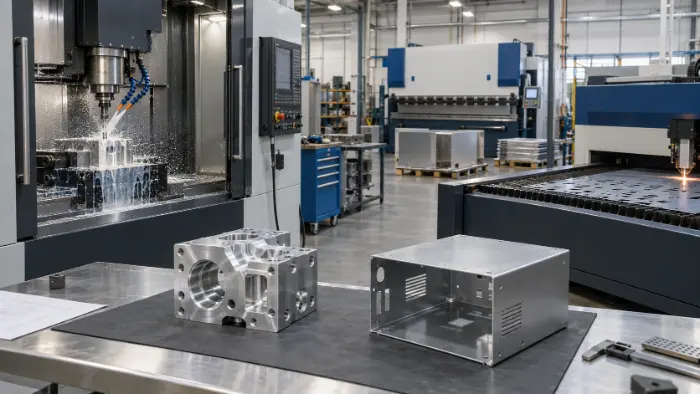
¿Qué procesos se incluyen en el mecanizado CNC y la fabricación de chapas metálicas?
El mecanizado CNC no es una única operación de fabricación, y la fabricación de chapas metálicas implica mucho más que el plegado. Comprender los procesos específicos que conlleva cada método de fabricación ayuda a los compradores a determinar si un plano es factible, cuántas operaciones se requieren y qué factores influyen en el presupuesto.
Procesos habituales de mecanizado CNC
Fresado CNC: Las herramientas de corte rotativas retiran material desde múltiples direcciones para crear superficies planas, cavidades, ranuras, orificios, escalones y contornos tridimensionales complejos. El mecanizado de tres ejes es adecuado para superficies y cavidades de dirección fija, mientras que el mecanizado de cuatro y cinco ejes reduce las repetidas configuraciones necesarias para piezas complejas. Entre las aplicaciones típicas se incluyen carcasas de precisión, bases de montaje, accesorios de sujeción y componentes estructurales.
Torneado CNC: La pieza gira alrededor del husillo mientras las herramientas de corte dan forma a diámetros exteriores, orificios interiores, caras frontales, conicidades, ranuras y roscas. Este proceso es adecuado para ejes, pasadores, manguitos, casquillos, accesorios y otros componentes rotativos. Las máquinas de fresado y torneado equipadas con herramientas motorizadas y subhusillos también pueden realizar agujeros transversales, caras planas, agujeros excéntricos y elementos en la cara posterior.
Taladrado y roscado: El taladrado permite crear orificios de fijación, orificios de referencia y conductos para fluidos, mientras que el roscado permite crear roscas internas. Al completar el perfil principal, el taladrado y el roscado en una sola configuración, se reducen los errores de posicionamiento provocados por los cambios de referencia.
Taladrado y escariado: El mandrinado corrige la posición, la rectitud y el diámetro del orificio, mientras que el escariado proporciona unas dimensiones de ajuste estables y una calidad superficial óptima. Estos procesos se utilizan principalmente para los orificios de cojinetes, los orificios de posicionamiento, los orificios de válvulas y los orificios de montaje de precisión.
Rectificado de precisión: El rectificado permite un control más preciso del diámetro exterior, la redondez, la cilindricidad, la planitud y la rugosidad superficial. Las piezas de acero templado deben contar con un margen de rectificado antes del tratamiento térmico, de modo que las dimensiones críticas puedan recuperarse mediante el rectificado final.
Procesos habituales en el trabajo de la chapa
Corte por láser de chapa metálica: Un rayo láser sigue un programa CNC para cortar el perfil de la pieza, los agujeros, las ranuras y las aberturas. El proceso no requiere troqueles de corte específicos, por lo que resulta adecuado para prototipos, pedidos de bajo volumen y piezas de chapa con variaciones frecuentes en el diseño. La calidad del corte viene determinada por el material, el espesor de la chapa, la potencia del láser, el gas de asistencia y los parámetros de corte.
Punzonado con torreta CNC: Una punzonadora de torreta utiliza herramientas estándar o a medida para realizar agujeros redondos, cuadrados y ovalados, rejillas, relieves y patrones de ventilación. El punzonado con torreta reduce el tiempo de producción cuando una pieza contiene numerosos agujeros repetidos o elementos conformados estándar.
Curvado: Una prensa plegadora CNC utiliza una matriz superior y otra inferior para dar forma a una chapa plana según un ángulo determinado. Las estructuras tridimensionales de las carcasas de los equipos, los soportes, los chasis y las cubiertas se fabrican principalmente mediante plegado. La resistencia del material, el espesor de la chapa, el radio de plegado y la apertura de la matriz determinan la fuerza de plegado necesaria y la recuperación elástica.
Laminado y curvado de chapas: Los rodillos modifican continuamente la curvatura de la chapa para fabricar cilindros, carcasas curvas, protecciones y estructuras tubulares. La fábrica debe compensar la recuperación elástica en función del radio deseado y controlar la curvatura final mediante múltiples pasadas de laminado.
Soldadura: La soldadura TIG, la soldadura MIG, la soldadura por puntos y la soldadura láser permiten unir múltiples componentes de chapa. Tras la soldadura, es necesario limpiar las soldaduras, corregir las dimensiones e inspeccionar la calidad de la unión. Los ensamblajes con requisitos dimensionales estrictos también requieren utillajes específicos para controlar la contracción y la deformación debidas a la soldadura.
Instalación de herrajes de ajuste a presión: Las tuercas de fijación automática, los pernos y las tuercas flotantes proporcionan interfaces de montaje fiables en chapas finas. Las especificaciones de los elementos de fijación, el diámetro del orificio de montaje y el espesor de la chapa deben ser compatibles. Una combinación incorrecta provoca rotación, aflojamiento o deformación de la chapa.
Las máquinas de corte de chapa, las punzonadoras de torreta y las plegadoras también utilizan sistemas CNC. Por lo tanto, la diferencia entre el mecanizado CNC y la fabricación de chapa no radica en si se utiliza o no el control numérico. La distinción radica en el método de fabricación: el mecanizado CNC se centra principalmente en la eliminación de material de piezas macizas, mientras que la fabricación de chapa consiste en cortar, conformar y unir piezas de chapa.

Comparación de capacidades principales: mecanizado CNC frente a chapistería
| Factor de comparación | Mecanizado CNC | Fabricación de chapas metálicas |
|---|---|---|
| Materia prima | Barras, chapas gruesas, lingotes, piezas de fundición y piezas forjadas | Láminas y bobinas de espesor constante |
| Estructura de las piezas | Piezas macizas, piezas de paredes gruesas y estructuras tridimensionales complejas | Cajas, paneles, soportes y chasis de paredes finas |
| Control dimensional | Adecuado para orificios de precisión, superficies de referencia y tolerancias locales muy ajustadas | Requiere el control de la recuperación elástica por flexión, la deformación por soldadura y la acumulación de tolerancias |
| Características de resistencia a la carga | Adecuado para cargas concentradas, uniones de precisión y estructuras integrales | Adecuado para proporcionar rigidez en estructuras ligeras gracias a las bridas y las nervaduras de refuerzo |
| Utilización del material | Las estructuras de alta eliminación generan más virutas | Un anidamiento eficiente de planos permite un mayor aprovechamiento del material |
| Cambios de diseño | La mayoría de las características se pueden modificar alterando el programa y la trayectoria de la herramienta | Los planos de desarrollo, los programas de plegado y las herramientas deben actualizarse al mismo tiempo |
| Productos típicos | Cuerpos de válvulas, bases de montaje, accesorios, ejes, y carcasas de precisión | Cajas, cubiertas, protecciones, soportes y paneles de montaje |
Esta tabla establece las directrices preliminares del proceso. La solución de fabricación definitiva debe determinarse mediante un análisis técnico del tipo de material, las dimensiones, las tolerancias, la cantidad, el método de montaje y los criterios de aceptación.
¿Cómo se debe elegir un proceso de fabricación en función de la geometría de la pieza?
Process selection should begin with part function and geometry rather than a comparison of unit prices. An incorrect manufacturing route increases material consumption, process count, and assembly errors, ultimately causing rework, scrap, and delivery delays.
When to Choose CNC Machining
The part contains precision holes and critical mating surfaces: Bearing bores, locating holes, sealing surfaces, and sliding fits require stable dimensional and geometric accuracy. CNC machining can produce holes, end faces, and external geometry from a common datum, reducing positional errors between features. Tight bore dimensions can be completed through boring, reaming, honing, or grinding.
The part contains complex three-dimensional geometry: Deep pockets, curved surfaces, steps, angled holes, and local features in multiple orientations cannot be produced through sheet bending. Three-axis, four-axis, or five-axis machining removes material according to the three-dimensional model and controls the positional relationships between complex surfaces.
The part requires thick sections or an integral load-bearing structure: Parts subjected to concentrated loads, impact, clamping forces, or internal pressure require continuous material sections. Integral machining eliminates welds and mechanical connection interfaces, preventing heat-affected zones and loose fasteners from becoming structural weak points.
Local tolerances and surface requirements are strict: CNC machining should establish defined datums when flatness, concentricity, roundness, position, or surface roughness directly affects assembly or motion. Heat-treated steel parts also require grinding to achieve final accuracy.
Complex features require rapid design changes: CNC machining changes holes, slots, pockets, and three-dimensional contours by modifying the program and toolpath without requiring new stamping dies. It is suitable for low-quantity functional prototypes with complex structures.
When to Choose Sheet Metal Fabrication
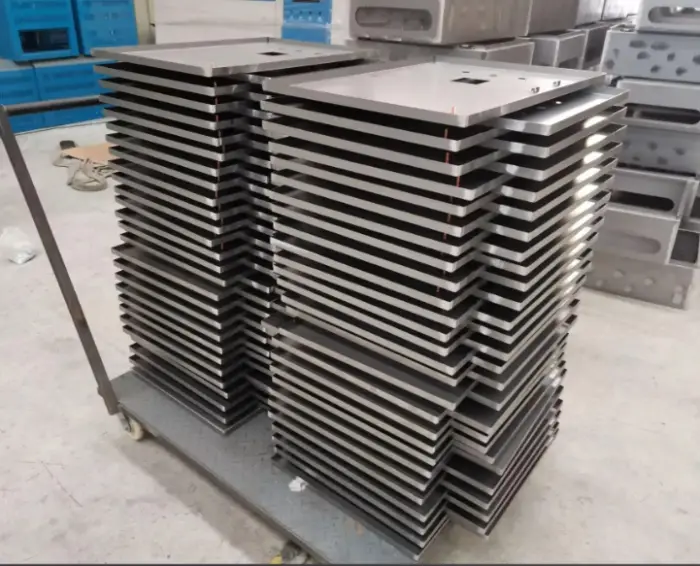
The part is mainly composed of constant-thickness walls: A part that can be unfolded into a flat pattern is suitable for sheet metal laser cutting followed by bending into its three-dimensional form. This route avoids removing large amounts of material from solid stock and is suitable for large thin-walled assemblies.
The product is an enclosure, panel, or bracket: Equipment enclosures, control cabinets, guards, chassis, and mounting brackets mainly provide covering, support, and mounting functions. Flanges, hems, and reinforcing beads provide sufficient stiffness at a lower weight.
The structure contains numerous sheet openings: Ventilation holes, cable openings, mounting holes, and cooling areas can be cut or punched while the sheet remains flat. Holes must be positioned outside bend-deformation zones and maintain adequate edge and bend distances.
The overall weight must be controlled: Sheet metal uses flanges, reinforcing beads, and local reinforcement plates to improve structural stiffness without increasing the thickness of the entire part. This construction is suitable for lightweight electronic equipment, automation systems, and transportation equipment.
The design is finalized for production: Once the design is frozen, the factory can optimize sheet nesting, bending sequences, welding fixtures, and assembly workflows. A fixed manufacturing route distributes programming and tooling costs while improving production consistency.
Large thin-walled enclosures should not be milled from solid blocks, and precision structures with strict datum relationships should not be forced into multi-piece welded sheet metal designs. The process must serve the part’s function rather than a single quotation.
What Are the Differences in Tolerance, Strength, and Surface Appearance?
Control de tolerancia
CNC machining can directly establish precision holes, mating surfaces, and inspection datums, making it suitable for parts with tight local dimensions and geometric tolerances. Tool condition, machine thermal stability, fixture rigidity, and inspection methods collectively determine final accuracy.
Thin-walled CNC-machined parts are affected by clamping force, cutting heat, and residual stress. The factory must control deformation through layered cutting, symmetrical material removal, low-stress fixturing, and intermediate unclamping. Removing a large amount of material from one side in a single operation disrupts the original stress balance, causing changes in flatness, wall thickness, and hole position.
Sheet metal dimensions are affected by thickness, rolling direction, bend radius, die opening, and springback. Each additional bend adds another source of variation to the dimensional chain. Key dimensions in multi-bend structures should originate from a common datum, preventing multiple non-critical dimensions from forming a complex accumulated tolerance chain.
Welding introduces localized thermal expansion and contraction. Assemblies with strict dimensional requirements need dedicated fixtures, symmetrical welding, intermittent welding, and controlled heat input. After welding, the assembly should be straightened before precision holes and mating surfaces are CNC machined.
Strength and Weight
An integrally CNC-machined structure has a continuous material section and is suitable for concentrated loads, impact, clamping forces, and internal pressure. Local sections can retain greater thickness, while radiused transitions reduce stress concentration.
Sheet metal structures provide a high stiffness-to-weight ratio. Flanges, hems, reinforcing beads, and ribs increase bending stiffness without significantly increasing material weight. The load capacity of a sheet metal part is determined by sheet thickness, material strength, bend direction, joining method, and the actual load path.
It is incorrect to assume that CNC-machined parts are always stronger or that sheet metal parts are always lighter. The correct comparison evaluates two designs that meet the same load, deflection, service-life, and safety-factor requirements before comparing weight and cost.
Surface Appearance
CNC-machined parts retain directional tool marks after machining. Bead blasting, brushing, polishing, anodizing, passivation, electroplating, and chemical conversion coating can improve appearance, corrosion resistance, and wear resistance. Drawings should distinguish cosmetic surfaces, mating surfaces, masking areas, and permitted clamping locations.
Sheet metal parts retain cut edges, bend marks, and welded areas. Weld grinding, brushing, bead blasting, powder coating, electrophoretic coating, and painting produce a consistent appearance. Cosmetic acceptance criteria must define visible surfaces, color, gloss, grain direction, and permissible defects so that the buyer and factory apply the same inspection standard.
How Do Cost, Quantity, and Lead Time Compare?
The two processes use different cost structures, so material prices or machine rates alone do not provide a valid comparison. Total cost includes material preparation, machining, tooling, post-processing, inspection, assembly, packaging, and nonconformance risk.
CNC Machining Cost Factors
Material and removal volume: The greater the difference between the finished-part volume and the raw-stock volume, the more material must be removed, increasing machine time, tool consumption, and material costs. Deep-pocket housings should be evaluated for near-net-shape blanks or a hybrid sheet metal and CNC structure to reduce unnecessary material removal.
Machining time and number of setups: Each additional machining direction requires more machine axes, another setup, or a dedicated fixture. Multiple setups increase labor and introduce datum-transfer errors. Four-axis, five-axis, and mill-turn machining reduce setups while improving accuracy and efficiency.
Complex features and tooling limitations: Deep holes, narrow grooves, small internal radii, and high-aspect-ratio pockets require long, slender tools and reduced cutting parameters. Lower tool rigidity increases the number of step-down passes, corner-cleaning operations, and finishing passes.
Tolerances and inspection: Tight tolerances require additional finishing passes, dimensional compensation, and inspection. High-precision requirements should be applied only to dimensions that affect fit, sealing, positioning, and motion. Non-functional dimensions should use practical general tolerances.
Sheet Metal Fabrication Cost Factors
Laser cutting and nesting: Sheet metal laser cutting costs are determined by total cut length, pierce count, material, and sheet thickness. Efficient nesting improves sheet utilization and reduces scrap. Numerous small holes and complex profiles increase piercing and cutting time.
Number of bends and tooling adjustments: Every bend requires positioning, reorientation, and angle compensation. Parts with numerous bend directions or tooling interference require special tooling, additional manual handling, or division into multiple components.
Welding and post-weld straightening: Longer welds increase labor, shielding gas, filler material, and grinding requirements. Weld shrinkage also causes warpage, so precision assemblies require dedicated fixtures, controlled welding sequences, and post-weld straightening.
Hardware and assembly: Self-clinching nuts, studs, hinges, and other components add material and installation operations. Buyers should compare the cost of the completed assembly rather than only the price of the laser-cut blanks.
The Effect of Quantity and Lead Time
During prototyping, neither CNC machining nor laser cutting and bending requires large dedicated production dies. CNC machining supports rapid changes to complex three-dimensional features, while sheet metal fabrication supports rapid revisions to flat patterns and bend geometry.
For production volumes, CNC costs are reduced by optimizing toolpaths, fixtures, and cycle time. Sheet metal costs are reduced through improved nesting, bend sequencing, welding fixtures, and assembly flow. Material availability, production quantity, surface finishing, and inspection requirements must be defined during quotation to establish a stable production plan.
Sheet metal fabrication reduces material weight and cutting time for large thin-walled enclosures. CNC machining reduces rework costs caused by welding, assembly, and accumulated errors for parts with precision interfaces, thick sections, or complex internal geometry.
When Should CNC Machining and Sheet Metal Be Combined?
Hybrid manufacturing provides a better balance of cost and performance when an assembly contains both a large thin-walled structure and local precision interfaces. Forcing the entire assembly into one process causes material waste, structural complexity, or insufficient accuracy.
Sheet metal body with CNC-machined precision mounting components: Equipment enclosures, chassis, and frames are laser cut and bent, while bearing housings, locating blocks, rails, and connection interfaces are CNC machined. The sheet metal controls the overall size and weight, while the CNC components provide precision location and load support.
Machine critical interfaces after welding: Flange faces, sealing surfaces, and precision mounting holes should not receive final machining before welding. The correct sequence is cutting, bending, welding, straightening, and then CNC machining the critical interfaces. This sequence removes the dimensional effects of weld shrinkage.
Use mechanical connections to reduce thermal distortion: Assemblies sensitive to welding distortion can use locating pins, bolts, self-clinching hardware, and CNC-machined locating shoulders. Mechanical connections simplify disassembly and maintenance while avoiding the large-area thermal distortion created by continuous welds.
Establish common assembly datums: CNC-machined components and sheet metal parts must use defined locating holes, shoulders, datum surfaces, or locating pins. Standard clearance bolt holes cannot independently provide precision location.
Hybrid manufacturing is not simply the assembly of two types of parts. Functions must be allocated during design: sheet metal parts provide coverage, support, and lightweight construction, while CNC-machined components provide location, fit, sealing, and local load capacity.
How Should You Select a Manufacturing Supplier?
A supplier that separately provides CNC machining and sheet metal fabrication does not automatically possess the engineering capability to integrate the two processes. Buyers must verify that the factory can manage machining datums, bending tolerances, welding distortion, surface finishing, and assembly inspection as one controlled workflow.
CNC machining capability: Confirm that the factory provides milling, turning, boring, tapping, and precision grinding. Critical parts also require verification of machine travel, axis configuration, spindle performance, fixturing methods, and inspection equipment. Machine quantity alone does not represent actual manufacturing capability; experience with similar parts and process control are equally important.
Sheet metal laser cutting and bending capability: Confirm the materials, sheet thicknesses, sheet sizes, and bending lengths the manufacturer can process. Large enclosures also require verification of press-brake tonnage, back-gauge accuracy, and special tooling. The factory should evaluate tooling interference, minimum flange length, and hole-to-bend distance before production.
Welding and distortion control: The supplier must select TIG, MIG, spot, or laser welding according to the material, thickness, and appearance requirements. Precision assemblies require dedicated welding fixtures, controlled welding sequences, and post-weld dimensional inspection. Manual straightening alone cannot ensure long-term production consistency.
Cross-process datum management: CNC-machined components and sheet metal parts within a hybrid assembly must use common assembly datums. Before production, the manufacturer should define the locating method, dimensional chain, and inspection approach. This prevents different departments from machining to separate datums, which can produce individually acceptable parts that fail during assembly.
Post-processing coordination: Anodizing, plating, passivation, powder coating, and painting change the surface condition and local dimensions. The supplier must account for coating thickness, masking areas, thread protection, and post-finish assembly clearances. Press-fit hardware and welding must also be scheduled according to the finishing sequence.
Quality and traceability: First-article inspection should cover critical dimensions, material, and surface condition. Production requires in-process and final inspection, with material batches, manufacturing records, and inspection results retained. Complete assemblies also require trial assembly, cosmetic inspection, and functional checks.
Before production, the factory should complete a DFM review and first-article validation. The DFM review must explain process selection, machining datums, bending sequence, welding-distortion control, post-processing effects, and inspection methods. Only after these elements are validated can the quotation, quality requirements, and lead time form an executable production plan.
Conclusión
CNC machining and sheet metal fabrication solve different manufacturing problems. CNC machining is suitable for solid structures, precision datums, complex three-dimensional features, and tight local tolerances. Sheet metal fabrication is suitable for large thin-walled structures, equipment enclosures, panels, brackets, and lightweight assemblies.
Las piezas que puedan desplegarse en planos con un espesor constante del material deben fabricarse mediante procesos de chapistería. Las piezas que requieran orificios de precisión, secciones gruesas o estructuras integradas que soporten carga deben mecanizarse con CNC. Los conjuntos que contengan ambos tipos de características deben fabricarse mediante un enfoque híbrido.
La solución de fabricación adecuada no solo reduce el coste unitario, sino que también minimiza los errores acumulados durante las fases de fijación, soldadura, montaje e inspección. Los compradores deberían llevar a cabo una revisión de la fabricación durante la fase de diseño, en lugar de esperar a que el plano esté finalizado y basarse en los presupuestos para determinar la ruta de fabricación.
Not Sure Whether to Choose CNC Machining or Sheet Metal?
Send your drawing to Weldo for an engineering review. Our engineers will evaluate the geometry, tolerances, material, quantity, and finishing requirements, then recommend CNC machining, sheet metal fabrication, or a hybrid manufacturing route.