
Hastelloy C22 is suitable for precision parts that remain in contact with corrosive media, including components used in valves, pumps, piping, and chemical-processing equipment. When purchasing these parts, buyers need to specify the medium, operating temperature, part geometry, and acceptance requirements—not just the material grade.
What Is Hastelloy C22, and What Are Its Equivalent Designations?
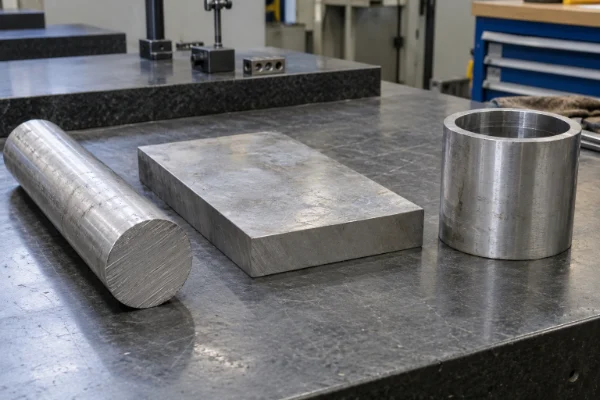
Hastelloy C-22 is a corrosion-resistant nickel-chromium-molybdenum alloy. Its generic designation is Alloy 22 / UNS N06022. The European material number 2.4602 and grade designation NiCr21Mo14W also identify this alloy and can be used to check drawings against material certificates.
Hastelloy is a trade name; other producers may supply Alloy 22 that meets UNS N06022 and the applicable product specification. C-22HS is a different material despite its similar name, so its strengthening condition and mechanical-property data must be checked separately. Haynes C-22 material data
What Are the Key Chemical Composition and Mechanical Properties of C22?
C22 has a nickel base, while chromium, molybdenum, and tungsten make important contributions to its corrosion resistance. The table shows its nominal composition; the measured composition of a specific batch is recorded on its material certificate. Haynes C-22 composition data
| Elemento | Nominal content (by weight) |
|---|---|
| Níquel (Ni) | Balance, approximately 56% |
| Cromo (Cr) | Approximately 22% |
| Molibdeno (Mo) | Approximately 13% |
| Tungsteno (W) | Approximately 3% |
| Hierro (Fe) | Approximately 3% |
C22’s mechanical properties vary with product form, thickness, and supply condition. The seven reference values below apply to the stated test conditions; they are not universal acceptance limits for every product size.
| Mechanical property | Typical value | Test condition |
|---|---|---|
| Resistencia a la tracción | 786 MPa | Room temperature, annealed plate |
| 0,21 TP3T límite elástico | 372 MPa | Room temperature, annealed plate |
| Alargamiento en la rotura | 62% | Room temperature, annealed plate |
| Dureza | Approximately 88 HRBW | Annealed plate |
| Dynamic modulus of elasticity | 206 GPa | Room temperature |
| Charpy V-notch impact energy | 568 J | Room temperature, annealed plate specimen |
| Elevated-temperature tensile strength | 676 MPa | 204°C, annealed plate |
The tensile data are for plate 6.4–19.1 mm thick; the hardness, modulus, and impact values come from their respective test conditions. For load-bearing or pressure-containing parts, design requirements should reflect the actual product form and service temperature. Acceptance should follow the applicable specification and the test results for the supplied material.
How Well Does C22 Conduct Heat and Electricity, and Is It Magnetic?
Heat transfer: C22 has a thermal conductivity of approximately 10.1 W/(m·K) at 50°C. It is selected primarily for corrosion resistance. If the part also serves as a heat-transfer component, its heat load, wall thickness, and heat-transfer area must be considered in the design.
Electrical conductivity: C22 conducts electricity and has a room-temperature electrical resistivity of approximately 1.14 μΩ·m. For grounding or electrical connections, the contact-surface condition and connection resistance must also be specified.
Magnetismo: Annealed Alloy 22 is essentially nonmagnetic. Magnetically sensitive projects should specify a permeability limit and test method on the drawing. A manufacturer’s data for an Alloy 22 product with the same UNS N06022 designation lists a relative permeability of ≤1.001.
What Heat-Treated and Supply Conditions Are Available for C22?
Mill Annealed (MA) is the common supply condition for wrought C22. Solution annealing is used to obtain good corrosion resistance and ductility, so a purchase specification should state the material condition as well as the grade.
Re-solution annealing must be evaluated after hot forming or substantial cold deformation. Haynes lists a C22 annealing temperature of approximately 1121°C, with water quenching preferred; holding time and cooling method depend on section thickness. If heat treatment is part of the manufacturing route for a precision part, final machining and inspection of critical mating surfaces should follow it. Property data for standard C22 must not be mixed with age-hardened C-22HS data. Haynes C-22 heat-treatment data
What Are the Advantages and Limitations of C22?
C22 performs well in many corrosive media and offers strong resistance to pitting and crevice corrosion in chloride-bearing environments. Its good ductility and weldability also support the manufacture of wetted valve components, piping parts, and complex machined parts.
Buyers should account for both material and manufacturing costs. C22’s tendency to work-harden, its relatively low thermal conductivity, and tool wear affect machining plans. Its corrosion performance must also be checked against the medium’s composition, concentration, and temperature.
How Does C22 Resist Corrosion in Different Environments?
Indoor and humid environments: C22 provides corrosion protection. For parts exposed only to air or ordinary humidity, buyers can first determine whether stainless steel meets the required service life before specifying C22.
Chloride-bearing media and seawater: C22 has strong resistance to pitting and crevice corrosion and can be considered for wetted valve, pump, and connection parts. Gasket contact faces, seal grooves, and flange crevices still require design attention because media can collect in these areas.
Acids and mixed media: C22 can be evaluated for hydrochloric acid, sulfuric acid, and media containing multiple chemicals. Corrosion rates can change with concentration and temperature, even for the same acid, so material selection should use data that match the operating conditions rather than the acid name alone.
High temperatures or changing media: Material data should be checked against the highest expected operating temperature, concentration, and impurity levels. Wetted welds, sealing faces, and connections must be assessed along with the main body of the part.
Is Hastelloy C22 Better Than Stainless Steel?
C22 is more suitable than commonly used 316L stainless steel in certain aggressive acid and chloride-bearing environments; 316L often has a cost advantage in less demanding service. The choice depends on the actual corrosion risk, target service life, and the cost of repair or downtime if the part fails.
| Factor de selección | C22 | Acero inoxidable 316L |
|---|---|---|
| Main reason for selection | More demanding corrosive media and localized-corrosion risks | General corrosion requirements with cost control |
| Common parts | Valves, pump components, and wetted connectors exposed to aggressive media | General fluid-handling parts, housings, and brackets |
| Purchasing focus | Medium concentration, temperature, seal geometry, and target service life | Whether the operating environment falls within the material’s suitable range |
Manufacturer tests in specific acids and chloride solutions show C22’s corrosion-resistance advantage. Those results must be matched to the project’s medium and temperature; they cannot be converted directly into a service-life estimate for every part.
What Common Stock Forms Are Available for C22?
C22 is commonly supplied as plate, bar, tube, and forging stock; part geometry helps determine the most suitable starting form. Stock close to the finished shape can reduce machining, while still leaving enough material for workholding and finishing.
| Formulario de acciones | Suitable custom parts | Stock-selection focus |
|---|---|---|
| Plate and sheet | Flanges, covers, partitions | Thickness and stock allowance for machining both faces |
| Round bar and billet | Shafts, sleeves, valve stems, seal rings | Maximum outside diameter and workholding length |
| Tube | Sleeves and piping connectors | Inside and outside diameters, wall thickness, and machining allowance |
| Forgings and forging stock | Larger-section valve bodies and connectors | Forging dimensions, condition, and finishing allowance |
C22 is also supplied as wire, mainly for welding or specific forming applications. Welding wire must be purchased to the appropriate filler-metal designation and specification.
How Does C22 Perform in CNC Machining?
C22 can be machined into precision parts, but controlling work hardening, cutting heat, and tool wear is central to the process. Repeated tool rubbing on a surface hardened by an earlier pass makes subsequent cutting more difficult and can affect dimensions and finish.
Machining calls for stable workholding and consistent, effective cutting. Thin walls require attention to clamping distortion; deep holes and channels require reliable chip removal. Sealing faces should receive a finishing operation capable of meeting the geometric tolerances and surface roughness specified on the drawing.
Which Machining Processes Can Be Used for C22 Parts?
CNC milling and multi-axis machining suit valve bodies, flanges, mounting features, flow channels, and holes approached from multiple directions. Multi-axis machining can reduce repeated setups on complex parts and help maintain the positional relationship between features.
CNC turning and turn-mill machining suit shafts, sleeves, seal rings, threads, and rotational parts with side holes. Turn-mill machining can be used when both turned surfaces and off-center holes or side features are required.
Precision boring, grinding, and wire EDM can produce specified close-tolerance holes, mating surfaces, narrow slots, or profiles. The final route should follow the drawing tolerances, surface requirements, workholding plan, and access for inspection.
How Does C22 Weld, and How Can Its Parts Be Joined?
C22 has good weldability and can be welded using TIG or MIG processes; ERNiCrMo-10 is a common matching filler wire. For parts exposed to corrosive media, weld corrosion resistance must be addressed alongside joint strength in the acceptance requirements.
Joints should be cleaned before welding, shielded during welding, and produced with controlled heat input. Oxides should then be removed and the weld inspected. Parts requiring periodic disassembly can use bolted flanges or threaded connections, with seals designed for the medium and pressure.
What Surface Finishing and Post-Processing Options Are Available for C22 Parts?
C22 derives its corrosion resistance primarily from the alloy itself; post-processing is used to meet specified surface, cleanliness, and assembly requirements. The drawing should identify the areas to be treated, particularly sealing faces and internal channels.
- Deburring and cleaning: Remove edge burrs, chips, and cutting fluid, and check blind holes and channels for residue.
- Pulido mecánico: Achieve the specified roughness on wetted or sealing surfaces while maintaining critical dimensions.
- Electropulido: Use where a defined surface finish is required; validate appearance, material removal, and dimensional change on a sample before production.
- Post-weld surface cleaning: Remove welding oxides and inspect the resulting surface.
Which Industries and Parts Use C22 CNC Machining?
C22 is mainly used for equipment parts that directly contact corrosive media. Material selection should begin with the medium, temperature, and pressure the part will experience, followed by its geometry and surface requirements.
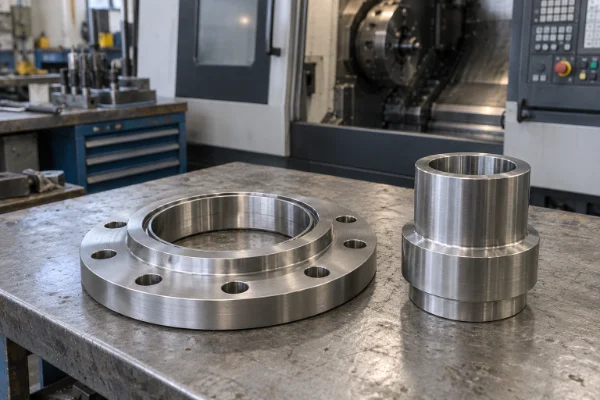
Chemical processing and fluid handling: Valve bodies, valve seats, pump shafts, sleeves, and piping connectors may remain in contact with acids or mixed chemicals. Purchasing priorities include verifying the material of wetted surfaces, seal dimensions, and the finish of valve cavities and flow channels.
Pharmaceutical equipment: C22 can be used for reactor components and fluid connectors exposed to corrosive process media. Buyers should also specify wetted-surface roughness, cleaning requirements, and how residue inside holes will be inspected.
Pollution-control and energy equipment: Flue-gas desulfurization and waste-incineration systems may produce corrosive condensates or mixed media. Nozzles, flanges, connectors, and internal supports require material selection based on the medium and temperature, with attention to welds and connections.
Semiconductor equipment: Systems handling corrosive process gases such as HCl can be evaluated for C22 piping and connection components. Purchasing requirements should cover the cleanliness of gas-contact surfaces, particle residue, and connection sealing.
How Can Buyers Control the Cost and Inspect Custom C22 Parts?
Cost control starts with stock selection and the drawing requirements. Choosing stock close to the finished shape, separating critical tolerances from general tolerances, and reducing repeated setups gives a clearer view of total manufacturing cost than material price alone.
For acceptance, first check UNS N06022, heat number, supply condition, and the material certificate. Then inspect critical dimensions, geometric tolerances, sealing-face roughness, burrs, and cleanliness. Product specifications depend on stock form: examples include ASTM B575 for plate, ASTM B574 for bar, and ASTM B622 for seamless tube. Welded parts also require the weld inspections specified on the drawing.
How Does Weldo Support Custom Hastelloy C22 Machining?
Weldo can review the stock form, workholding datums, CNC machining route, critical dimensions, and post-processing requirements against the drawing and operating conditions. Multi-axis machining, turn-mill machining, precision grinding, wire EDM, and dimensional inspection can then be coordinated around the part’s requirements.
For a presupuesto, provide the drawing, quantity, process medium, operating temperature, critical tolerances, and inspection requirements. The engineering team can use these details to establish a manufacturing and acceptance plan and prepare a project-specific quote.