
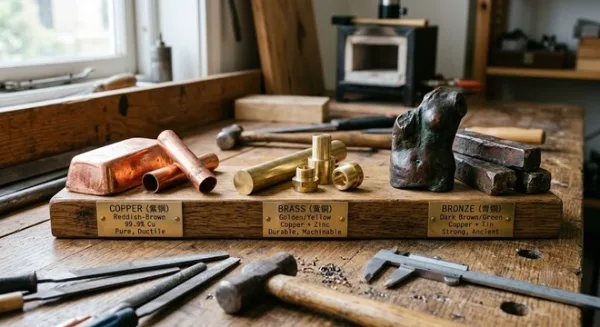
Copper, brass, and bronze are all important copper-based materials, but they are not the same material. Pure copper is defined by its high copper content, brass modifies material properties by adding zinc, while bronze relies on tin, aluminum, silicon, and other elements to form a more complex alloy system. Because of these compositional differences, the three materials show clear variations in color, hardness, strength, electrical conductivity, thermal conductivity, corrosion resistance, machinability, and cost. This article will provide a systematic Copper vs brass vs bronze comparison to help you better understand their material properties, mechanical performance, and practical selection criteria for different machining needs.
Copper vs brass vs bronze common alloy
Elemental Composition
The elemental composition differences among copper, brass, and bronze mainly lie in the proportions of their alloying elements:
Pure copper is mainly composed of Cu, with copper content usually >=99.50%. Oxygen-free copper can reach a purity of more than 99.97%, with relatively low impurity content;
Brass is a copper-zinc alloy, with Zn content usually ranging from 5% to 45%. Lead, tin, aluminum, manganese, and other elements can also be added to improve machinability, corrosion resistance, or strength;
Bronze is a copper-based multi-element alloy that commonly contains tin, aluminum, silicon, beryllium, and other elements,
among which tin bronze contains about 3%–14% Sn,
aluminum bronze contains about 5%–11% Al, and silicon bronze contains about 1%–5% Si,
while beryllium bronze contains about 1.6%–2.5% Be. Overall, bronze is more oriented toward high strength, wear resistance, and corrosion resistance.
Copper
Copper is also known as red copper or pure copper, and its copper content is usually above 99.5%. The following materials all fall within the copper category:
Ordinary Red Copper (T1, T2, T3, T4)
Common grades include T1, T2, T3, and T4. They offer good plasticity, ductility, and hot and cold workability, and are commonly used for wires, cables, copper busbars, bus ducts, conductive terminals, and general conductive parts.
Oxygen-Free Copper (TU1, TU2)
Common grades include TU1 and TU2. Their oxygen content is extremely low, which helps reduce weld porosity, hydrogen embrittlement, and cracking risks. They are suitable for electrodes, electronic components, vacuum devices, and high-purity conductive parts.
Deoxidized Copper (TUP, TUMn)
Common grades include TUP and TUMn. By adding small amounts of phosphorus, manganese, and other elements, the oxygen content is reduced, giving the material better weldability, brazability, and tube-processing stability. It is often used for plumbing copper tubes, air-conditioning copper tubes, fittings, and welded structural parts.
Special Copper (Tellurium Copper, Silver Copper, Arsenic Copper, etc.)
Common types include tellurium copper, silver copper, and arsenic copper. By adding small amounts of alloying elements, these materials obtain distinctive properties and are commonly used for electrodes, precision fittings, special industrial copper parts, and red copper handicrafts.
Brass
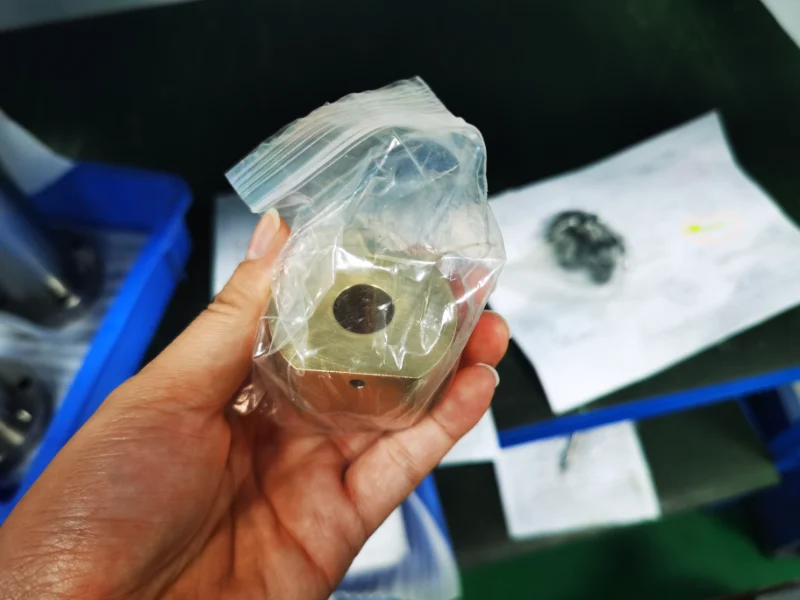
Brass is a copper alloy mainly composed of copper and zinc. Lead, tin, manganese, iron, and other elements can be added to further improve its performance as required.
C26000 / H70 / C2600
With a zinc content of about 30%, it has good plasticity and ductility. It is suitable for cold stamping, deep drawing, and complex cold forming, and is commonly used for connector spring contacts, heat exchanger tubes, cartridge cases, and deep-drawn parts.
C27000 / H65
It offers a good balance between strength and plasticity, good hot and cold pressure workability, and moderate machinability. It is commonly used for hardware parts, fasteners, stamped parts, and general structural parts.
C28000 / H62 / H59
With a higher zinc content, it has better strength and hardness, and its machinability is better than that of high-copper brass. It is commonly used for general hardware parts, gears, structural parts, and mechanical components.
C36000 / C3604 / HPb59-3
Its lead content is usually about 2.5%–3%, giving it excellent machinability. It is one of the most commonly used brasses in CNC machining and is suitable for precision parts, valves, fittings, nuts, and pipe components.
C37700 Forging Brass
It is suitable for hot forging, can be used to form complex structural parts, and helps maintain good strength and dimensional integrity after forging. It is commonly used for valve bodies, pipe fittings, connectors, and hot-forged hardware parts.
C44300 / HSn60-1 Tin Brass
After tin is added, the material gains better corrosion resistance, especially in humid or marine environments. It is commonly used for marine parts, heat exchanger tubes, condenser tubes, and corrosion-resistant copper alloy components.
Bronze
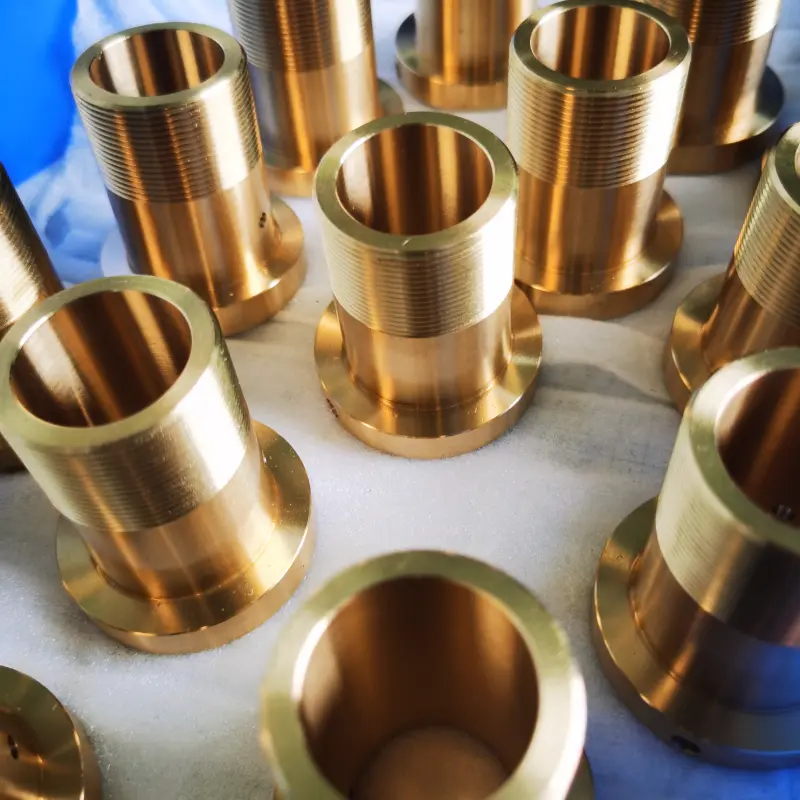
Bronze is a metal material based on copper with tin as the main alloying element. It has high strength, wear resistance, and corrosion resistance.
Phosphor Bronze
Common U.S. standard grades include C51000, C51900, and C52100. It belongs to the copper-tin-phosphorus alloy family and has good elasticity, fatigue resistance, wear resistance, and corrosion resistance. It is commonly used for precision springs, connector spring contacts, sliding bearings, and wear-resistant bushings.
Aluminum Bronze
Common grades include C62300, C63000, and C95400. It has high strength, good wear resistance, and excellent seawater corrosion resistance. It is suitable for heavy-duty bearings, marine propellers, offshore engineering components, and high-strength mechanical parts.
Silicon Bronze
The common grade is C64700. It offers a balanced combination of strength and elasticity, good corrosion resistance and weldability, and does not become brittle at low temperatures. It can be used for structural parts in corrosive environments, wear-resistant parts, and some applications as a substitute for tin bronze.
Beryllium Bronze
The common grade is C17200. It has high strength, high elasticity, good electrical and thermal conductivity, and non-sparking performance under impact. It is commonly used for precision spring contacts, non-sparking tools, resistance welding electrodes, and high-performance elastic parts.
Chromium Zirconium Bronze
The common grade is C18200. It combines relatively high strength, good electrical conductivity, heat resistance, and corrosion resistance, and is suitable for electrical and electronic equipment, welding electrodes, marine engineering, and aerospace components.

Property Differences Among the 3 Materials
To help you better understand the differences among these three copper materials, I will compare them from the following dimensions.
Color
Copper, brass, and bronze are relatively easy to distinguish by appearance:
Fresh pure copper surfaces are reddish purple or rose red. After oxidation, they form a dark brown or black-brown oxide film, giving the material a warm texture.
Depending on zinc content, brass is usually golden yellow to pale yellow, with a bright luster and an appearance close to gold;
Bronze is usually bluish gray, grayish yellow, or dark gold, with an overall darker tone. After oxidation, some tin bronze surfaces can form a blue-green patina.
Melting Point
The melting point differences among copper, brass, and bronze mainly depend on material composition.
Pure copper has a melting point of about 1083°C, which is stable and the highest among the three;
As a copper-zinc alloy, brass usually has a melting point of 870°C–900°C, and the melting point changes with zinc content;
Bronze has a more complex alloy system, with a melting point range of about 700°C–950°C, greatly affected by tin, aluminum, silicon, and other elements.
Density / Weight
The density differences among copper, brass, and bronze are mainly affected by alloy composition. Pure copper has a density of about 8900 kg/m³, which is stable and the highest;
As a copper-zinc alloy, brass usually has a density of 8500–8700 kg/m³, and the density decreases as zinc content increases;
Bronze has a more complex composition, with a density range of about 7500–8900 kg/m³. Some aluminum bronzes have relatively low density.
Hardness
The hardness of copper, brass, and bronze generally follows the trend: bronze > brass > pure copper.
Copper has the lowest hardness, about 35–45 HB in the annealed state. It is soft and ductile, but its wear resistance is relatively weak;
Brass has moderate hardness, usually about 80–120 HB. It can balance machinability, strength, and the application needs of hardware parts;
Bronze has relatively high hardness, usually above 100–150 HB. It offers better wear resistance, elasticity, and load-bearing capacity, making it suitable for heavy-duty or wear-resistant parts such as bushings, bearings, and gears.
Mechanical Properties of the Three Materials
From a machining perspective, understanding the corresponding strength parameters is necessary to meet different performance requirements and choose the right material more effectively.
Tensile Strength
The tensile strength of copper, brass, and bronze generally follows the trend: bronze > brass > pure copper.
Pure copper has relatively low tensile strength, about 200–250 MPa in the annealed state, making it more suitable for copper sheets, copper foils, flexible connectors, and easy-to-form parts under low tensile loads;
Brass has moderate tensile strength, about 300–500 MPa, and is suitable for fittings, nuts, valve bodies, and hardware parts that require a certain level of structural strength;
Bronze has relatively high tensile strength, about 400–600 MPa, and performs more stably in bushings, gears, and connectors that bear larger mechanical loads or assembly tension.
Yield Strength:
The yield strength of copper, brass, and bronze generally follows the trend: bronze > brass > pure copper.
Pure copper has relatively low yield strength, about 40–70 MPa in the annealed state. It is more prone to plastic deformation under load, making it more suitable for low-load conductive sheets, flexible connectors, copper foils, and easy-to-form parts;
Brass has moderate yield strength, about 100–250 MPa. It offers better dimensional stability during assembly and connection and is commonly used for fittings, nuts, valve bodies, and hardware structural parts;
Bronze has relatively high yield strength, about 150–400 MPa, with stronger resistance to deformation. It is suitable for bushings, sliders, gears, and mechanical connection parts that need to bear higher loads.
Shear Strength:
The shear strength of copper, brass, and bronze generally follows the trend: bronze > brass > pure copper.
Pure copper has relatively low shear strength, about 150–200 MPa in the annealed state. It is more likely to deform under shear loads and is suitable for low-load conductive terminals, copper sheets, and flexible connectors;
Brass has moderate shear strength, about 200–350 MPa, making it more suitable for threaded parts, fittings, nuts, fasteners, and other parts requiring a certain level of connection strength;
Bronze has relatively high shear strength, about 250–420 MPa, and is more stable in pin holes, keyways, gear tooth loading areas, or heavy-duty connection structures.
Elongation:
The elongation of copper, brass, and bronze generally follows the trend: pure copper > brass > bronze.
Pure copper has an annealed-state elongation of about 45%–55% and the best plasticity, making it suitable for high-deformation processing such as copper tubes, copper foil, cable wire, and deep-drawn parts;
Brass has an elongation of about 20%–40% and is suitable for some stamped parts, drawn parts, and formed hardware parts;
Bronze has an elongation of about 10%–30% and relatively lower plasticity.
Fatigue Strength
The fatigue strength of copper, brass, and bronze generally follows the trend: bronze > brass > pure copper.
Pure copper has relatively low fatigue strength, about 100–150 MPa, and is more suitable for static or low-cycle load parts;
Brass has moderate fatigue strength, about 200–300 MPa, and can be used for general spring contacts, connectors, and repeatedly assembled hardware parts; bronze has relatively high fatigue strength, about 250–400 MPa, and beryllium bronze C17200 can exceed 400 MPa, making it more suitable for springs, spring contacts, connectors, and precision elastic parts under high-cycle loads.
Corrosion Resistance
Copper
Pure copper has good corrosion resistance. It mainly relies on the Cu2O oxide film formed on the surface to protect the base metal, and it performs stably in atmospheric, freshwater, and neutral environments. Its corrosion resistance is closely related to copper purity, but it is easily attacked in environments containing sulfides, ammonia, or oxidizing acids such as nitric acid.
Brass
The corrosion resistance of brass is greatly affected by zinc content. Ordinary brass performs well in atmospheric and freshwater environments, but it is prone to dezincification corrosion in seawater, acidic, or chloride environments. Adding tin, arsenic, or phosphorus can improve dezincification resistance. Among them, tin brass is more suitable for marine and humid environments, while leaded brass has good machinability but relatively weaker corrosion resistance.
Bronze
Bronze generally has better corrosion resistance than ordinary brass, and the key lies in its added elements. Tin can improve resistance to seawater and steam corrosion, aluminum can form a stable aluminum oxide passivation film to enhance resistance to seawater, chlorides, and high-temperature oxidation, and silicon helps improve resistance to pitting and crevice corrosion. Therefore, bronze is more suitable for marine, chemical, and highly corrosive working conditions.
Machinability
Copper, brass, and bronze each have different machining characteristics. Pure copper has the best plasticity and is suitable for rolling, drawing, stamping, and bending, but its cutting machinability is poor. It is prone to tool sticking, burrs, and surface scratches, so machining requires sharp tools, proper cooling, and stable chip evacuation.
Brass has the best overall machinability, especially C36000 leaded brass. Lead improves lubrication and chip breaking, resulting in low cutting resistance, high surface finish, and longer tool life. It is a commonly used material for CNC turning, threads, fittings, valve bodies, and small precision parts.
Bronze has good castability and is suitable for complex castings. However, because it has high hardness and strong wear resistance, it is more likely to wear cutting tools during machining. Some aluminum bronzes and tin bronzes may also show work hardening, so lower cutting speeds, stronger cooling, and wear-resistant tools are usually required.
Weldability
The weldability of copper, brass, and bronze mainly depends on factors such as oxygen content, low-boiling-point elements, and surface oxide films.
Pure copper has good weldability, but when ordinary red copper contains oxygen, high temperatures can easily cause porosity, hydrogen embrittlement, or cracking. Therefore, oxygen-free copper and phosphorus-deoxidized copper are more suitable for welding, brazing, and pipe connections, and are commonly used for air-conditioning tubes, heat exchangers, and conductive parts.
Brass has relatively poor weldability. The core reason is that zinc has a low boiling point and easily volatilizes during welding, forming fumes, pores, and impurities. Leaded brass such as C36000 may also crack due to lead segregation, so welding is generally not recommended.
Bronze weldability varies significantly by type. Tin bronze has good molten pool fluidity and is suitable for brazing and repair of wear-resistant parts. Aluminum bronze easily forms a high-melting-point Al2O3 oxide film because of aluminum, which can cause slag inclusion and lack of fusion; therefore, the surface must be strictly cleaned before welding and shielding gas control is required.
Magnetism
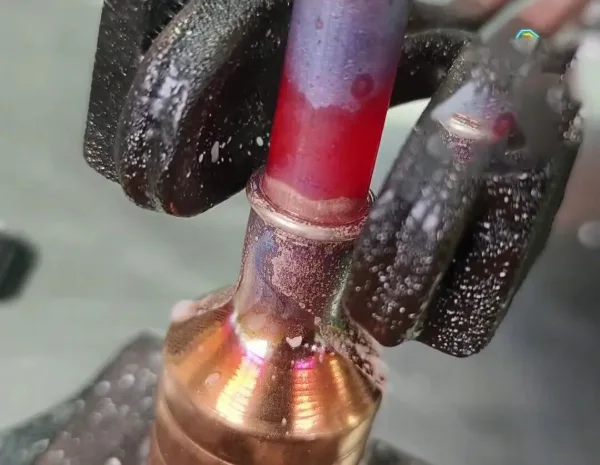
Copper, brass, and bronze are all non-ferromagnetic materials, meaning they are not attracted by magnets. All three have no ferromagnetism, but they have weak diamagnetism, producing a slight repelling force in a strong magnetic field. This property makes them widely used in applications that require resistance to magnetic interference, such as precision instruments, compasses, electronic devices, and marine engineering components.
Formability
The formability of copper, brass, and bronze is mainly affected by material plasticity, alloying elements, and deformation resistance. Pure copper has the best formability, with an annealed-state elongation of about 45%–55%. Its copper matrix has high purity and good plasticity, making it suitable for rolling, drawing, bending, and deep drawing with large deformation.
Brass has relatively balanced formability. Zinc can improve strength, but it also reduces plasticity. Low-zinc brass is more suitable for cold stamping, drawing, and bending; high-zinc brass has higher strength but greater forming difficulty, making it more suitable for medium- to low-deformation parts.
Bronze has relatively low formability. Tin, aluminum, silicon, and other elements strengthen the copper matrix, increasing hardness and strength while also increasing deformation resistance. Therefore, bronze is not suitable for large-deformation cold forming and is more often used for parts that require higher strength and wear resistance with smaller deformation.
The usual order of hot and cold formability is: pure copper > brass > bronze. Pure copper is suitable for high-ductility forming, brass is suitable for hardware parts that balance strength and formability, and bronze is more suitable for wear-resistant structural parts formed by small deformation or subsequent machining.
Castability: bronze > brass > pure copper, because tin bronze has good fluidity and low shrinkage, brass is suitable for general casting and forging, while pure copper is more prone to shrinkage cavities and casting defects.
Electrical Conductivity
The electrical conductivity ranking of copper, brass, and bronze is usually: pure copper > brass > bronze. IACS stands for International Annealed Copper Standard and is used to measure metal electrical conductivity.
Pure annealed copper is defined as 100% IACS. Pure copper has an electrical conductivity of about 97%–101% IACS. With high copper content, low impurity content, and fewer lattice defects and electron scattering, it has the best electrical conductivity and is suitable for wires, cables, copper busbars, and bus ducts.
Brass has an electrical conductivity of about 20%–30% IACS. Zinc enters the copper matrix as a substitutional solid solution, causing lattice distortion; this solid-solution strengthening increases electron scattering and reduces conductivity continuity.
Bronze has an electrical conductivity of about 10%–22% IACS. Tin, aluminum, and other elements increase lattice distortion and electron scattering through solid-solution strengthening or second-phase strengthening, so its electrical conductivity is usually lower than that of brass and pure copper.
Thermal Conductivity
The thermal conductivity of copper, brass, and bronze usually follows the order: pure copper > brass > bronze. Pure copper has a thermal conductivity of about 390–400 W/(m·K). With high copper content, few lattice defects, and efficient free-electron conduction, it has the best thermal conductivity.
Brass has a thermal conductivity of about 100–120 W/(m·K). Zinc enters the copper matrix as a substitutional solid solution, causing lattice distortion and increasing electron scattering, which significantly reduces thermal conductivity.
Bronze has a thermal conductivity of about 50–80 W/(m·K). Tin, aluminum, silicon, and other elements further increase lattice distortion, phase interfaces, and electron scattering, so bronze has the lowest thermal conductivity.
Antibacterial Properties
The antibacterial performance of copper, brass, and bronze usually follows the order: pure copper > brass > bronze.
Pure copper has the strongest antibacterial performance. It mainly relies on Cu+/Cu2+ copper ions released from the surface to damage microbial cell membranes, interfere with enzyme activity, and trigger oxidative stress. Therefore, it is suitable for medical instruments, door handles, water pipes, and other components requiring high antibacterial performance.
Because zinc is added to brass, the copper content is reduced and the copper ion release capacity is weaker than that of pure copper, but high-copper brass still has a certain antibacterial effect. Leaded brass has weaker antibacterial performance because the lead phase affects surface copper ion release.
Tin, aluminum, and other elements in bronze can easily form relatively stable oxide films or passivation layers, limiting copper ion release. Therefore, bronze usually has weaker antibacterial performance than pure copper and brass, and is more suitable for wear-resistant and corrosion-resistant parts rather than highly hygiene-sensitive applications.
Price Cost
The purchasing cost hierarchy of copper, brass, and bronze is: bronze > pure copper > brass, but it varies by specific grade and alloying elements. The purchasing cost of pure copper is mainly affected by copper content and purity. Ordinary red copper has relatively stable pricing, while oxygen-free copper usually has a higher purchase price than ordinary red copper because of its higher purity and lower oxygen content.
Because zinc is added to brass and zinc is usually cheaper than copper, ordinary brass generally has a lower purchasing cost than pure copper.
Bronze prices vary widely. Tin bronze, beryllium bronze, and other grades usually have significantly higher purchasing costs than ordinary brass and pure copper because tin, beryllium, and other alloying elements are more expensive.
Scrap Value
The scrap value of copper, brass, and bronze can usually be summarized as: pure copper is the highest, brass is in the middle, and bronze varies greatly by grade.
Because pure copper has high copper content and few impurities, its scrap value is closest to the electrolytic copper benchmark price;
Because brass contains zinc, its scrap value is usually lower than that of pure copper, and leaded brass may receive a lower quotation due to processing requirements. Among bronzes, tin bronze usually has a higher scrap value than ordinary brass because of its tin content; aluminum bronze, affected by aluminum, iron, manganese, and other elements, generally has a scrap value close to or slightly lower than brass; although beryllium bronze has high material value, beryllium is toxic, recycling treatment requirements are strict, market circulation is limited, and the actual scrap value often needs to be assessed separately.
Microscopic Grain Structure Comparison
The microscopic grain structure differences among copper, brass, and bronze are mainly determined by alloying elements and processing conditions.
Pure copper is mostly composed of uniform equiaxed grains. It contains fewer second phases and impurities, and its structural continuity is good, which benefits electrical conductivity, thermal conductivity, and plastic deformation.
Brass is strongly affected by zinc content. Low-zinc brass is mostly an alpha single-phase structure with good plasticity; high-zinc brass is more likely to form an alpha + beta dual-phase structure, which increases strength but reduces plasticity.
Bronze has the most complex structure. Tin, aluminum, silicon, beryllium, and other elements can form solid-solution strengthening, second-phase strengthening, or precipitation strengthening, giving the material higher strength, hardness, and wear resistance.
Overall, pure copper has the most uniform structure, brass adjusts its properties through zinc content, and bronze obtains higher mechanical properties through multiphase strengthening.
To help you better understand the property comparison of these three materials, I have summarized the above content in the following table:
| Comparison Dimension | Pure Copper / Red Copper (Copper) | Brass | Bronze |
| Main Composition | Cu >=99.50%, high purity | Cu-Zn alloy, Zn about 5%–45% | Cu-based alloy, often containing Sn, Al, Si, Be, and other elements |
| Color Appearance | Reddish purple or rose red | Golden yellow to pale yellow | Bluish gray, grayish yellow, or dark gold |
| Melting Point | Highest, about 1083°C | Medium, about 870°C–900°C | Wide range, about 700°C–950°C |
| Density / Weight | High, relatively the heaviest | Medium, usually lower than pure copper | Varies greatly; some aluminum bronze is lighter |
| Hardness | Low, relatively soft | Medium, balancing strength and machinability | High, with better wear resistance and load-bearing capacity |
| Tensile Strength | Low, suitable for low-load parts | Medium, suitable for general structural parts and hardware parts | High, suitable for higher-load mechanical parts |
| Yield Strength | Low, more prone to plastic deformation under load | Medium, with better dimensional stability | High, with stronger resistance to deformation |
| Shear Strength | Low, suitable for low-load connection parts | Medium, suitable for nuts, fittings, and fasteners | High, suitable for keyways, pin holes, and heavy-duty connection structures |
| Elongation | High, with the best plasticity and formability | Medium, balancing plasticity and strength | Low to medium, with relatively weaker plasticity |
| Fatigue Strength | Low, suitable for static or low-cycle loads | Medium, suitable for general spring contacts and connectors | High, suitable for elastic parts under high-cycle loads |
| Corrosion Resistance | Good, suitable for atmospheric, freshwater, and neutral environments | Medium; dezincification corrosion should be noted | Good, especially tin bronze and aluminum bronze for seawater and chemical environments |
| Cutting Machinability | Average; prone to tool sticking and burrs | Good, especially C36000 leaded brass with excellent machinability | Average to poor; high hardness causes more obvious tool wear |
| Weldability | Good; oxygen-free copper and phosphorus-deoxidized copper are more suitable for welding | Poor; zinc volatilizes easily, and leaded brass is not recommended for welding | Medium; tin bronze is better, while aluminum bronze is more difficult to weld |
| Formability | Good, suitable for drawing, bending, rolling, and deep drawing | Relatively good; low-zinc brass has better formability | Average; more suitable for small deformation or subsequent machining |
| Castability | Average; prone to shrinkage cavities | Good, suitable for general casting and forged parts | Good; tin bronze has good fluidity and low shrinkage |
| Electrical Conductivity | High, about 97%–101% IACS | Medium-low, about 20%–30% IACS | Low, about 10%–22% IACS |
| Thermal Conductivity | High, about 390–400 W/(m·K) | Medium, about 100–120 W/(m·K) | Low, about 50–80 W/(m·K) |
| Antibacterial Properties | Good, with strong copper ion release capability | Medium; high-copper brass still has some antibacterial performance | Average; oxide films or passivation layers limit copper ion release |
| Purchasing Cost | Relatively high; oxygen-free copper is more expensive | Medium; ordinary brass offers good cost performance | High; tin bronze and beryllium bronze cost more |
| Scrap Value | High, closest to the electrolytic copper benchmark price | Medium, usually lower than pure copper | Varies greatly; tin bronze is higher, while beryllium bronze needs separate evaluation |
| Microstructure | Relatively uniform structure with few second phases | Affected by zinc content; low-zinc is alpha single phase, while high-zinc can form alpha + beta dual phase | Complex structure; can form solid-solution strengthening, second-phase strengthening, or precipitation strengthening |
| Overall Characteristics | Best electrical conductivity, thermal conductivity, plasticity, and antibacterial performance | Balanced machinability, strength, cost, and appearance | More outstanding strength, hardness, wear resistance, and corrosion resistance |
How to Choose Copper, Brass, and Bronze Based on Your Needs?
If you need high electrical or thermal conductivity, choose pure copper first. It is suitable for wires, cables, copper busbars, bus ducts, heat sinks, and heat exchangers.
If you need easy machining and cost control, choose brass first. It has good machinability and is suitable for CNC turned parts, nuts, fittings, valve bodies, and precision hardware parts.
If you need wear resistance, load-bearing capacity, and fatigue resistance, choose bronze first. It is more suitable for bushings, bearings, gears, sliders, and high-load mechanical parts.
If the part is used in seawater, humid, or chemical environments, bronze is recommended. Tin bronze, aluminum bronze, and silicon bronze offer more stable corrosion resistance.
If you need stamping, drawing, bending, or deep drawing, choose pure copper or low-zinc brass first. Bronze has lower plasticity and is not suitable for large-deformation cold forming.
If appearance decoration is important, brass has more advantages. Its color is close to gold, making it suitable for lamps, handles, nameplates, and decorative hardware parts.
If the focus is purchasing cost control, ordinary brass is usually more suitable. Pure copper is more expensive, and tin bronze and beryllium bronze usually cost more.
Overall, pure copper is suitable for electrical conductivity, thermal conductivity, and high plasticity requirements; brass is suitable for easy machining, lower cost, and decorative parts; bronze is suitable for high strength, wear resistance, and corrosion resistance applications.
Weldo Machining
When choosing a copper alloy machining supplier, customers should not only focus on material price, but also evaluate the machining center’s practical understanding of material grades, tool selection, machining parameters, tolerance control, and surface treatment. A professional machining team can help customers reduce material waste, improve part stability, and find a better balance between performance and cost.
Weldo Machining can provide DFM services based on the functional requirements, machining accuracy, material performance, and application environment of customer parts. Whether it is high-conductivity copper parts, easy-to-machine brass components, or wear-resistant bronze bushings and mechanical parts, custom machining can be carried out according to drawings, samples, or assembly requirements. If you want to learn more or compare machining quotations, you can contact our professional engineers.