Custom Audio Connector Manufacturing

Custom Speaker Terminals & Binding Posts

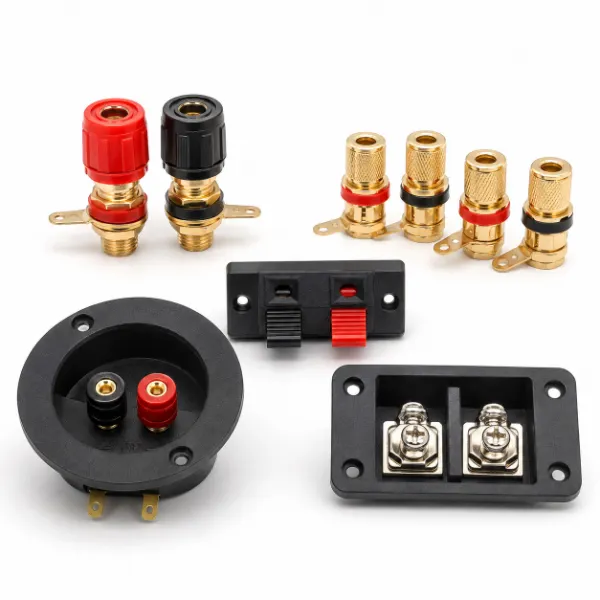
Weldo manufactures precision speaker terminal components from brass, copper alloys, stainless steel, aluminum and engineering plastics. We support custom loudspeaker terminals from functional prototypes through repeat production.

CNC turning, turn-mill machining, multi-axis milling and wire EDM are combined to control conductive surfaces, threads, insulating features and mounting geometry from one manufacturing source.

Ø4 mm Standard banana-plug interface
±0,005 mm Selected critical features after review
1–100,000+ Prototype and production quantities
Custom CNC-machined speaker terminal parts
Productomschrijving

What Is a Speaker Terminal?

A speaker terminal is the conductive interface between speaker cable and an amplifier, loudspeaker driver or enclosure wiring system. Common designs accept banana plugs, spade connectors, bare wire or threaded cable lugs.

A custom speaker terminal controls more than its external appearance. Its conductor material, contact geometry, thread fit, insulation, plating system and panel mounting method determine assembly reliability and long-term electrical performance.

  • Custom diameters, lengths, threads and anti-rotation flats
  • Conductive and insulating parts designed as one assembly
  • Selective gold, nickel, silver or tin plating
  • Interfaces for banana plugs, spades, bare wire or cable lugs
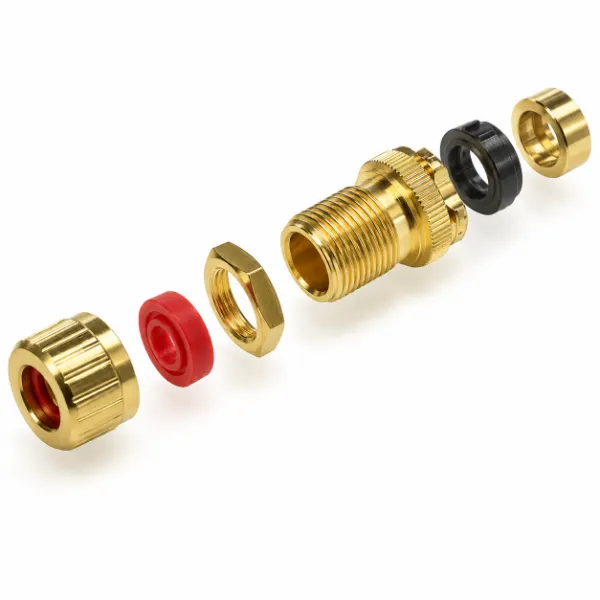
Exploded assembly of a gold-plated speaker terminal
Product Range

Speaker Terminal Types We Produce

We machine individual conductive parts, insulating components and complete terminal assemblies to customer drawings. These configurations cover common custom audio applications.

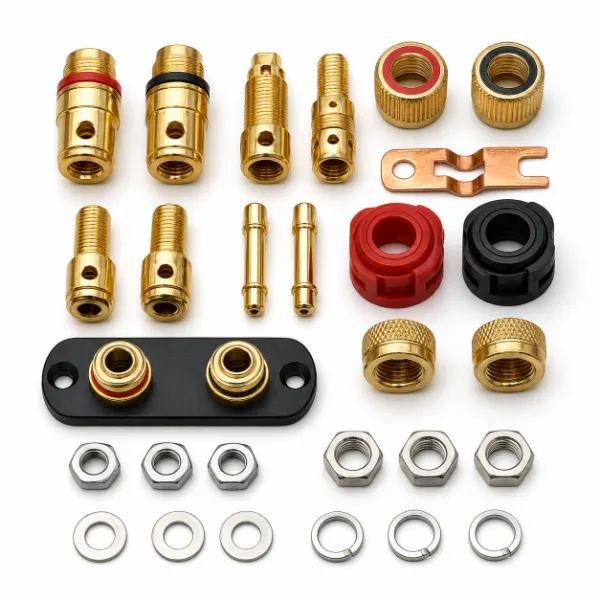
Collection of CNC-machined speaker terminal components
01

Five-Way Binding Posts

Multi-interface posts for banana plugs, spades, cable lugs and bare wire. Used on premium speakers and amplifiers.

  • Ø4 mm banana interface
  • M4–M8 mounting threads
  • Ø8–18 mm body range
  • Gold, nickel or silver plating
02

Panel-Mount Terminal Studs

Conductive studs with insulating collars, retaining nuts and anti-rotation features for panel installation.

  • M3–M8 thread range
  • 1–8 mm panel thickness
  • Single- or double-nut designs
  • Custom flats and shoulders
03

Banana-Plug Sockets

Precision sockets for standard banana plugs with solder, threaded, crimp or PCB termination features.

  • Ø4.0 mm nominal interface
  • Ø6–12 mm machined body
  • Straight or right-angle layouts
  • Selective contact plating
04

PCB and Solder Terminals

Compact terminals with controlled tail geometry for soldered, through-hole or mechanically retained connections.

  • Ø1–4 mm terminal tails
  • Custom PCB pitch
  • Cross-holes and solder cups
  • Burr-controlled contact edges
05

Speaker Box Terminal Plates

Two-pole and multi-pole speaker box terminals supplied as components or complete mounting assemblies.

  • 2- and 4-pole layouts
  • Custom post spacing
  • Flush or recessed mounting
  • POM, PA or aluminum plates
06

High-Current Custom Posts

Larger copper-alloy terminals for subwoofers, power amplifiers and designs requiring increased conductor cross-section.

  • C11000 or C14500 copper
  • Ø10–22 mm conductor bodies
  • Custom lug interfaces
  • Electrical rating verified by design
Engineering Specifications

Key Parameters for Custom Speaker Terminals

Final dimensions must follow the cable interface, mating connector, panel structure and plating thickness. These values are practical design references rather than fixed catalog limits.

Design ItemTypical ReferenceTechnische focus
Banana-plug interfaceØ4.0 mm nominalContact fit, insertion force and plating allowance
Mounting threadM3–M8Panel thickness, torque and insulating washer stack
Conductive body diameterØ6–22 mmCurrent path, stiffness and installation space
Panel thickness1–8 mmShoulder length, anti-rotation feature and nut engagement
Gold plating0.05–2 μmContact life, appearance and customer specification
Nickel underplate1–5 μmDiffusion barrier, adhesion and corrosion resistance
Machined surfaceRa ≤ 0,8 μmSelected contact surfaces can reach Ra ≤ 0.4 μm
Materiaalkeuze

Materials for Speaker Terminal Components

Conductive, structural and insulating components serve different functions. Material selection must consider conductivity, machinability, strength, corrosion resistance and plating compatibility.

Conductive Copper Alloys

  • C36000 Brass: High machinability for threaded bodies, caps and retaining nuts.
  • C11000 ETP Copper: High conductivity for large current paths and low-resistance parts.
  • C14500 Tellurium Copper: Combines conductivity with improved chip control for precision contacts.
  • C17200 Beryllium Copper: High elasticity and fatigue resistance for spring-contact elements.

Structural and Insulating Materials

  • 303 / 304 / 316 Stainless Steel: Used for nuts, shafts and structural parts requiring strength.
  • 6061-T6 Aluminum: Lightweight material for mounting plates and amplifier panels.
  • POM / Acetal: Stable electrical insulation for collars, bushings and terminal bodies.
  • PTFE or PA66: Selected for insulation, heat resistance and assembly requirements.
Selectierichtlijnen

When Is a Custom Speaker Terminal the Right Choice?

Catalog terminals suit standard audio assemblies. Custom machining is the stronger choice when fixed catalog geometry restricts installation, performance or product design.

Decision FactorCatalog TerminalCustom Weldo Terminal
MeetkundeFixed dimensions and configurationManufactured to the drawing
Panel integrationPanel must match the purchased terminalShoulders, flats and threads match the enclosure
MateriaalSupplier-selected conductor alloyC36000, C11000, C14500 or specified alloy
GalvaniserenStandard finish and coverageSpecified coating stack and selective masking
NauwkeurigheidCommercial catalog toleranceCritical dimensions controlled to the assembly
Supply controlDependent on catalog availabilityDrawing-controlled repeat production
Best useStandard general audio productsPremium, compact or non-standard assemblies
Apparatuur en capaciteit

Machining Capabilities for Speaker Terminals

Weldo combines multi-axis milling, precision turning, turn-mill machining and wire EDM. Related bores, threads, flats, cross-holes and mounting features can be controlled from fewer setups.

Explore CNC Machining →
HAAS & HURCO

3-, 4- en 5-assig CNC-frezen

Terminal plates, cups, anti-rotation flats, counterbores, slots and multi-face mounting features.

DOOR FANUC AANGESTUURDE APPARATUUR

CNC-draaien en draai-freesbewerkingen

Conductor bodies, sockets, threads, grooves, knurls, cross-holes and solder features.

PRECISIE-DRAADVONKSLASSEN

Conductive Profile Cutting

Narrow slots, split-contact features and internal profiles in electrically conductive materials.

SECUNDAIRE BEWERKINGEN

Finishing and Assembly

Deburring, polishing, plating coordination, insulation fitting and final assembly inspection.

Overzicht van de productiecapaciteit

CNC-freesbereik Up to 1000 × 500 × 500 mm*
Turn-mill bar diameter Ø1–65 mm*
Chucked turning diameter Up to Ø300 mm*
Terminal thread range M3–M8
Wire EDM wire diameter Ø0.10–0.25 mm
Wire EDM thickness 0.5–300 mm*
Standaardtolerantie ±0,01 mm
Selected critical tolerance ±0.005 mm*
Gekozen oppervlakteafwerking Ra ≤ 0.4 μm*
Productieondersteuning Van prototype naar serieproductie

*Final capacity depends on material, geometry, aspect ratio, feature access and inspection method.

Maatnauwkeurigheid

Speaker Terminal Machining Tolerance Reference

Terminal performance depends on controlled mating geometry. Oversized bores affect fit. Poor concentricity affects assembly, while uncontrolled plating changes contact diameters and threads.

Precision limits are assigned to functional dimensions. General features retain economical production tolerances.

±0.01 mm standard production reference
±0.005 mm selected critical features
0.001 mm inspection reporting resolution
Ra 0.4 μm selected machined surfaces
FunctieProduction ReferenceSpecial SetupInspectiemethode
Turned conductor OD±0,01 mm±0,005 mmMicrometer and CMM
Banana socket bore±0,02 mm±0,01 mmPlug gauge or optical measurement
Post spacing±0,05 mm±0,02 mmCMM or QUICK VISION
Concentricity / runout0.02 mm0.01 mmCMM or dial measurement
Knurled diameter±0,05 mm±0,02 mmMicrometer and profile inspection
Metric thread fit6H / 6g4H / 4gGO/NO-GO thread gauges
Machined surfaceRa ≤ 0,8 μmRa ≤ 0.4 μmSurface roughness tester
Procesbesturing

Critical Points in Speaker Terminal Manufacturing

Conductivity and Machinability

Copper grade selection balances electrical resistance, chip control, dimensional stability and tool wear.

Coaxial Geometry

Bores, shoulders and threads use common datums to control runout and terminal alignment.

Plating Allowance

Contact diameters and threads include coating buildup. Masking protects surfaces that must remain unplated.

Burr Control

Cable holes, solder cups and thread starts are deburred without reducing the functional contact area.

Insulator Fit

POM, PTFE and PA components require controlled fits that prevent looseness without cracking the material.

Assembly Torque

Threads and shoulders must support installation torque while maintaining electrical isolation.

Oppervlakteafwerking

Finishing Options for Speaker Terminals

The finish must support the conductor material, contact environment, cosmetic requirement and mating cycle. Plating thickness should be stated on the drawing.

Vergulden

Provides stable contact surfaces, oxidation resistance and a premium appearance. Nickel is commonly used as an underplate.

Vernikkelen

Improves corrosion and wear resistance and creates a diffusion barrier beneath gold.

Verzilveren

Supports conductive contact surfaces in high-current designs where tarnish is addressed by the specification.

Vertinnen

A practical finish for solderable terminals and cost-controlled internal connections.

Passivering

Restores corrosion resistance on compatible stainless-steel terminal components.

Aluminum Anodizing

Protects mounting plates and amplifier panels. Conductive interfaces require masking.

Kwaliteitsborging

How Speaker Terminal Parts Are Inspected

Speaker terminal inspection covers material, functional dimensions, thread fit, geometric accuracy and surface finish. The 0.001 mm values below refer to instrument display or reporting resolution, not a universal ±0.001 mm machining tolerance.

InspectieapparatuurReferentiecapaciteitGebruik bij inspecties
Hexagon CROMA Bridge CMM0,001 mm meetresolutie Position, concentricity, profile, perpendicularity and datum relationships
Mitutoyo QUICK VISIONWeergaveresolutie van 0,001 mm Small holes, post spacing, slots, edges and optical profiles
Optische profielprojectorVergelijking van profiel en hoek Threads, radii, chamfers, knurls and terminal outlines
Digitale hoogtemeterWeergaveresolutie van 0,001 mm Step height, shoulder position and mounting plate dimensions
Micrometers en boorgatmetersMaatverdeling van 0,001 mm Turned diameters, socket bores and production sampling
GO/NO-GO Thread GaugesSpecified thread class Internal and external thread acceptance
OppervlakteruwheidsmeterRa/Rz-meting Contact surfaces and visible machined surfaces
Plating Inspection RecordsThickness and process certificate Gold, nickel, silver and tin plating verification

Materiaalcontrole

Material grade and supplier documents are checked before machining.

Inspectie tijdens het productieproces

Diameters, bores, threads and post spacing are monitored during production.

Eindcontrole

Dimensions, geometric tolerances, finish and assembly fit are verified.

Inspection Records

Dimensional, material and plating reports are supplied when specified.

Audio Applications

Where Custom Speaker Terminals Are Used

Custom terminals are used where the enclosure, amplifier panel, conductor size or product appearance requires a dedicated connection interface.
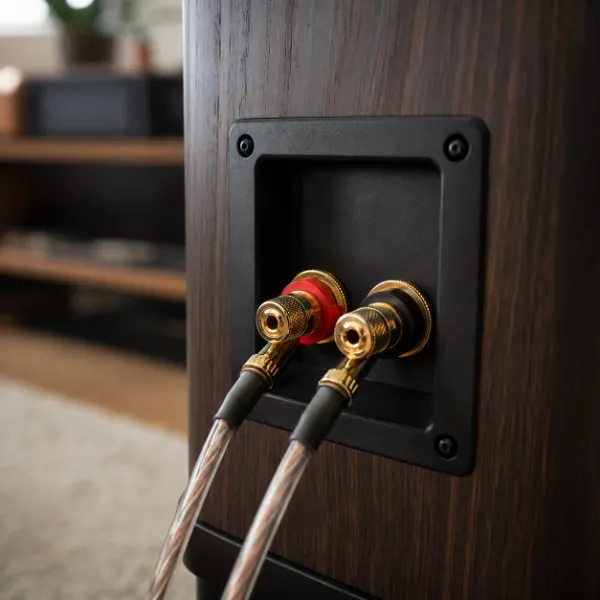
Gold-plated binding posts on a Hi-Fi speaker

Hi-Fi Loudspeakers

Premium loudspeaker terminals for floor-standing speakers, bookshelf speakers, studio monitors and custom audio systems.
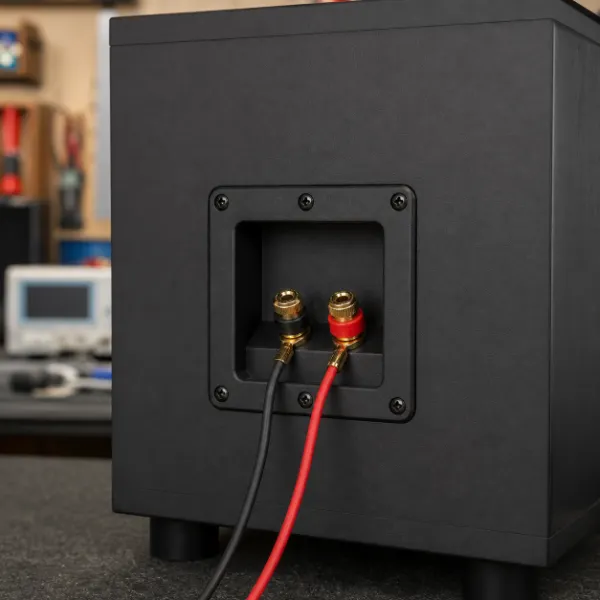
Subwoofer terminal cup with red and black binding posts

Subwoofers and Speaker Boxes

Recessed speaker box terminals for powered subwoofers, passive enclosures and professional speaker cabinets.
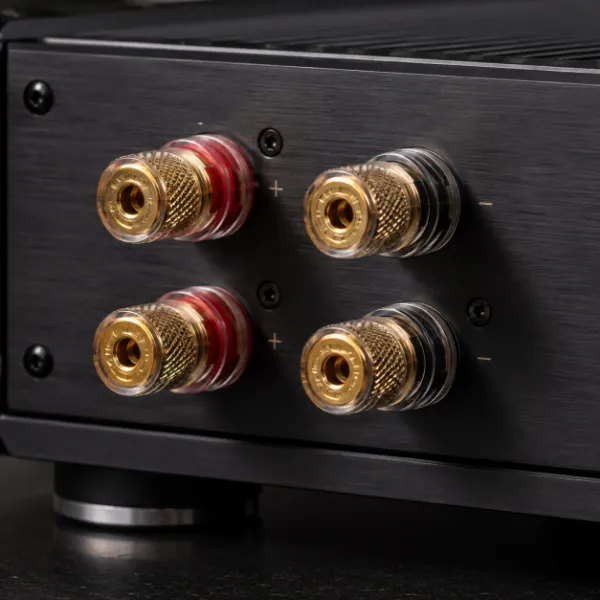
Gold-plated binding posts on an audio amplifier

Amplifiers and Audio Equipment

Panel-mounted outputs for stereo amplifiers, power amplifiers, receivers and specialized audio electronics.

Cost Control

How to Reduce Custom Speaker Terminal Cost

Reliable cost control comes from matching the design to the correct manufacturing route. Material price alone does not determine the finished terminal cost.

Use Functional Tolerances

Apply tight limits only to contact bores, mating diameters, spacing and assembly datums.

Standardize Interfaces

Retain standard Ø4 mm banana interfaces and common metric threads unless the design requires alternatives.

Reduce Re-Clamping

Use turn-mill or multi-axis machining to complete related features from fewer setups.

Select the Right Alloy

Use C36000 for efficient machining and higher-conductivity copper only where required.

Define Selective Plating

Apply premium coatings only to specified contact and cosmetic surfaces.

Consolidate Repeat Orders

Stable drawings and planned batch quantities reduce repeated setup and qualification costs.

Veelgestelde vragen

Speaker Terminal FAQs

How to fix a speaker terminal?

Disconnect the amplifier from power. Check the mounting nut, cable connection, solder joint and insulating washer. Tighten loose hardware or replace cracked insulators and damaged terminals. Internal amplifier repairs require a qualified technician.

Which terminal on a speaker is positive?

The positive terminal is normally red or marked with a plus sign. The negative terminal is normally black or marked with a minus sign. Confirm the product marking before connection.

How to connect wires to speaker terminals?

Strip the cable without cutting the conductor strands. Connect it using a banana plug, spade connector or the bare-wire opening. Match positive to positive and negative to negative.

What is the most common speaker failure?

Common failures include damaged voice coils, deteriorated surrounds, loose internal wiring and poor terminal connections. Inspect the terminal first when sound changes as the cable moves.

What causes a speaker to have no sound?

No sound results from an open cable, loose terminal, incorrect amplifier setting, damaged crossover, failed driver or amplifier fault. Test the cable and connection first.

Start Your Custom Speaker Terminal Project

Send Weldo your 2D drawing or 3D model with the material, quantity, tolerance, plating, mounting and inspection requirements. Our team will review manufacturability and prepare a machining quotation.

Ontvang advies over verspaning en een offerte