








Tensile strength is an important mechanical property that measures the maximum load-bearing capacity of a material under uniaxial tensile loading. It is widely used in material selection, structural design, quality inspection, and part performance verification. Tensile strength varies significantly among different materials, and even the same grade may show different values because of heat treatment condition, product form, and test conditions.
This article explains the definition, calculation formula, testing method, and influencing factors of tensile strength. It also compares typical data for common aluminum alloys, steels, stainless steels, and engineering plastics, and discusses its practical significance in CNC machining and material selection.
What Is Tensile Strength?
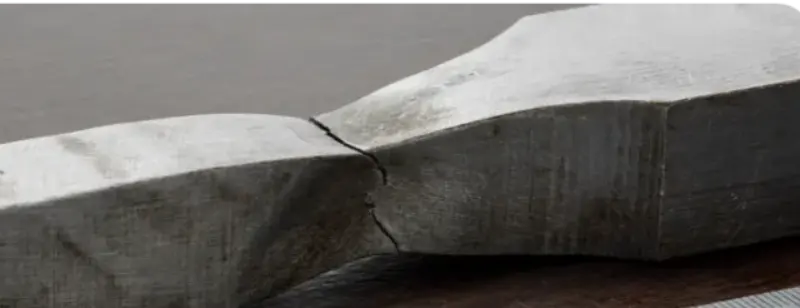
Tensile strength, also known as ultimate tensile strength (UTS), is the maximum engineering stress reached by a material during a uniaxial tensile test. It is commonly represented by Rm, while older references may also use σb. The usual units are MPa or N/mm².
For ductile metals, tensile strength usually corresponds to the end of uniform plastic deformation and the beginning of localized necking. For materials with low ductility, it is generally closer to the tensile fracture strength. Tensile strength reflects a material’s ultimate tensile capacity, but it cannot be used directly as the safe working stress of a part.
Tensile Strength Formula and Units
Tensile strength is calculated by dividing the maximum load recorded during a tensile test by the original cross-sectional area of the specimen:
Rm = Fm / S₀
- Rm: tensile strength, MPa
- Fm: maximum load recorded during the tensile test, N
- S₀: original cross-sectional area of the specimen, mm²
Tensile strength is usually expressed in MPa or N/mm²:
1 MPa = 1 N/mm²
The calculation must use the original cross-sectional area before testing rather than the area at the necked region after fracture. For ductile materials, the maximum load is usually reached before final fracture.
Tensile Strength on the Stress-Strain Curve
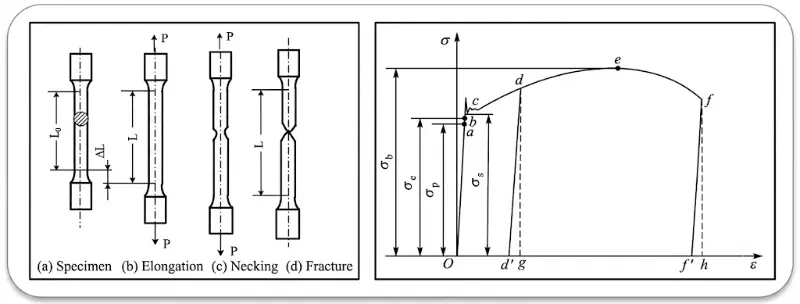
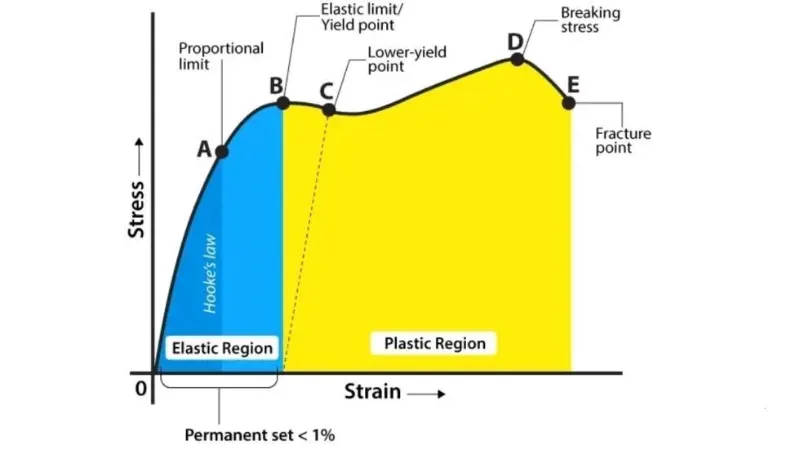
On a typical stress-strain curve, a material passes through elastic deformation, yielding, uniform plastic deformation, necking, and fracture. The highest engineering stress on the curve is the material’s tensile strength.
Before tensile strength is reached, strain hardening allows the material to continue increasing its load-bearing capacity. After this point, deformation gradually concentrates in a localized region, necking develops, and fracture follows. Therefore, for ductile materials, the tensile strength point is usually not the same as the final fracture point.
How Is Tensile Strength Tested?
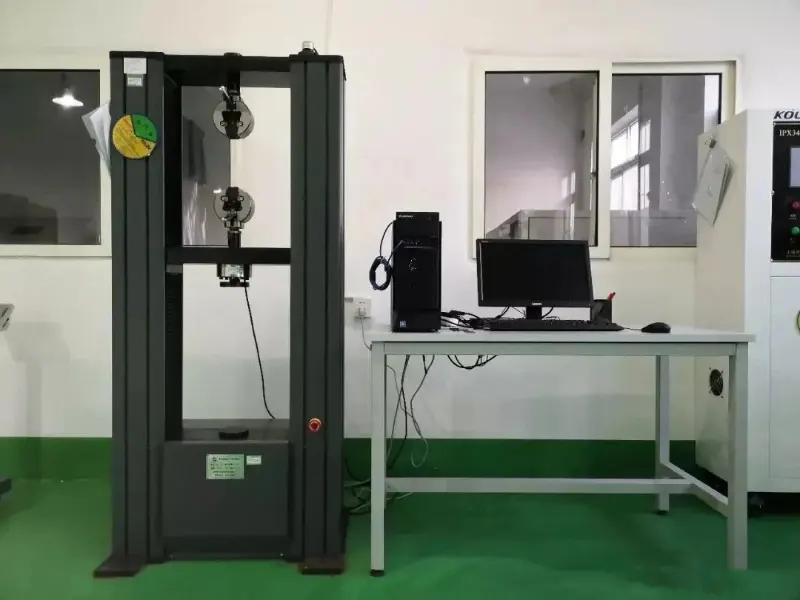
Tensile strength is usually measured through a standardized tensile test. The specimen is installed in a universal testing machine and subjected to an axial tensile load at a specified rate until fracture occurs.
The basic test procedure includes:
Prepare and inspect the tensile specimen according to the applicable standard;
Measure the specimen width, thickness, diameter, and original gauge length;
Center the specimen in the grips of the testing machine;
Apply an axial tensile load at the specified rate;
Record the load, displacement, and strain data;
Calculate tensile strength from the maximum load.
A tensile test can usually also determine elastic modulus, yield behavior, elongation after fracture, and reduction of area. Specimen dimensions, sampling direction, loading rate, grip alignment, surface defects, and fracture location can all affect the test results.
Factors Affecting Tensile Strength
Tensile strength is influenced by material composition, microstructure, processing condition, and service environment. The same grade may therefore show clearly different tensile properties under different conditions.
Chemical Composition: Alloying elements can increase strength through solid-solution strengthening, precipitation strengthening, or transformation strengthening, while also affecting ductility, toughness, and corrosion resistance.
Grain Size and Microstructure: Grain size, phase composition, and microstructural uniformity influence dislocation movement, strain hardening, and fracture behavior.
Heat Treatment: Quenching, tempering, solution treatment, aging, and annealing alter the microstructure and tensile strength of a material.
Manufacturing Process: Rolling, forging, drawing, extrusion, and cold working may increase strength through grain refinement or work hardening.
Defects and Surface Quality: Cracks, pores, inclusions, burrs, and surface scratches create stress concentrations that may cause premature failure.
Temperature and Strain Rate: High temperatures generally reduce the tensile strength of most metals, while loading rate also changes deformation and fracture behavior.
Corrosion and Environment: Pitting, stress-corrosion cracking, and hydrogen embrittlement can reduce the effective cross-section or accelerate crack growth.
Size and Loading Direction: Material thickness, specimen size, and the rolling, forging, or extrusion direction can all influence test data.
Tensile Strength of Common Aluminum Alloys
The tensile strength of aluminum alloys commonly used in machining is mainly determined by the alloy series, heat treatment condition, and product form. 6061 is suitable for general CNC parts, 2011 emphasizes high-speed cutting, while 2024, 7050, and 7075 are better suited to high-strength structural components.
| Aluminum Alloy | Typical Tensile Strength | Machining Characteristics | Common Applications |
| 2011-T3 / T8 | Approx. 310-380 MPa | Produces short chips, offers high cutting efficiency, and is suitable for high-speed turning | Threaded parts, fittings, bushings, and automatic lathe components |
| 2014-T6 | Approx. 450-500 MPa | High strength and suitable for precision cutting, but with limited corrosion resistance | Aerospace parts, heavy-duty brackets, and high-strength mechanical components |
| 2024-T3 / T351 | Approx. 430-485 MPa | Good machinability, with high strength and fatigue performance | Aerospace structural parts, connectors, and precision CNC components |
| 5052-H32 | Approx. 210-260 MPa | Good formability, but relatively average machinability | Enclosures, panels, tanks, and corrosion-resistant structural parts |
| 5083-H111 / H116 | Approx. 275-330 MPa | Good corrosion resistance and suitable for machining plate and large parts | Marine components, fixture plates, and large mechanical parts |
| 6061-T6 / T651 | Approx. 290-330 MPa | Stable cutting performance, wide availability, and suitable for anodizing | Brackets, fixtures, mounting plates, enclosures, and general CNC parts |
| 6063-T6 | Approx. 205-245 MPa | Better suited to extruded profiles, with cutting usually used as a secondary operation | Frames, guide rails, heat-dissipation structures, and profile components |
| 6082-T6 | Approx. 290-340 MPa | A balanced combination of strength and machinability | Supports, structural plates, connectors, and machine frames |
| 7050-T7451 | Approx. 470-525 MPa | High strength with good resistance to stress-corrosion cracking | Aerospace load-bearing parts, spars, and high-strength precision components |
| 7075-T6 / T651 | Approx. 540-570 MPa | High strength and good machinability, but machining distortion must be controlled | Aerospace parts, drones, racing components, and high-strength CNC parts |
2011 is suitable for high-efficiency turning, 6061 offers broader overall applicability, while 2024, 7050, and 7075 are mainly used for high-strength precision components. The advantages of 5052 and 6063 are more closely associated with forming and extrusion applications.
Actual tensile strength varies with material condition, dimensions, and product form. Final selection should therefore be based on the applicable standard and material certificate.
Tensile Strength of Common Carbon and Alloy Steels
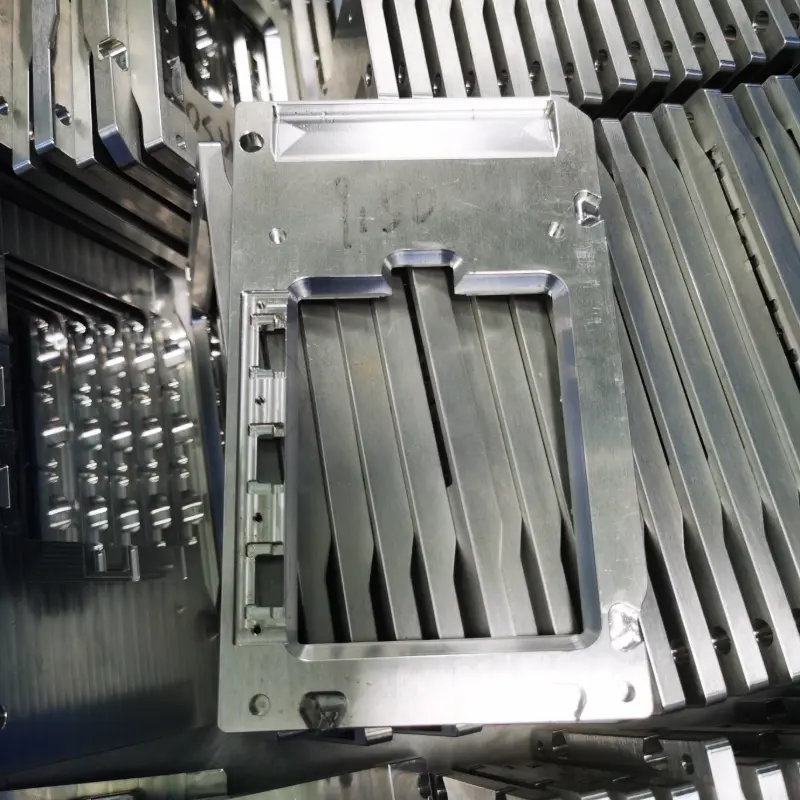
Steel covers a wide strength range, and carbon content, alloy composition, and heat treatment condition all have a significant influence. Low-carbon steels are suitable for general structures and machined parts, while medium-carbon and alloy steels are better suited to shafts, gears, and high-load components.
| Steel Grade | Typical Tensile Strength | Main Features | Common Applications |
| ASTM A36 | Approx. 400-550 MPa | Low cost, with good weldability and formability | Frames, bases, brackets, and structural plates |
| S235JR | Approx. 360-510 MPa | General-purpose low-carbon structural steel that is easy to weld and form | Steel structures, sections, brackets, and machine bases |
| S355J2 | Approx. 470-630 MPa | A balanced combination of strength, toughness, and weldability | Load-bearing frames, mechanical structures, and supports |
| AISI 1018 | Approx. 440-640 MPa | Good machinability, ductility, and weldability | Shafts, pins, fasteners, and machined parts |
| AISI 1020 | Approx. 380-550 MPa | Easy to form, weld, and surface harden | Sleeves, pins, structural parts, and carburized components |
| AISI 1045 / C45 | Approx. 570-800 MPa | Properties can be improved through quenching and tempering or surface hardening | Shafts, gears, pins, rollers, and connectors |
| AISI 4140 / 42CrMo4 | Approx. 800-1,200 MPa | High strength, toughness, and fatigue performance after quenching and tempering | Drive shafts, high-strength fasteners, and heavy-duty parts |
| AISI 4340 | Approx. 930-1,400 MPa | High hardenability and good toughness even at high strength levels | Aerospace shafts, gears, and highly loaded components |
| AISI 8620 | Approx. 530-850 MPa | Carburizing can produce a hard surface and a tough core | Gears, cams, sprockets, and transmission parts |
The data in the table are suitable for preliminary comparison. Formal material selection must also confirm the heat treatment condition, section size, delivery condition, and material certificate.

Tensile Strength of Common Stainless Steels
The tensile strength of stainless steel is closely related to its microstructural type, cold working, and heat treatment condition. Austenitic stainless steels place greater emphasis on corrosion resistance and ductility, while duplex and precipitation-hardening grades can achieve higher strength.
| Stainless Steel Grade | Typical Tensile Strength | Main Features | Common Applications |
| 303 Stainless Steel | Approx. 515-690 MPa | Good machinability, with slightly lower corrosion resistance | Shafts, threaded parts, fittings, and precision CNC components |
| 304 Stainless Steel | Approx. 520-720 MPa | A balanced combination of corrosion resistance, formability, and weldability | Food equipment, enclosures, fasteners, and mechanical parts |
| 316 / 316L Stainless Steel | Approx. 485-690 MPa | Better resistance to pitting and chloride environments | Medical, chemical, marine, and fluid-handling equipment parts |
| 2205 Duplex Stainless Steel | Approx. 660-860 MPa | High strength with good resistance to pitting and stress-corrosion cracking | Valves, flanges, shafts, and oil and gas equipment components |
| 17-4 PH Stainless Steel | Approx. 1,030-1,365 MPa | High strength and good corrosion resistance after aging | Aerospace, energy, high-strength connectors, and load-bearing shaft components |
Cold working can increase the strength of some austenitic stainless steels, while the properties of 17-4 PH change significantly with aging condition. Material selection should confirm the grade, heat treatment condition, and product form.
Tensile Strength of Common Engineering Plastics
Engineering plastics generally have lower tensile strength than metals, but offer advantages in weight, corrosion resistance, low friction, and electrical insulation. Their data are readily affected by temperature, humidity, fiber reinforcement ratio, and molding direction.
| Engineering Plastic | Typical Tensile Strength | Main Features | Common Applications |
| ABS | Approx. 35-50 MPa | Good toughness and machinability | Enclosures, prototypes, and consumer electronics parts |
| PA6 / PA66 Nylon | Approx. 60-90 MPa | Wear-resistant and tough, but moisture-absorbing | Gears, bushings, rollers, and mechanical parts |
| POM / Acetal | Approx. 60-75 MPa | Low friction, good dimensional stability, and good machinability | Precision gears, sliders, and connectors |
| Polycarbonate, PC | Approx. 55-75 MPa | Outstanding impact resistance | Protective covers, equipment enclosures, and safety components |
| PEEK | Approx. 90-100 MPa | Good high-temperature resistance, chemical resistance, and strength | Aerospace, medical, and semiconductor equipment parts |
| PTFE | Approx. 20-35 MPa | Low friction and corrosion-resistant, but with low stiffness | Seals, bushings, and insulating parts |
| UHMWPE | Approx. 20-40 MPa | Wear-resistant, impact-resistant, and self-lubricating | Guide rails, wear liners, and conveyor components |
Engineering plastics must also be evaluated for creep, long-term loading, and service temperature. Although fiber reinforcement can improve strength, it also increases directional dependence and tool wear.
How Tensile Strength Affects CNC Machining
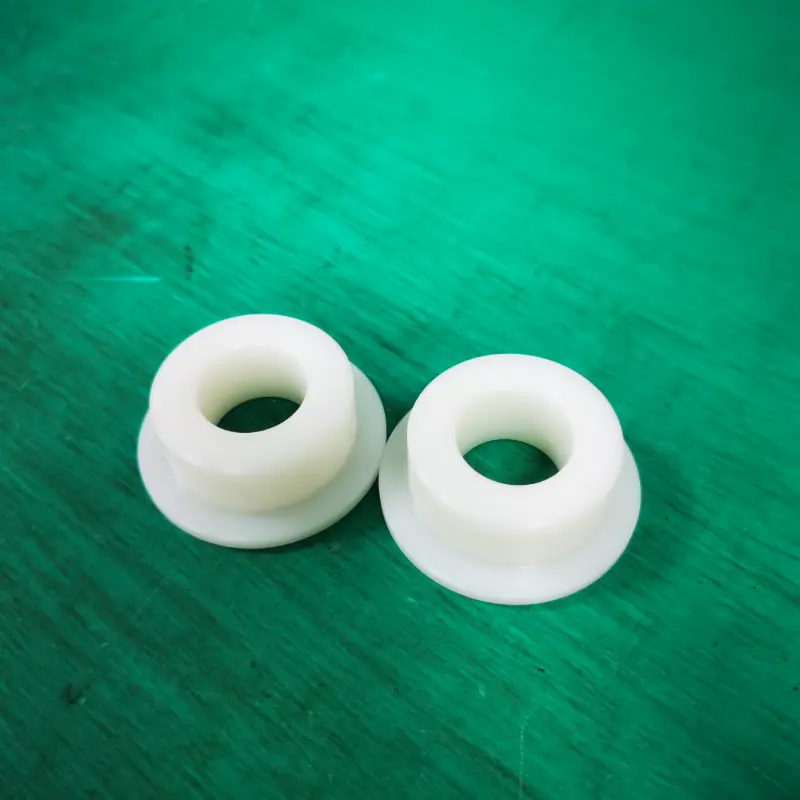
Tensile strength can be used as a reference for judging material load capacity and machining load, but it cannot independently determine CNC machinability. Hardness, toughness, work-hardening tendency, thermal conductivity, and microstructure usually have a more direct influence.
Material Selection and Quotation: High-strength materials are commonly used for load-bearing parts and may also bring higher material, inspection, and machining costs.
Cutting Force and Machine Load: Materials with higher tensile strength often require greater cutting force, which may increase spindle load and machining vibration.
Tool Selection and Wear: High-strength materials generally require more rigid tools, suitable coatings, and stable cutting parameters.
Roughing and Heat Control: During heavy material removal, depth of cut, feed rate, cooling, and chip evacuation should be properly controlled to avoid heat buildup.
Chip and Burr Formation: Material toughness and elongation affect chip breaking and burr formation. Tougher materials are more likely to produce long chips and burrs.
Final Part Performance: Tensile strength can be used to evaluate the ultimate load-bearing capacity of a part under tensile loading, but fatigue, notches, and the safety factor must also be considered.
Machining distortion in thin-walled parts and large flat components is usually more closely related to elastic modulus, yield strength, residual stress, wall thickness, and workholding method than to tensile strength alone.
How to Use Tensile Strength in Material Selection
Tensile strength is suitable for comparing the ultimate tensile capacity of different materials, but actual selection must also consider part loading, weight, stiffness, environment, and manufacturing requirements.
Compare different grades and heat treatment conditions;
Determine whether the material can meet tensile load requirements;
Evaluate strength-to-weight ratio and lightweighting value;
Check whether the material certificate meets drawing requirements;
Confirm whether the required properties can be maintained after machining or heat treatment;
Evaluate it together with yield strength, elongation, hardness, and fatigue performance.
For CNC parts, machinability, dimensional stability, surface treatment, and material cost should also be considered.
Common Mistakes When Using Tensile Strength Data
Tensile strength data are meaningful only when the material condition and test conditions are clearly defined. Common mistakes include:
Treating UTS as Allowable Stress: Tensile strength is not the safe working stress of a part. Design must also consider yielding and the safety factor.
Ignoring Material Condition: The same grade may have clearly different strength in annealed, quenched-and-tempered, aged, or cold-worked conditions.
Comparing Different Test Data Directly: Data obtained from different specimens, standards, gauge lengths, and test speeds may not be directly comparable.
Ignoring Thickness and Direction: Material thickness, bar diameter, and the rolling or extrusion direction can all affect tensile properties.
Using Tensile Strength Alone: High tensile strength does not necessarily mean that a material has better impact resistance, fatigue resistance, or long-term load capacity.
Assuming High UTS Means Poor Machinability: Machining difficulty is also affected by hardness, toughness, work hardening, and chip characteristics.
FAQ About Tensile Strength
Is higher tensile strength always better?
Not necessarily. Higher tensile strength can increase ultimate load-bearing capacity, but it may also be accompanied by lower ductility, higher material cost, or greater machining difficulty. Material selection must also consider stiffness, fatigue performance, corrosion resistance, and the service environment.
Why does the same material have different tensile strength values?
The tensile strength of the same grade is affected by heat treatment condition, degree of cold work, product dimensions, sampling direction, and manufacturing process. Material data are therefore usually expressed as a range.
Can heat treatment improve tensile strength?
Yes. Quenching, tempering, solution treatment, and aging can improve tensile strength by changing the material microstructure. However, the increase in strength may also be accompanied by changes in ductility, toughness, or corrosion resistance.
Does material thickness affect tensile strength?
Tensile strength does not simply increase with thickness, but thickness can affect cooling rate, heat treatment response, microstructural uniformity, and defect distribution, resulting in different specified values for products of different thicknesses.
Conclusion
Tensile strength is an important parameter for comparing material performance, performing quality control, and evaluating ultimate load-bearing capacity. Aluminum alloys, steels, stainless steels, and engineering plastics cover different strength ranges, but actual material selection must still consider yield strength, elastic modulus, ductility, fatigue performance, and the service environment.
For CNC parts, material properties also affect cutting load, tool selection, machining cost, and finished-part reliability. Weldo Machining can provide material recommendations, DFM analysis, and CNC machining quotations based on part drawings, load requirements, and application environments, helping projects achieve a balance among performance, manufacturability, and cost.