Drawing-Based Manufacturing
Custom Water Manifold Manufacturing
Weldo manufactures Custom Water Manifolds from your drawings for reliable fluid distribution.
Request a Custom Quote →Structural Types
Water Manifold Types by Core Structure
Select the structure from passage geometry, flow capacity, material, production volume and service requirements.
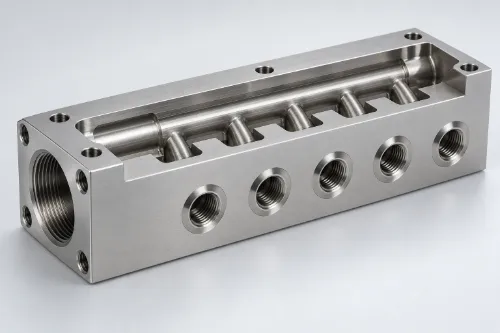
01CNC-Machined Block Manifold
A one-piece manifold machined from solid plate or billet with intersecting internal passages.
- Aspetto Compact rectangular body with dense threaded ports and machined sealing faces.
- Best use Precision equipment cooling, test systems and low-to-medium-volume custom units.
- Key control Cross-hole alignment, sealing grooves, port position and internal deburring.
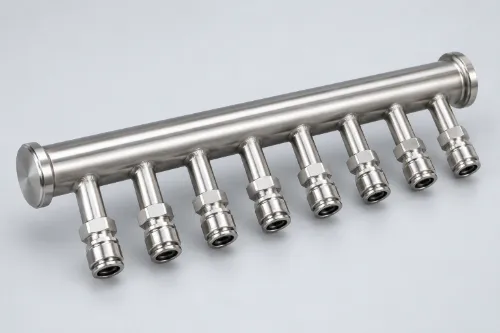
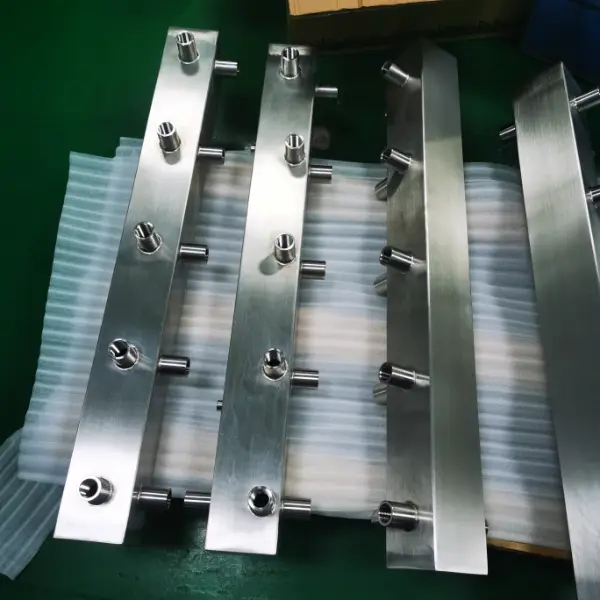
02Tubular Header Manifold
A main header tube distributes or collects fluid through multiple connected branches.
- Aspetto Long round or rectangular header with evenly spaced outlet necks or quick-connect ports.
- Best use High-flow in-rack liquid cooling, row distribution, HVAC and industrial cooling.
- Key control Branch spacing, joint integrity, straightness and pressure-drop control.
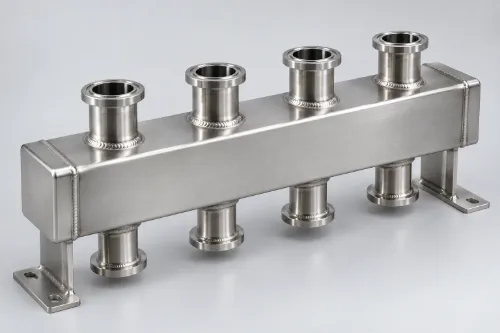
03Welded Fabricated Manifold
Machined headers, branch necks, end caps and brackets are permanently joined into one assembly.
- Aspetto Box or tube-based body with visible joints, mounting feet and configurable connection points.
- Best use CDUs, process-cooling skids and large or irregular equipment cooling circuits.
- Key control Weld distortion, joint penetration, passivation and leakage testing.
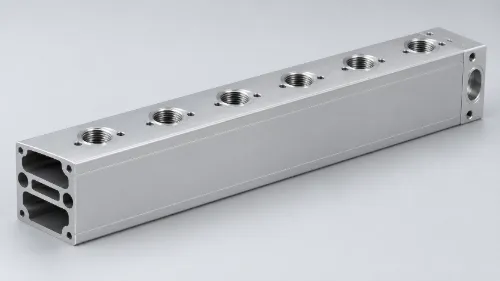
04Extruded Profile Manifold
An aluminum extrusion forms continuous longitudinal channels before ports and ends are CNC machined.
- Aspetto Long rectangular rail with a constant cross-section and regularly machined branch ports.
- Best use Repeat-volume rack, battery and power-electronics cooling systems.
- Key control Profile variation, end sealing, port accuracy and corrosion protection.
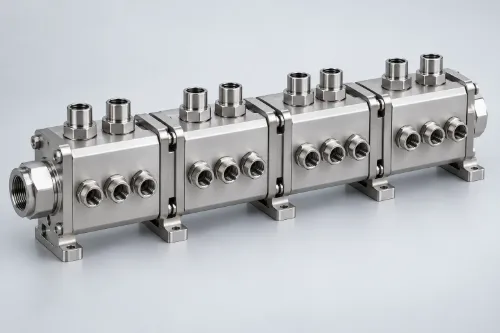
05Modular Manifold Assembly
Individual manifold blocks connect through sealed mechanical interfaces to create a configurable system.
- Aspetto A repeating row of compact modules with visible joints, ports and mounting features.
- Best use Expandable data-center racks, laboratory loops and equipment requiring branch replacement.
- Key control Joint sealing, module alignment, assembly torque and maintenance access.
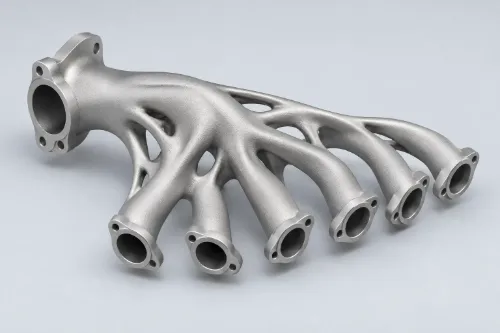
06Additively Manufactured Manifold
Metal additive manufacturing builds curved internal passages as one integrated component.
- Aspetto Compact organic form with smoothly branching outlets and fewer joined components.
- Best use Space- and weight-critical thermal management and high-value prototype systems.
- Key control Powder removal, internal surface quality, CT inspection and finish machining.
Applicazioni
Fluid Distribution for High-Value Equipment
Manifold architecture follows the fluid chemistry, operating pressure and flow, cleanliness target and installation environment.
Data Center Liquid Cooling
In-rack and row-level distribution between CDUs, server racks and cold plates.
Industrial Equipment Cooling
Cooling circuits for CNC machines, laser systems, test rigs and power electronics.
Water Treatment Equipment
Controlled distribution for filtration, circulation, dosing and process-water systems.
Semiconductor Process Cooling
Clean, corrosion-controlled routing for process cooling water and equipment cooling water.
Battery & Energy Systems
Compact coolant routing for battery packs, storage cabinets and charging equipment.
Engineering Inputs
Define the Operating Boundary Before Production
Complete fluid, pressure-flow and interface data gives every critical feature a measurable purpose.
Fluid
Type, concentration, chemistry, temperature and wetted-material compatibility.
Flow & Pressure
Total and branch flow, working pressure, pressure peaks, back pressure and allowable pressure drop.
Interfacce
Port standard, quantity, spacing, orientation, sealing method and mounting datums.
Servizio
Isolation, venting, drainage, monitoring, maintenance access and future expansion.
Materiali e finiture
Match the Material to the Complete Fluid System
Material selection follows coolant chemistry, operating pressure, temperature, weight, cleanliness and joining requirements.
Acciaio inossidabile 304L
Balanced corrosion resistance for controlled water and glycol circuits.
Low carbon content supports welded construction and reduces sensitization risk around correctly produced joints. Material approval must account for chloride concentration, temperature, dissolved oxygen and the complete coolant chemistry.
- General corrosion resistance
- Stable welded construction
- Good strength and cleanability
Closed treated-water or water-glycol loops with controlled chloride, oxygen and conductivity.
Data-center secondary loops, industrial cooling and process-water equipment.
Acciaio inossidabile 316L
Improved pitting resistance for more demanding controlled-water service.
Molybdenum improves resistance to chloride-induced pitting compared with 304L. Final approval must consider chloride concentration, temperature, crevice geometry, weld condition and coolant chemistry.
- Improved pitting resistance
- Low-carbon weldability
- High-cleanliness surface capability
Controlled water or glycol circuits where chloride exposure, humidity or cleanliness requirements exceed the practical range of 304L.
High-density liquid cooling, semiconductor equipment and corrosion-sensitive service.
Alluminio 6061
Lightweight material for compact CNC-machined manifold blocks.
6061 supports efficient milling, drilling and thread machining. Reliable fluid service requires aluminum-compatible coolant, galvanic isolation and a validated surface-treatment specification.
- Elevato rapporto resistenza/peso
- Efficient CNC machining
- Buona conducibilità termica
Weight-sensitive systems using controlled, aluminum-compatible coolant chemistry.
Battery cooling, power electronics, mobile systems and compact machined manifold blocks.
Alluminio 6063
Consistent extruded sections for long header and tubular layouts.
6063 supports dedicated extrusion profiles followed by precision port machining. Extrusion tolerance, straightness, end sealing and coolant compatibility remain controlled characteristics.
- Excellent extrudability
- Low component weight
- Consistent longitudinal passages
Long, repeat-volume assemblies with controlled coolant chemistry and galvanic isolation.
Rack manifolds, long cooling headers and regularly spaced branch systems.
Ingegneria delle materie plastiche
Chemical resistance for specialized water and process-fluid distribution.
PVDF, PFA, PTFE and CPVC serve different chemical environments and production routes. Pressure, temperature, creep, permeation, sealing load and dimensional stability determine the approved material.
- Strong chemical compatibility
- Low metal-ion contribution
- Low component weight
Chemically aggressive or metal-sensitive service within the pressure and temperature limits of the selected resin.
Water treatment, laboratory equipment and chemical-process distribution systems.
Processo produttivo
CNC Machining Built Around Internal Passage Quality
The approved route connects material control, Lavorazione CNC , CNC milling, CNC turning, deep-hole machining, joining, cleaning and verification.
DFM & Material Release
Review ports, wall thickness, tool access, sealing geometry and inspection access. Verify the material certificate, grade, condition and blank size, plus any specified visual or nondestructive examination.
Lavorazione CNC
Mill multi-face geometry, turn cylindrical interfaces, drill controlled passages and finish threads, O-ring grooves and sealing faces.
Joining & Finishing
Apply the approved welding, brazing or mechanical assembly route, followed by passivation, electropolishing, anodizing or the specified finish.
Deburring & Cleaning
Remove cross-hole burrs, chips, cutting fluid and joining residue. Rinse, dry and protect every fluid-contact passage.
Verification & Delivery
Inspect dimensions and complete the approved leakage, pressure, flow or cleanliness tests before controlled packaging.
Capacità produttiva di Weldo
Machining Envelope and Tolerance Capability
Use these ranges for RFQ screening. Material, manifold geometry, feature depth, tool access, fixturing and inspection determine the released capability.
Multi-Face CNC Milling
Machine external geometry, sealing faces, ports, brackets and intersecting features from controlled datums.
CNC Turning & Port Machining
Produce concentric end fittings, adapters, threads and sealing interfaces for reliable assembly.
Deep-Hole Passage Control
Plan drilling direction, chip evacuation and cross-hole intersections around internal cleanliness.
Joining & Post-Processing
Support approved welding, brazing, deburring, cleaning, surface treatment and pressure verification.
Maximum milling envelope
Machine travel; usable size depends on fixturing and tool access.
Maximum turning capacity
For round bodies, fittings and tubular components.
General tolerance classes
Selected by material, nominal size and released drawing.
Tolleranza dimensionale standard
Applied to quoted machined features unless otherwise specified.
Caratteristiche di precisione selezionate
Subject to geometry, material, process and inspection review.
Reference minimum wall
Typical metal / engineering-plastic value after DFM review.
As-machined surface roughness
Feature, cutting direction and material dependent.
Selected sealing-face roughness
Specified from seal type, pressure and leakage requirement.
Maximum envelope describes machine travel rather than a guaranteed usable part size. ISO 2768 applies only when stated on the drawing; drawing-specific tolerances and GD&T take precedence.
Internal Quality
Inspect What the Finished Exterior Cannot Show
Internal intersections, residual contamination and flow restrictions receive direct controls throughout production.
Passage Inspection
Verify deep-hole direction and cross-hole intersections.
Internal Deburring
Remove loose burrs from every fluid-contact intersection.
Controlled Cleaning
Flush, rinse, dry and seal the completed flow path.
Functional Verification
Complete specified pressure, leakage, flow and cleanliness checks.
Dimensional Report
CMM verification of datums, ports, grooves and sealing relationships.
Pressure & Leakage
Controlled test medium, pressure, temperature and holding time.
Flow & Pressure Drop
Branch performance recorded under defined boundary conditions.
Clean Delivery
Drying, port caps, identification and protective packaging.
Project Workflow
From Drawing Review to Repeat Production
One controlled path connects your operating requirements to production records and final delivery.
-
01Submit Requirements 2D, 3D, fluid data, interfaces and quantity
-
02DFM & Process Review Material, machining route, tolerances and tests
-
03Prototype or First Article Dimensions, interfaces and approved functions
-
04Produzione controllata Released programs, tooling and inspection plan
FAQ
Questions Beyond the Manufacturing Overview
What is the difference between a water manifold and a hydraulic manifold? +
A water manifold distributes water or coolant through cooling and process circuits. A hydraulic manifold integrates valve cavities and control passages for hydraulic-fluid power and control. Media compatibility, operating pressure, sealing, cleanliness and validation requirements differ by system.
Can Weldo reproduce an obsolete manifold without the original drawings? +
Yes. Reverse engineering starts with sample inspection, dimensional capture and interface verification. Operating pressure, fluid, temperature and functional requirements complete the controlled replacement specification.
How are design changes controlled after first-article approval? +
Every change receives a controlled drawing revision. Changes to materials, ports, passages, sealing features or testing trigger a new DFM review and the corresponding revalidation.
What documents are supplied with an order? +
The purchase specification defines the document package. It includes the requested material certificates, dimensional reports, test records, surface-treatment records and batch traceability.
How should a water manifold be maintained? +
Maintenance follows operating data and the approved service plan. Routine checks cover leakage, corrosion, pressure, temperature, flow, filter condition and coolant chemistry. Internal service starts only after isolation, pressure release and drainage.
Can customer-specified valves, sensors and quick disconnects be installed? +
Yes. Assembly follows the approved component model, port standard, sealing material, pressure rating, temperature rating and installation procedure.