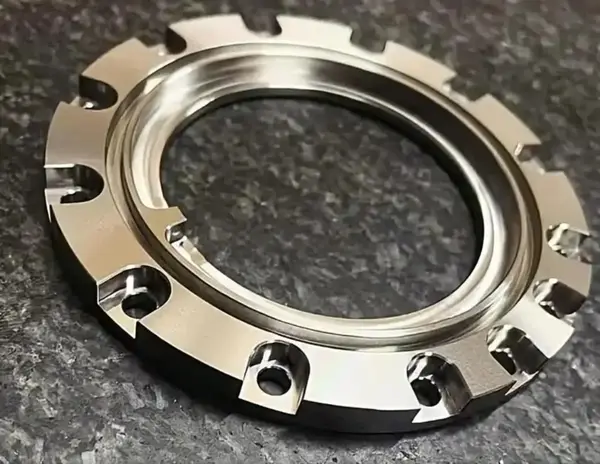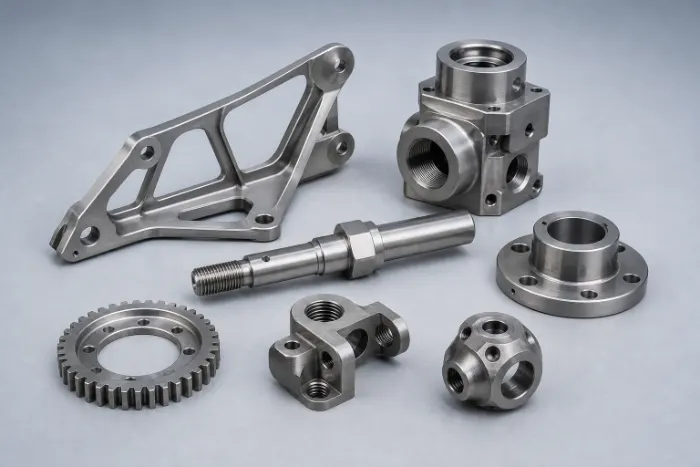
Precision CNC-machined titanium pipe component
Complex Titanium Components

Custom Titanium CNC Machining Services

Weldo machines complex titanium alloy parts for aerospace, medical, automotive and 3C applications, with coordinated process planning and surface treatment support.

Published Dimensional Tolerance±0.005–±0.02 mm
Lunghezza massima di lavorazione5 m
Diametro minimo di lavorazione0,5 mm
Published Mirror FinishRa < 0.4 μm
Request a Titanium Parts Quote
Selezione del materiale

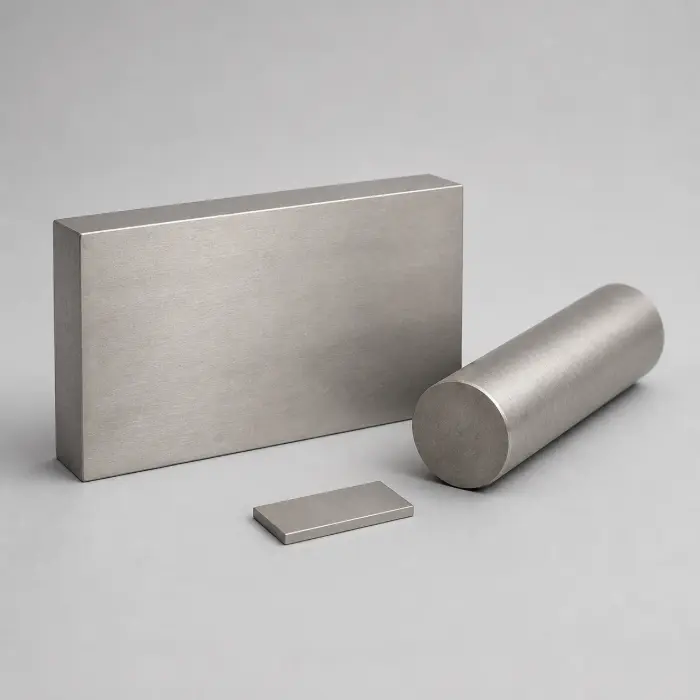
Titanium Alloy Families for CNC Machining

Titanium machining requires controlled tooling, toolpaths, cutting parameters and cooling because of the material’s strength, low thermal conductivity and chemical reactivity.

α

Alpha Titanium

Heat and Oxidation Resistance

Stable for long-term operation around 500°C, with strong oxidation resistance. Used in high-temperature aerospace and corrosion-resistant chemical equipment.

β

Beta Titanium

Cold Formability

Offers good cold-deformation plasticity and can be heat-treated for strengthening, but has poorer thermal stability below 300°C.

αβ

Alpha + Beta Titanium

Prestazioni equilibrate

Balances strength, plasticity and toughness for aero-engine blades and orthopedic implants, including TC4.

Titanium CNC machining capacity example
Published Process Capability

Titanium Machining Capacity

The original page lists the following dimensional, surface and delivery capabilities. Final requirements should be confirmed against the drawing.

Maximum Length5 m
Diametro minimo0,5 mm
Tolleranza dimensionale±0.005–±0.02 mm
Flatness / Roundness≤0.01 mm
Position / Perpendicularity≤0.008 mm
Mirror FinishRa < 0.4 μm
General FinishRa 0,8–1,6 μm
Published Delivery1-3 giorni
Send a Drawing for Capability Review
Prestazioni e utilizzo

Titanium CNC Machining Advantages

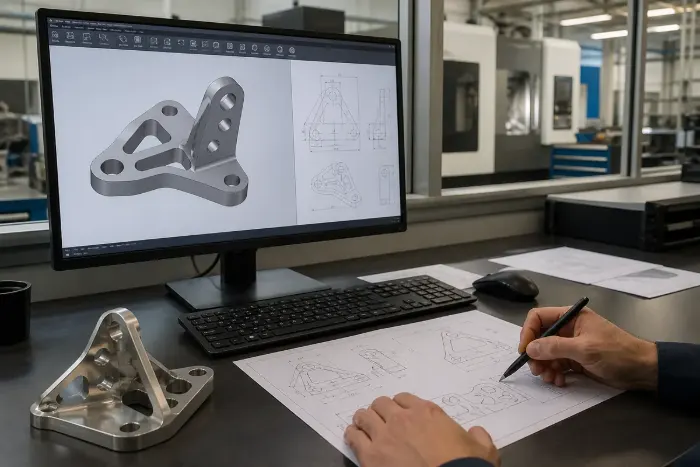
CNC machining supports precision titanium components, complex geometry and controlled surface quality while reducing setup-related error.

CNC-machined titanium parts

Controlled Precision

Supports demanding aerospace and medical dimensional requirements.

Complex 5-Axis Geometry

Fewer setups help reduce accumulated positioning error.

Qualità della superficie

Published mirror finish reaches Ra < 0.4 μm.

Material Utilization

MIM or 3D-printed preforms can be followed by CNC finishing.

Applicazioni comuni
Aerospace Blades & StructuresMedical Joints & Dental ImplantsAutomotive Engines & Exhausts3C Frames & Casings
Surface Protection and Appearance

Surface Finishes for Titanium Parts

The original list of ten processes is consolidated into four practical groups for easier comparison.

Scopri le finiture superficiali
As-machined surface finish

Finitura lavorata a macchina

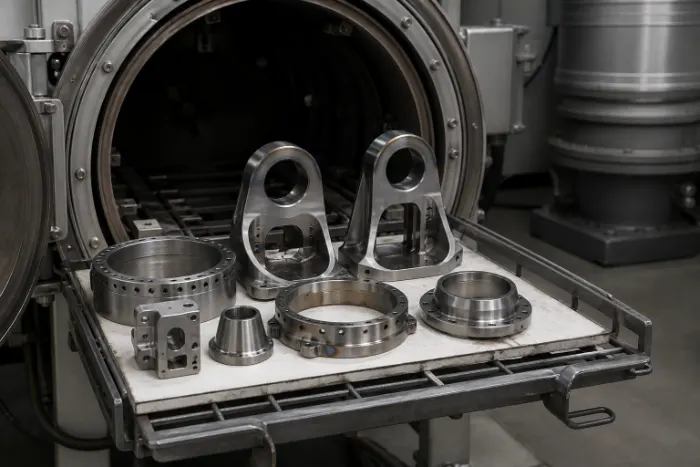
Come lavorati, polished and brushed surfaces control texture, smoothness and appearance.

Anodized machined part

Conversion and Anodizing

Anodizing and Alodio support corrosion protection, adhesion and selected color requirements.

Sand blasted surface finish

Abrasive Texture

Sand blasting creates a clean, rough and matte surface using high-pressure abrasive media.

Powder coated machined part

Protective Treatments

Powder coating, galvanotecnica, black oxide and heat treatment address functional targets.

Machining Strategy

How Titanium Machining Is Controlled

Titanium concentrates heat at the cutting zone and can accelerate tool wear. Stable results depend on coordinated tooling, cooling, toolpaths and workholding.

01

Selezione dello strumento

Carbide tools such as YG6 or YG8 are prioritized; TiCN or TiAlN coatings help reduce sticking and oxidation.

02

Controllo termico

High-pressure or internal coolant directs fluid to the cutting zone to remove heat and chips.

03

Stable Toolpaths

Five-axis programming and optimized cutting paths reduce setups, trial cuts and accumulated error.

04

Deformation Control

Balanced clamping plus roughing, semi-finishing and finishing stages release stress before final dimensions.

Cutting speed, feed, depth, coolant pressure and cryogenic methods must be confirmed for the alloy, feature geometry, tool and machine—not treated as universal settings.

Titanium Machining FAQ

Domande frequenti

The original technical answers are shortened for faster reading while retaining their key guidance.

Why is titanium difficult to CNC machine?

Low thermal conductivity concentrates heat, chemical reactivity promotes tool sticking, and low elastic modulus can contribute to deflection and work hardening.

Which tool materials are suitable?

Carbide tools such as YG6 or YG8 are commonly prioritized. Ceramic tools suit selected volume work; TiCN or TiAlN coatings help limit sticking and oxidation.

How is machining temperature controlled?

Direct high-pressure coolant or internal-coolant tooling removes heat and chips. Cryogenic cutting may be considered for suitable processes.

How can titanium machining efficiency be improved?

Coordinate cutting parameters, indexable tooling, wear monitoring, automation and five-axis CAM toolpaths to reduce interruptions and trial cuts.

How is titanium part deformation reduced?

Use distributed clamping force, controlled cutting loads and a roughing–semi-finishing–finishing sequence so stress is released before final sizing.

Start Your Titanium Project

Send Your Titanium Part Drawing for Review

Upload the drawing, titanium grade, quantity, tolerance and surface requirement. Weldo can review manufacturability before quoting.

Carica il disegno per ricevere un preventivo

È sufficiente un file di progetto per iniziare la revisione.