
스위스 CNC 가공 서비스
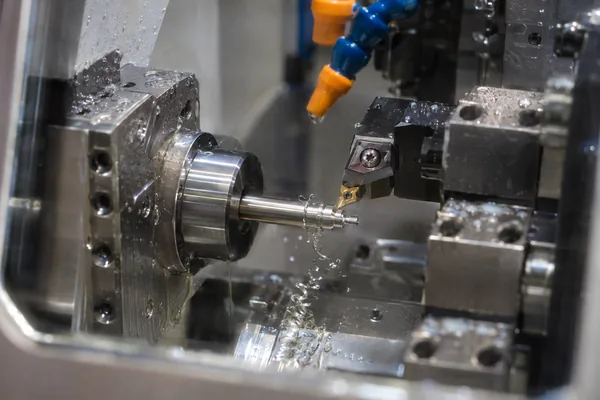
Precision Swiss CNC 가공 for small-diameter and slender parts. Guide-bushing support and integrated turning, milling, drilling, and backworking help control deflection and feature alignment from prototype to repeat production.
- Guide-Bushing Support
- Turn-Mill Operations
- First-Article Inspection
Support Close to the Cutting Point
In guide-bushing mode, Swiss lathe machining uses a sliding headstock to feed bar stock through a support beside the tool. A short unsupported length helps stabilize slender features.
Reduced Deflection
Close support helps limit bending, chatter, taper, and diameter variation on slender sections.
통합 기능
Turned diameters, flats, slots, cross holes, and threads can share a coordinated machining route.
Rear-Side Completion
Sub-spindle transfer allows rear faces, bores, and chamfers to be finished before release.
반복 가능한 생산
Automatic bar feeding, tool-life control, and a stable cycle support consistent repeat orders.
Precision Parts Made from Bar Stock
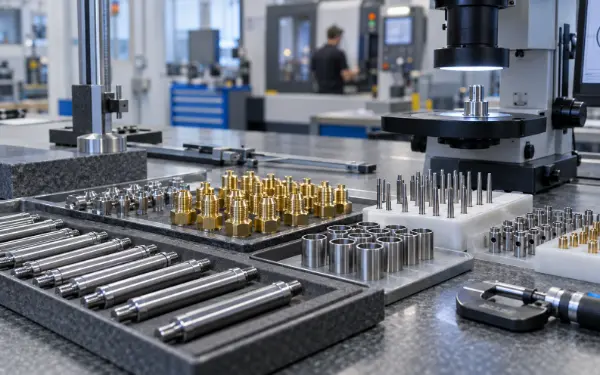
Swiss machining is well suited to rotational parts with slender sections, repeated features, or close relationships between turned and milled details.
정밀 샤프트 및 핀
Dowel pins, valve stems, probe shafts, and actuator pins with controlled diameters, straightness, runout, and tip geometry.
부싱 및 슬리브
Thin or close-fitting cylindrical parts requiring wall-thickness control, coaxial bores, and defined end-face relationships.
부속품 및 커넥터
Ports, sealing grooves, flats, cross holes, and threads completed with fewer datum changes and less secondary handling.
의료 및 기기 부품
Micro Swiss machining serves miniature guides, threaded hardware, and instrument components, with material traceability, burr control, and inspection matched to feature size.
Swiss Machining Capability References
Use these figures for initial quotation review. The approved drawing, material, bar condition, and measurement plan define the accepted requirements.
| 특징 | Reference | Review Requirement |
|---|---|---|
| Starting diameter | 약 Ø1 mm | Material, supported length, workholding, and inspection access. |
| 일반 공차 | 일반적으로 ±0.01 mm | Confirmed by feature geometry, process capability, and drawing review. |
| 주요 기능 | ±0.005 mm까지 | Requires engineering approval, thermal control, and a matched measurement method. |
| Deep-hole design guidance | Prefer ≤5 × D | Greater depths, including up to 10 × D, need dedicated tooling, coolant, and chip-evacuation review. |
These references are not universal limits or guaranteed tolerances. D = hole diameter.
When Swiss Machining Fits
Small diameters, high length-to-diameter ratios, close runout relationships, multiple turned and milled features, and repeat quantities.
When Conventional Turning Fits
Short, rigid, larger-diameter parts or simple one-off geometries may be more economical with conventional CNC turning .
소재 및 마감 옵션
Material grade, chip formation, thermal behavior, and stability influence small-diameter machining. Finishing allowances are included before the first cut.
스테인리스강
Corrosion resistance, strength, and clean surfaces for precision hardware and fluid-handling parts.
View material details
- 일반적인 부품
- Valve stems, fittings, sleeves, fasteners, and sensor hardware.
- 가공 중점
- Grade-specific control of work hardening, chip breaking, cutting heat, and tool life.
- Finish & inspection
- Passivation, electropolishing, or polishing where specified; check diameters, threads, burrs, and cleanliness.
Carbon & Alloy Steel
Strength and heat-treatment flexibility for loaded, wear-resistant, and transmission components.
View material details
- 일반적인 부품
- Pins, shafts, bushings, drive components, and high-strength fasteners.
- 가공 중점
- Control tool wear and stock allowance for grade-specific heat treatment and final sizing.
- Finish & inspection
- Compatible hardening, carburizing, black oxide, or plating; confirm size, hardness, case requirements, and coating thickness.
알루미늄 합금
Low mass and good machinability for lightweight fittings, sensor parts, and instrument hardware.
View material details
- 일반적인 부품
- Connectors, lightweight housings, fittings, and precision instrument components.
- 가공 중점
- Sharp tools, built-up-edge control, chip clearance, and low-distortion thin-wall workholding.
- Finish & inspection
- Anodizing, hard anodizing, conversion coating, or plating as appropriate; account for coating buildup and cosmetic zones.
황동 및 구리
Electrical conductivity, corrosion resistance, and grade-dependent machinability for contacts and fittings.
View material details
- 일반적인 부품
- Contacts, terminals, nozzles, threaded adapters, and valve components.
- 가공 중점
- Match grade to conductivity, strength, lead-content requirements, edge quality, and chip behavior.
- Finish & inspection
- Nickel, tin, silver, or specified functional plating; inspect threads, coating coverage, and mating dimensions.
티타늄
Corrosion resistance and high specific strength for demanding medical and aerospace hardware.
View material details
- 일반적인 부품
- Precision pins, sleeves, medical equipment hardware, and aerospace fittings.
- 가공 중점
- Stable engagement, suitable tool geometry, coolant access, and disciplined tool-life control.
- Finish & inspection
- Controlled cleaning, polishing, or specified surface treatments; inspect surface integrity, small features, and required records.
POM / 아세탈
Wear resistance and machinability for close-fitting mechanical and electrical-insulation components.
View material details
- 일반적인 부품
- 부싱, 롤러, 가이드, 스페이서 및 절연 샤프트.
- 가공 중점
- Sharp tools, low cutting heat, and supported workholding with controlled clamping force.
- Finish & inspection
- Precision deburring and cleaning; check dimensions after fixture release and temperature stabilization.
PEEK
Thermal performance and mechanical strength for demanding industrial and instrument assemblies.
View material details
- 일반적인 부품
- Insulators, valve parts, precision sleeves, and medical-equipment components.
- 가공 중점
- Material conditioning, sharp tooling, balanced stock removal, and residual-stress control.
- Finish & inspection
- Controlled deburring, cleaning, and annealing when specified; verify dimensions after thermal and stress stabilization.
PTFE
Low-friction sealing and insulation performance, with deformation and creep considered in the design.
View material details
- 일반적인 부품
- Seals, valve seats, insulating sleeves, and spacers.
- 가공 중점
- Supported cutting, sharp edges, light clamping, and careful handling of flexible sections.
- Finish & inspection
- Gentle deburring and cleaning; inspect in the free state under controlled temperature.
PA / 나일론
Durable sliding and guiding components with fits adjusted to the specified moisture condition.
View material details
- 일반적인 부품
- Rollers, sleeves, guide elements, and wear-resistant bushings.
- 가공 중점
- Control cutting heat and moisture-related dimensional change; define the conditioning state.
- Finish & inspection
- Controlled deburring and cleaning; measure after agreed temperature and moisture conditioning.
PMMA / 아크릴
Optical clarity for transparent cylindrical parts requiring careful edge and surface handling.
View material details
- 일반적인 부품
- Transparent sleeves, optical supports, and instrument components.
- 가공 중점
- Limit cutting heat, scratching, and residual stress; use suitable tools and compatible cleaning agents.
- Finish & inspection
- Specified edge finishing or polishing; inspect critical dimensions, clarity, cracks, and surface defects.
Specify material grade, supplied condition, coating thickness, masked surfaces, and post-treatment dimensions. Finishing and inspection methods are confirmed for the selected material.
Design for Stable Swiss Machining
Connect functional tolerances to bar quality, tool access, workholding, and a measurement method that can verify the finished feature.
Slender Geometry
Review bar straightness, roundness, guide-bushing clearance, and unsupported length to control taper and runout.
얇은 벽
Balance cutting order, tool sharpness, and sub-spindle grip force to reduce collapse and springback.
Small & Deep Holes
Confirm depth-to-diameter ratio, coolant delivery, chip removal, and inspection access before accepting tolerances.
Cross-Hole Burrs
Define breakthrough edges, deburring access, and measurable burr limits appropriate to the part's function.
Threads & Runout
State thread standard, class, relief, engagement, and gauge method alongside the assembly datum.
용량 할당
Reserve tight tolerances for fits, sealing diameters, and locating features; use practical limits elsewhere.
Deep holes, thin walls, complex driven-tool work, special bar stock, tight geometry, heat treatment, and difficult internal deburring.
Quality from First Article to Final Release
In high volume Swiss machining, first-article approval establishes the process, while tool-life monitoring and in-process checks help maintain critical dimensions across the batch.
리뷰
Function, datums, material, and quantity.
계획
Machine mode, tooling, and control plan.
준비하기
Bar stock, guide bushing, and offsets.
첫 번째 기사
Measure agreed critical features.
생산
Monitor tool life and dimensional trends.
보도자료
Final checks, cleaning, and packing.
검사 범위
- 재질 등급 및 봉재 형태
- OD, ID, and shoulder locations
- 원형도 및 동축도
- Hole size and position
- 나사산 게이지 검사
- 표면 거칠기
- Cross-hole burr condition
- Coating and treatment results
Documentation by Agreement
Confirm documentation during quotation so traceability and report requirements are included in the production plan.
Weldo coordinates drawing review, material preparation, machining, deburring, finishing, inspection, and shipment through one manufacturing route.
Swiss Machining Applications
Part geometry, material, surface condition, and inspection requirements are matched to the intended service environment.
의료 장비
Instrument shafts, holders, guides, threaded parts, and precision hardware.
자동차
Valve parts, sensor housings, pins, connectors, bushings, and drive components.
전자제품
Conductive pins, contacts, terminals, miniature housings, and connectors.
유체 제어
Nozzles, valve stems, fittings, adapters, and parts with sealing grooves or internal passages.
산업 자동화
Locating pins, guide shafts, actuator parts, precision spacers, and bushings.
정밀 기기
Adjustment parts, lightweight sleeves, shafts, and miniature fasteners.
스위스 CNC 가공 자주 묻는 질문
How does Swiss machining differ from conventional turning?
In guide-bushing mode, the sliding headstock moves bar stock through a support close to the tool. This limits unsupported length on slender parts. Conventional turning generally holds exposed stock in a chuck or collet and is often economical for short, rigid components.
Is Swiss screw machining limited to screws?
No. The term refers to Swiss-type automatic machining rather than a screw-only process. It is also used for precision shafts, pins, bushings, fittings, and other parts with combined turned and milled features.
Can Swiss machining produce prototypes?
Yes. It is useful when a prototype requires close support, integrated driven-tool features, or validation of a route intended for repeat production. Simple one-off parts are reviewed against conventional turning for cost.
What tolerances can be achieved?
There is no single tolerance for every part. Diameter, length, material, bar quality, thermal stability, and measurement access affect the result. Critical requirements are confirmed through drawing review and first-article inspection.
How are internal cross-hole burrs controlled?
The route considers tool direction, edge-break geometry, tool condition, and deburring access. Internal intersections receive an application-specific method and inspection criteria based on flow, assembly, and mating-part requirements.
What determines cost and production lead time?
Material, bar availability, quantity, setup, cycle complexity, tolerances, deburring, finishing, and documentation all affect the schedule and quote. Shipment timing is confirmed after the technical requirements are agreed.
Can rear-side features be completed in the same cycle?
On a suitable sub-spindle machine, the part is transferred before cutoff for rear-side operations. The final sequence depends on geometry, tool access, clamping surfaces, and inspection needs.