
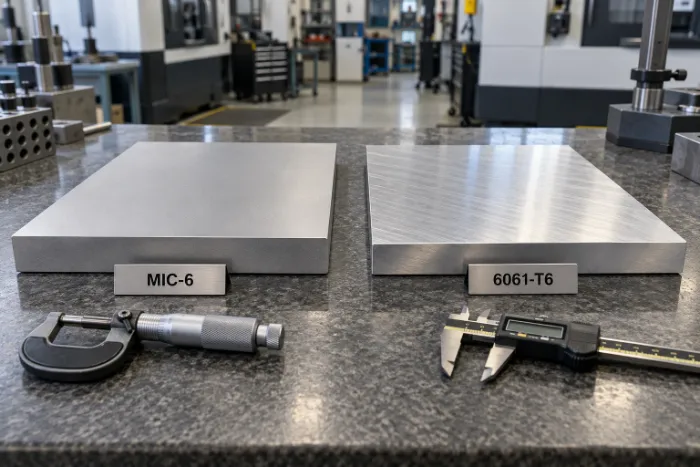
When comparing MIC 6 vs 6061, buyers often ask the same question: MIC 6 generally costs more and may require a longer lead time, so can 6061 be used instead? The answer mainly depends on the flatness and dimensional stability required after machining.
Use these three principles when selecting the material:
- Choose MIC 6 when the part requires a stable, flat reference surface after machining, such as fixtures, base plates and mold blanks.
- Choose 6061 when the part must carry structural loads, requires welding or needs a lower material cost.
- Replace MIC 6 with 6061 only when flatness requirements are moderate and load-bearing capacity or weldability is the primary concern.
This MIC 6 vs 6061 guide uses comparison tables and a decision tree to explain the selection process. Separate articles linked within the text provide more detail on each material’s composition, temper and mechanical properties.
What Is Mic 6?
Mic 6 is a registered trademark for a precision cast aluminum tooling plate (Cast Tooling Plate); it is not an internationally recognized AA grade. Its alloy base is close to the 6061 family, but it is made by casting with stress-relief processing rather than wrought heat treatment. When purchasing, specify flatness, thickness tolerance, and sheet size as a “cast tooling plate”—do not order it as a 6061-T6 temper.
What Is 6061?
6061 is an Al-Mg-Si wrought aluminum alloy and an internationally recognized AA grade. It is heat-treatable, with the T6 temper being the most widely used. It offers moderate strength, good weldability, easy machining, mature anodizing, and low cost, making it the most widely used structural aluminum. It is available as plate, bar, extrusion, and tube.
Core Difference: Casting vs. Wrought
6061 is a wrought aluminum alloy, formed by rolling or extrusion, and is a general-purpose structural aluminum. Mic 6 is a precision casting with stress-relief processing; residual stress through the full thickness is ≤10 MPa and microstructural uniformity is ≥98%. In short, 6061 is strong and versatile, while Mic 6 is stable and will not warp.
Mechanical Property Comparison of Mic 6 vs 6061
| Indicator | 6061 | Mic 6 |
| Tensile strength | 124–310 MPa | ≈159 MPa |
| Yield strength | 55–276 MPa | ≈145 MPa |
| Hardness (Brinell) | 30–95 HB | ≈65 HB |
| Elongation | 12–30% | ≈8–10% |
| Shear strength | 83–207 MPa | ≈110 MPa |
| Modulus of elasticity | ≈69 GPa | ≈69 GPa |
| Poisson’s ratio | ≈0.33 | ≈0.33 |
6061’s strength varies with temper; the T6 temper is the top of the range (tensile ≈310 MPa), about 2× that of Mic 6, and this gap determines which material a load-bearing part uses. 6061-T6 can carry structural loads, while Mic 6’s 159 MPa tensile strength only suits light-duty and non-load-bearing locating parts. In terms of elongation, 6061 has better toughness than Mic 6, with stronger formability and impact resistance. The hardness difference makes 6061’s surface more wear-resistant, whereas Mic 6 relies on flatness rather than hardness for frequently clamped reference surfaces. Modulus of elasticity and Poisson’s ratio are identical for both, showing that the two materials have the same stiffness and deformation behavior; the difference lies in strength and toughness, not rigidity.
Physical Property Comparison of Mic 6 vs 6061
| Indicator | 6061 | Mic 6 |
| Thermal conductivity | ≈167 W/(m·K) | Close, slightly lower due to cast structure |
| Electrical conductivity | 40–47% IACS | Close |
| Magnetism | Non-magnetic | Non-magnetic |
| Coefficient of thermal expansion | ≈23.6 μm/(m·°C) | 21.4 μm/(m·°C) |
| Density | ≈2.70 g/cm³ | ≈2.70 g/cm³ |
| Specific heat capacity | ≈900 J/(kg·K) | Close |
Both are aluminum: thermal conductivity, electrical conductivity, density, and specific heat are close, so heat-dissipation, electrical, and lightweighting applications do not distinguish between them. Being non-magnetic is common to aluminum, so the two are equivalent in electromagnetic-compatibility and non-magnetic environments. Mic 6 has a lower coefficient of thermal expansion (21.4 vs 23.6), so it drifts less in size under large temperature swings—one of the physical reasons it suits precision reference surfaces. All other physical dimensions match, showing the two overlap heavily in physical behavior, with thermal expansion the only stable difference.
Pros and Cons of mic 6 vs 6061 aluminum
6061 pros: high strength, weldable, low cost, wide use, mature anodizing.
6061 cons: warps after machining of large-area or thin-wall parts, hard to achieve an ultra-flat reference surface.
Mic 6 pros: extremely high flatness, no deformation after machining, dimensionally stable, consistent.
Mic 6 cons: about half the strength, not suited to welded structures, clearly premium-priced, long lead time.
CNC Machining Performance and Challenges
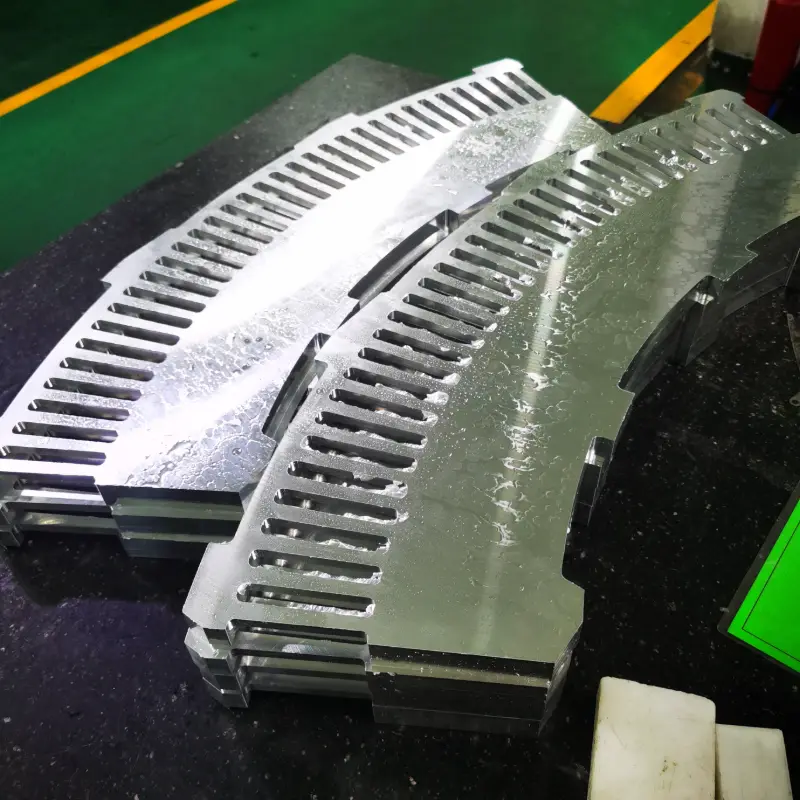
6061 cuts easily with low tool wear, chips break and clear well, and it supports high-speed milling. The challenge: residual stress is released after heavy material removal on large areas, so thin-wall or large flat parts warp and need secondary straightening, and finish-machining large flats requires an added stress-relief step.
Mic 6 has near-zero stress, does not deform after heavy cutting, has a low work-hardening rate (n≈0.02), and holds consistent dimensions. The challenge: microstructural unevenness in the cast structure affects surface consistency, and since the plate is already near-net, the focus is preserving flatness rather than removing large amounts of material. For fixtures that are clamped repeatedly, Mic 6’s consistency reduces tool-setting and setup time.
If you fear deformation, choose Mic 6; for ordinary structural parts, choose 6061.
Welding Performance and Property Comparison
6061 has excellent weldability and is among the best-welding structural aluminum grades. Both TIG and MIG welding produce sound welds; strength drops in the weld and heat-affected zone, and post-weld re-heat-treatment can restore it, though this is impractical for large welded assemblies. After welding, 6061 retains good corrosion resistance and structural integrity, making it suitable for batch-welded frames, brackets, and hull structures.
Mic 6 should not be welded. The high heat of welding re-introduces stress, causing the weld zone and surrounding area to warp and destroying the reference surface; the cast structure also makes welds prone to porosity and cracking, with low weld strength. Mic 6 is a non-welded precision tooling plate; structures that need welding should use 6061.
Choose 6061 for weldable structures; choose Mic 6 for precision reference surfaces, and Mic 6 is not used for welding.
Surface Treatment Options
1. Anodizing
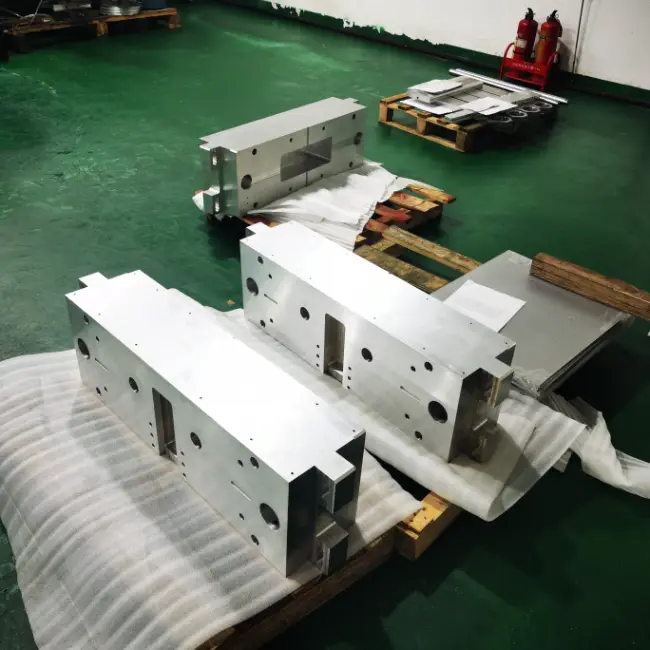
An oxide film is grown on the aluminum surface. 6061 anodizes well, with mature clear and colored processes, and the film is wear- and corrosion-resistant. Mic 6 can be anodized, but the cast structure causes uneven film color, so it is not suited to appearance parts.
2. Powder Coating
Applied electrostatically and cured at high temperature; the coating is uniform, strongly adhered, and weather-resistant. It suits both 6061 and Mic 6, is insensitive to substrate structure, and is the first-choice appearance solution for hiding cast color variation.
3. Liquid Painting
Applied with solvent-based or waterborne paint; it suits complex shapes and small batches, with flexible color choices. It suits both materials; Mic 6 with painting fully avoids the anodizing color-variation problem.
4. Electroplating
Deposits metals such as nickel or chromium on the surface to raise hardness, wear resistance, and decorative appeal. 6061 electroplating is a mature process; Mic 6, being cast, requires strict pre-treatment and is rarely used for decorative surfaces.
5. Chemical Conversion Coating / Passivation
A thin protective film is formed by chromate-free or chromate passivation, serving as a paint base or for short-term rust prevention. It suits both materials and is a standard pre-treatment step before painting.
6. Electrophoretic Coating (E-coat)
Paint is deposited electrophoretically; film thickness is uniform, internal cavities are well covered, and corrosion resistance is strong. It suits both 6061 and Mic 6 and is ideal for structural parts needing high corrosion protection.
Choose 6061 for appearance and colored anodizing; choose Mic 6 for reference-surface stability; hide Mic 6’s cast color variation with powder or liquid painting.
Heat Treatment Feasibility Comparison
6061 is a heat-treatable Al-Mg-Si alloy. 6061-T6 is produced by solution heat treatment plus artificial aging, and T4, T651, and other tempers are also available. Strength drops in the weld heat-affected zone, and restoring it requires re-heat-treatment, a process that does not apply to large welded assemblies.
Mic 6 leaves the factory in a stress-relieved, stabilized condition and receives no further strengthening heat treatment. Heating it again re-introduces stress and warps the plate, destroying flatness. Mic 6 cannot be strengthened by heat treatment.
6061 gains strength through heat treatment, while Mic 6 relies on stabilization to ensure flatness; the two process routes are mutually exclusive.
Application Areas and Typical Parts
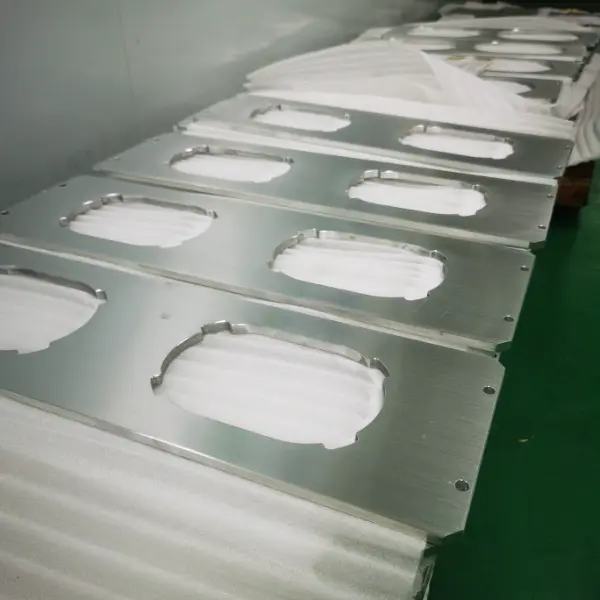
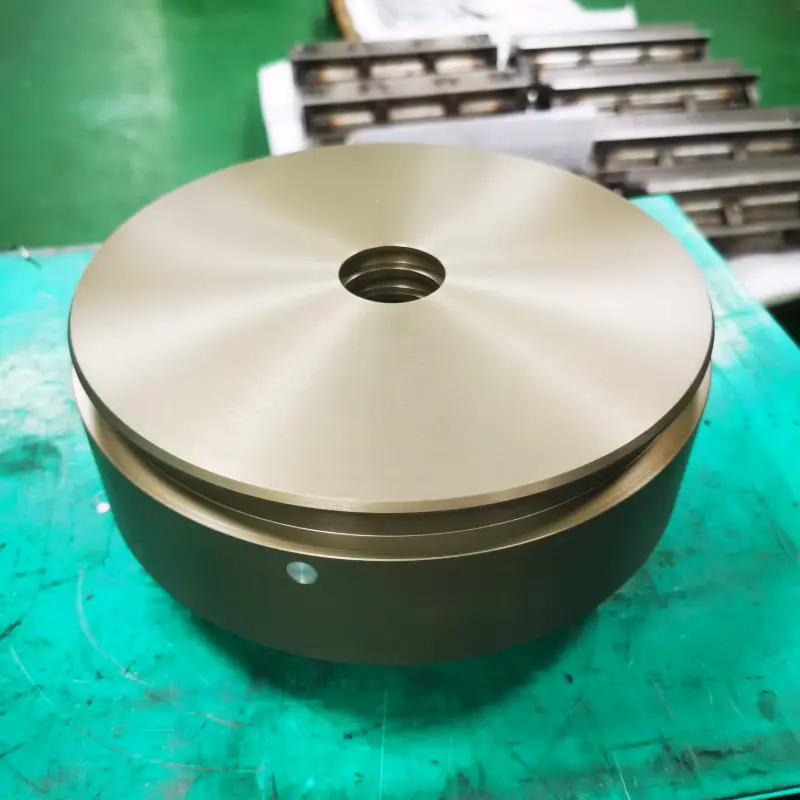
Mic 6 is used for fixtures, jigs, CNC base plates, mold blanks, vacuum-chuck tables, inspection plates, and precision frames for semiconductor and medical equipment. What these parts share is reliance on flatness and repeatable clamping accuracy rather than load-bearing.
6061 is used for structural frames, brackets, automotive and marine parts, architectural extrusions, general machined parts, and welded assemblies. These parts rely on strength, weldability, or low cost.
Choose Mic 6 for base-plate-type parts; choose 6061 for load-bearing and welded parts.
Cost Comparison: Procurement Cost vs. Processing Cost
Material procurement cost: Mic 6 is a premium specialty plate, priced higher than ordinary 6061 rolled plate, and is mostly imported with longer lead times.
Processing cost: for 6061, rework, scrap, and repeated clamping caused by warping can offset the material price gap; Mic 6 is more expensive as material but is completed in a single clamping with low scrap. For parts with high flatness requirements, on a total-cost basis, Mic 6’s overall cost is no higher than 6061’s, and in some scenarios it is lower.
Equivalents and Substitutes
Mic 6: as a proprietary product, equivalent substitutes include K-100, Alca 5, and domestic cast aluminum tooling plates. Before substituting, verify three indicators: residual-stress level, flatness and parallelism tolerance, and thickness tolerance and sheet size. All three must be met, or the precision reference-surface performance cannot be guaranteed.
6061: an internationally recognized grade, directly matched across national standards:
- China GB 6061 (formerly LD30)
- ISO / EN AW-6061: AlMg1SiCu
- Japan JIS A6061
Grades with comparable performance that can substitute:
- 6082 (AlSi1MgMn): common for structural parts, strength close to 6061, the mainstream substitute for European standard parts
- 6063 (AlMg0.7Si): common for extruded profiles, slightly lower strength, better extrudability
When substituting, match on target performance (strength, weldability, extrudability) and confirm the standard grade and supply temper for the purchasing region.
Selection Decision Tree
Fear of warping, need for flatness, need for repeatable clamping → choose Mic 6.
Need for load-bearing, welding, or controlling procurement cost → choose 6061.
Low flatness requirement and mainly load- or weld-driven → 6061 can replace Mic 6.
The essence of the decision is to judge whether the part’s constraint is “stability” or “strength/cost”.
If the constraint is stability, Mic 6 cannot be replaced; if the constraint is strength or cost and flatness is not critical, 6061 wins.
FAQ
Do Mic 6 and 6061 have the same strength?
No. 6061-T6 is about 2× the strength of Mic 6 (310 vs 159 MPa). Mic 6’s premium comes from dimensional stability, not strength.
What exactly is Mic 6, and is it 6061?
No. Mic 6 is the trade name for a cast aluminum tooling plate, not an AA standard grade; its composition is close to the 6061 family, but it uses a casting plus stress-relief process and must not be ordered as a 6061 temper.
Which should I use for my custom part, and can 6061 replace it?
If you need dimensional stability and fear machining warpage → Mic 6; if you need load-bearing, welding, or cost control → 6061. Only when flatness requirements are low can 6061 replace Mic 6.
How much more expensive is Mic 6 than 6061, and is there a domestic substitute?
Mic 6 is a premium specialty plate, priced higher than 6061 rolled plate with longer lead times. Equivalents include K-100, Alca 5, and domestic cast tooling plates. Before substituting, verify residual stress, flatness, and thickness tolerance.
Can both be heat treated?
6061 can be heat treated (T6 and other tempers). Mic 6 leaves the factory already stabilized and must not be heat treated again, or it will warp and destroy flatness.
Why Choose Weldo Machining for Custom Mic 6 and 6061 Parts
Transparent pricing: itemized by material, machining hours, and finishing, so the cost structure of Mic 6 and 6061 is clear, with no hidden fees.
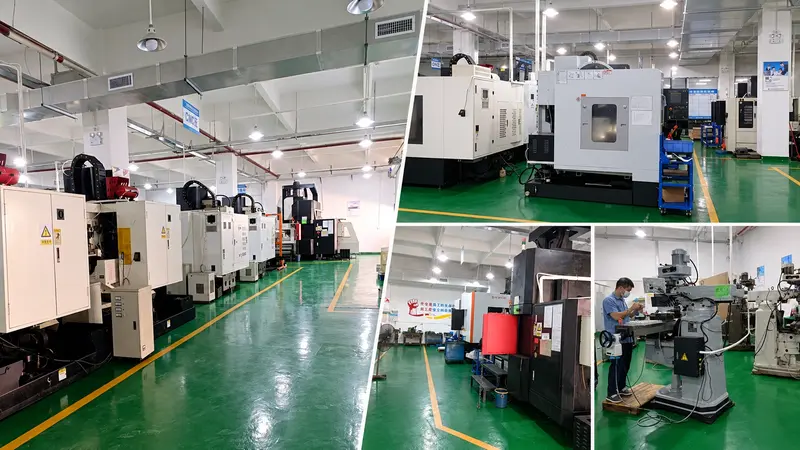
One-stop service: from material-selection advice, CNC machining, and surface finishing to inspection and shipping, all completed on a single production line, with no need to coordinate multiple vendors.
On-time delivery rate: volume orders maintain an on-time delivery rate above 98%, with lead times written into and locked by contract.
Selection engineering support: engineers determine Mic 6 or 6061 based on operating conditions and issue a substitution feasibility assessment to avoid rework from the wrong material.
Flatness assurance: each Mic 6 part is inspected for flatness and thickness tolerance before delivery, with an inspection report provided.
Conclusion
The divide between Mic 6 and 6061 is not “which is better,” but what constrains your part.
If it must stay dimensionally stable with a flat reference surface after machining, choose Mic 6;
if it must carry load, be welded, and stay low-cost, choose 6061.
When stability is the constraint, Mic 6 cannot be replaced;
when strength or cost is the constraint and flatness is not critical, 6061 will do.
To settle the grade, judge by the part’s flatness requirement and its load/welding needs against the decision tree above.