
ABS and POM are both common engineering plastics used in CNC machining.
They are lightweight, corrosion-resistant, and can be turned, milled, and drilled into complex parts.
However, the two materials are designed around different performance priorities.
ABS emphasizes impact resistance, finishing options, and manufacturing cost. POM focuses on rigidity, wear resistance, and dimensional stability.
These differences directly affect machining methods and part applications.
Electronic housings, functional prototypes, gears, and bushings have completely different material requirements.
Choosing the wrong material can lead to deformation, burrs, wear, or insufficient assembly accuracy. It can also increase rework and replacement costs later.
Therefore, an ABS vs POM comparison cannot be based on material price alone.
Part geometry, tolerances, loads, friction, and operating conditions must all be considered.
This article compares their material properties, CNC machining performance, applications, and costs to help you select the right engineering plastic for your project.
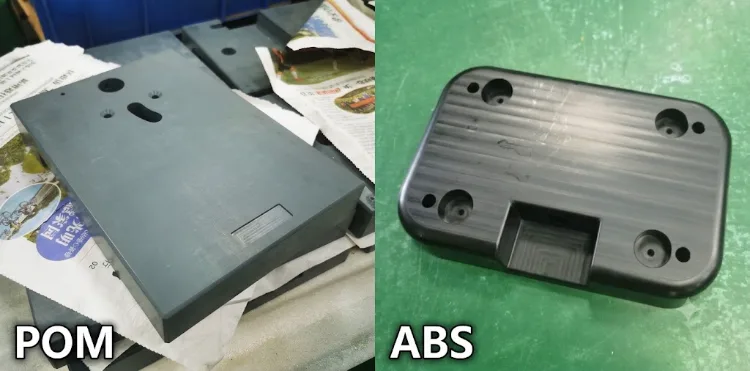
What Is ABS?
Material Composition
ABS stands for acrylonitrile-butadiene-styrene copolymer.
It is an amorphous thermoplastic whose three components work together to provide a balanced set of properties.
Acrylonitrile improves rigidity and chemical stability. Butadiene adds toughness and impact resistance, while styrene improves machinability and surface quality.
This combination gives ABS a good balance of strength, toughness, and cost.
CNC Machining Performance
ABS does not have a clearly defined melting point like crystalline materials.
It gradually softens when heated, so tool temperature and localized heat buildup must be controlled during machining.
ABS has low cutting resistance. Sharp tools can be used for milling, turning, drilling, and machining complex contours.
Excessive machining heat can cause burrs, softened edges, and surface deformation. Clamping pressure must also be controlled when machining thin-walled parts.
Suitable Parts
ABS supports sanding, painting, bonding, electroplating, and other finishing processes. It is suitable for electronic housings, automotive interior parts, equipment panels, and functional prototypes.
Its material cost is also lower than that of POM. Therefore, ABS is suitable for appearance parts, assembly test parts, and cost-sensitive CNC projects.
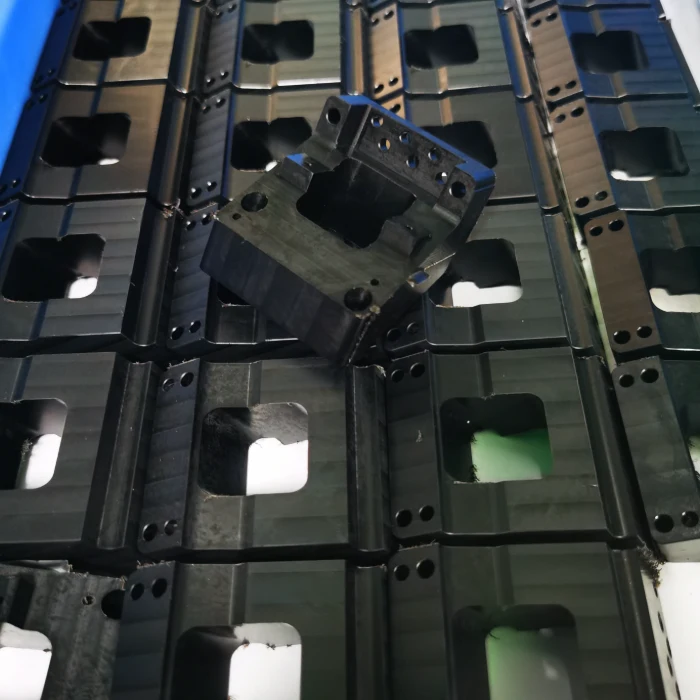
What Is POM?
Material Structure
POM stands for polyoxymethylene and is also known as acetal or polyacetal.
It is a highly crystalline engineering plastic made of repeating −CH₂O− structural units.
POM offers relatively high strength, rigidity, and surface hardness. It can maintain a stable shape under continuous loads.
POM is divided into homopolymer POM-H and copolymer POM-C. POM-H provides greater rigidity and strength, while POM-C offers better thermal stability and processing adaptability.
CNC Machining Performance
POM produces consistent chips and a smooth machined surface. It is suitable for turning, milling, drilling, and precision contour machining.
However, POM exhibits springback and has a relatively high coefficient of thermal expansion.
When machining thin walls, deep holes, and tight-tolerance parts, clamping, cutting heat, and machining sequence must be controlled.
Suitable Parts
POM has a low coefficient of friction and good self-lubricating properties. Under light loads or with limited lubrication, it can reduce sliding wear.
Its low moisture absorption also helps maintain assembly clearances and accuracy during repeated movement.
Therefore, POM is widely used for gears, bearings, bushings, sliders, rollers, and pump components.
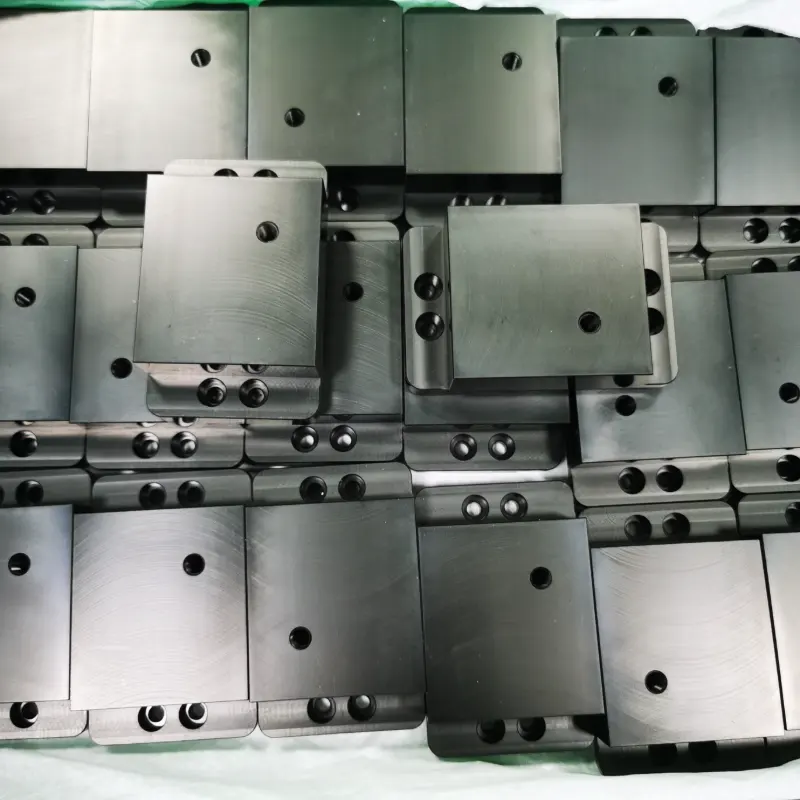
ABS vs POM Quick Comparison
Both ABS and POM are suitable for CNC machining, but they solve different problems.
ABS is better suited to housings, prototypes, and parts that require surface finishing. POM is better suited to gears, bushings, and mechanical parts that move continuously.
| Comparison Item | ABS | POM |
|---|---|---|
| Material structure | Amorphous | Highly crystalline |
| Impact resistance | Higher | Good |
| Rigidity | Moderate | Higher |
| Coefficient of friction | Higher | Lower |
| Wear resistance | Moderate | Higher |
| Dimensional stability | Good | Better |
| CNC machinability | Good | Excellent |
| Painting and bonding | Easy | Difficult |
| Typical parts | Housings, panels, prototypes | Gears, bushings, sliders |
| Material cost | Lower | Higher |
This table provides an initial comparison. Final material selection must also consider tolerances, wall thickness, loads, temperature, and the way the part moves.
Key Differences Between ABS and POM in CNC Machining
1. Strength and Rigidity
Strength determines how much load a part can carry. Rigidity determines how easily the material bends or deforms under load.
ABS: Better Impact Resistance
ABS can absorb energy from impacts and vibration without fracturing suddenly.
This makes it suitable for equipment housings, protective covers, control panels, and assembly prototypes.
These parts place greater emphasis on drop protection and structural toughness.
However, ABS is less rigid than POM. Parts subjected to long-term pressure are more likely to bend or experience dimensional changes.
POM: Greater Rigidity and Resistance to Deformation
POM offers greater rigidity and surface hardness. It can maintain its shape more consistently under continuous loads.
Therefore, POM is better suited to gears, rollers, bushings, valve bodies, and mechanical connectors.
The high rigidity of POM does not make it suitable for every impact environment. Sharp corners, deep grooves, and abrupt section changes can still create stress concentrations.
Material Selection Conclusion
ABS is better at absorbing impact, while POM is better at resisting deformation.
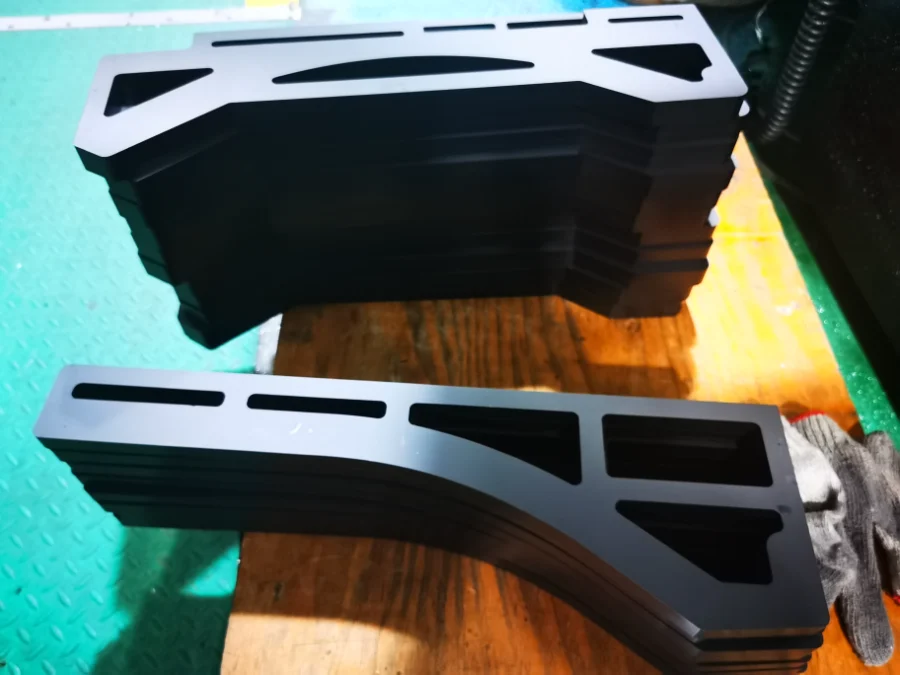
2. CNC Machinability
Machinability determines whether a material can be efficiently milled, turned, drilled, and finish-machined.
ABS: Easy to Cut but Sensitive to Heat
ABS has low cutting resistance, and sharp tools can be used to machine contours, holes, and internal features.
However, ABS is sensitive to machining heat. If the tool remains in one area for too long or the cutting parameters are unsuitable, the material can soften, stick to the tool, and form burrs.
Thin-walled ABS parts should be held with low clamping pressure. Large flat panels also need uniform support to prevent vibration and warping.
POM: Consistent Chips and Better Surface Quality
POM produces clean chips and a smooth machined surface.
It is suitable for precision holes, sleeves, gear teeth, and complex mechanical contours. Its machined edges are also cleaner than those of ABS.
However, POM has noticeable springback. When drilling, slotting, or machining tight-tolerance dimensions, dimensional recovery after the tool moves away must be considered.
Material Selection Conclusion
POM makes it easier to achieve consistent surfaces and repeatable dimensions. ABS is better suited to simpler parts where appearance and cost are the main priorities.
3. Dimensional Stability and Tolerances
Dimensional stability determines whether a part can maintain its design dimensions during machining, assembly, and service.
ABS: Machining Heat and Internal Stress Affect Dimensions
ABS can meet the standard tolerance requirements of housings, panels, brackets, and functional prototypes.
As the machining area heats up, the material expands and then contracts as it cools.
Sheets and rods may also retain manufacturing stresses. Removing a large amount of material from one side can redistribute these stresses and cause flat surfaces to warp.
Material should be removed evenly when machining thin-walled ABS parts. After rough machining, the part should cool completely before finish machining and inspection.
POM: Less Affected by Humidity but Still Subject to Thermal Expansion
POM has low moisture absorption. Environmental humidity has less effect on its dimensions than on many engineering plastics.
It also offers good rigidity and creep resistance, making it suitable for precision holes, sleeves, and components that move repeatedly.
However, POM has a higher coefficient of thermal expansion than metal. Temperature changes directly affect tight-tolerance dimensions.
Parts requiring extensive material removal should be machined symmetrically and in stages to reduce dimensional springback.
Material Selection Conclusion
Choose ABS for standard housings and assembly prototypes. Give priority to POM for shaft-and-hole fits and parts that move repeatedly.
Neither material should use metal-part tolerances without adjustment.
4. Friction and Wear Resistance
Friction and wear resistance directly affect the service life of gears, bearings, sliders, and guide rails.
ABS: Suitable for Static and Infrequently Moving Parts
ABS can perform structural functions in housings, brackets, and protective components.
However, it has a higher coefficient of friction than POM. Continuous sliding causes surface heating, wear marks, and material loss.
Lubrication can reduce friction, but it cannot change the fundamental wear resistance of ABS.
Therefore, ABS is not suitable for precision gears, plain bearings, or high-speed guide components that operate continuously.
POM: Suitable for Continuous Sliding and Rotation
POM has a low coefficient of friction and good self-lubricating properties.
The transfer film formed during friction reduces direct surface contact, lowering wear and operating noise.
Its greater surface hardness also helps gear teeth, bores, and sliding surfaces maintain a longer service life.
Material Selection Conclusion
Choose ABS for static structures and infrequently moving parts. Choose POM for parts that slide or rotate continuously.
5. Heat and Chemical Resistance
Temperature and chemical exposure can change the strength, dimensions, and surface condition of plastics.
ABS: Gradually Softens When Heated
ABS is an amorphous material and does not have a single defined melting point. When heated, it passes through its glass transition and gradually softens.(click to know more details about abs melt point)
Concentrated machining heat can cause tool adhesion, burrs, and edge deformation. High-temperature environments also reduce part rigidity.
ABS can withstand water, weak acids, and weak alkalis. Ketones, esters, and certain organic solvents can damage its surface.
Long-term ultraviolet exposure causes fading and embrittlement. Outdoor parts require a weather-resistant grade or surface protection.
POM: Better Resistance to Oils
POM retains its rigidity in hot environments better than standard ABS.
However, overheated POM decomposes and releases irritating formaldehyde gas. Continuous heat buildup must be prevented in the machining area.
POM offers good resistance to fuels, lubricants, hydrocarbons, and various solvents, but it does not resist strong acids or strong oxidizing agents.
Its UV resistance is also limited. Long-term outdoor use requires a weather-resistant modified grade.
Material Selection Conclusion
Give priority to evaluating POM for parts exposed to fuel, lubricants, or industrial fluids.
Final heat and chemical resistance decisions should be based on the data sheet for the specific grade.
6. Surface Quality, Painting, and Bonding
After CNC machining, some parts still require sanding, painting, bonding, or printing.
ABS: A Wide Range of Finishing Options
ABS responds well to surface finishing. Tool marks can be further improved through sanding and polishing.
It supports painting, screen printing, electroplating, and texturing, and it can also be joined with adhesives.
Machining oil, dust, and burrs must be removed before bonding. Joints under continuous load also require mechanical fastening.
POM: Better Suited to Mechanical Joining
CNC-machined POM can achieve a smooth, dense surface.
However, it has low surface energy. Standard paints and adhesives cannot form a stable bond.
Painting or bonding POM requires plasma, flame, or chemical treatment. These processes increase manufacturing time and cost.
Therefore, POM parts are better assembled using screws, snap fits, press fits, and mechanically interlocking features.
Material Selection Conclusion
Choose ABS when color, painting, and bonding are important. Choose POM when a smooth surface and mechanical fit are the priorities.
7. Material and CNC Machining Costs
Cost comparisons cannot be based only on the price of rods or sheets.
ABS: More Economical Raw Material and Finishing
ABS costs less than POM as a raw material. It is suitable for budget-sensitive prototypes, housings, and lightly loaded structural parts.
Standard geometries can be machined quickly, and painting and bonding are easier to perform.
However, complex thin-walled parts require more time for clamping and deformation control. High-quality cosmetic finishes also add cost.
POM: Higher Material Cost but Longer Service Life
POM has a higher raw material cost. Precision grades and specially modified materials further increase procurement costs.
Its good machinability helps produce consistent surfaces and can reduce some finishing time.
For gears, bushings, and sliders, the wear resistance of POM can also reduce future replacement and maintenance costs.
Material Selection Conclusion
The most economical material is not the one with the lowest purchase price, but the one that meets service-life and assembly requirements.
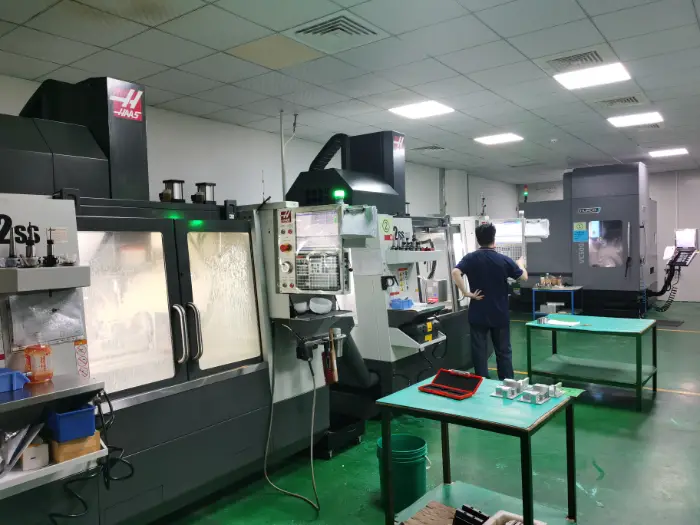
CNC Machining Considerations for ABS and POM
ABS and POM are both softer than metal. Stable machining requires simultaneous control of tools, heat, clamping force, and inspection temperature.
Use Sharp Cutting Tools
Sharp tools cut the material cleanly and reduce pulling, burrs, and localized heating.
Dull tools compress the plastic surface. Machined edges can melt, roll over, or develop rough tool marks.
Tools also need sufficient chip-clearance space. Chips must not remain in the cutting area for extended periods.
Control Machining Heat
Plastics conduct heat more slowly than metals. Cutting heat can easily concentrate on the tool and workpiece surface.
Suitable spindle speeds and feed rates allow the chips to carry heat away.
Compressed air can clear chips and reduce localized temperature rise. Before using coolant, confirm that it will not damage the material.
Reduce Clamping Pressure
Both ABS and POM are affected by fixture pressure.
Excessive clamping causes elastic deformation. After the fixture is released, the dimensions recover and can fall outside tolerance.
Soft jaws and larger contact areas distribute pressure. Thin-walled parts also require internal or bottom support.
Machine in Stages
Removing large amounts of material releases residual stress in sheets or rods.
Complex parts should first be rough-machined with a uniform allowance left in every direction.
After rough machining, allow the part to return to a stable temperature before semi-finishing and finish machining.
Set Realistic Tolerances
Plastics have higher coefficients of thermal expansion than metals. Changes in operating temperature affect bore diameters, shaft diameters, and assembly clearances.
Designers must set tolerances according to part size, wall thickness, and operating temperature.
Gears, sleeves, and sliding fits also need operating clearance. An excessively tight fit increases friction and deformation.
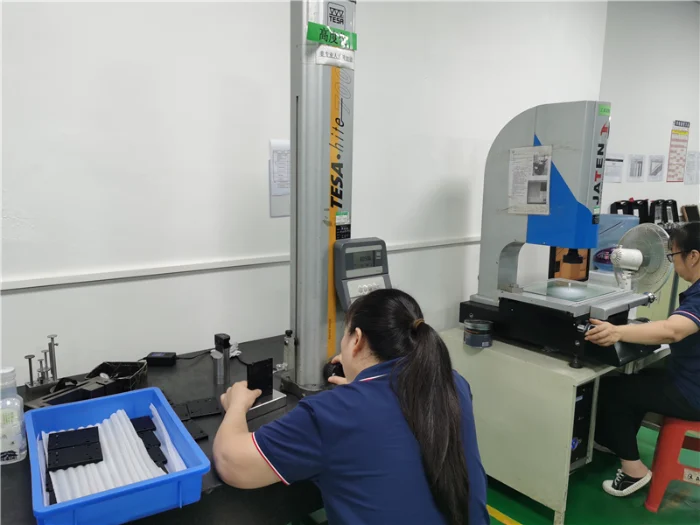
Inspect at a Stable Temperature
Freshly machined parts still retain cutting heat. Measurements taken at this stage are unstable.
Parts should cool to the inspection environment temperature before final measurement.
High-precision projects must also standardize machining, inspection, and operating temperatures and state these conditions on drawings or inspection documents.
Typical CNC-Machined ABS and POM Applications
ABS is used more often for static structures, appearance parts, and prototypes. POM is mainly used for mechanical components requiring movement, friction, and precision fits.
CNC-Machined ABS Applications
Electronic Equipment Housings
Electronic housings must protect internal components while accommodating ports, buttons, and mounting holes.
ABS can be machined with complex openings and slots, then sanded, painted, screen-printed, and bonded.
Functional Prototypes
During product development, dimensions, assembly, and appearance must be verified.
CNC machining ABS does not require an injection mold. After a design change, only the drawing and machining program need to be updated.
Automotive Interior and Non-High-Temperature Parts
ABS is suitable for automotive control panels, decorative covers, mounting brackets, and interior structural parts.
Flame-retardant, weather-resistance, and temperature ratings must also be confirmed for automotive projects.
Jigs and Assembly Aids
ABS can be used to make locating blocks, inspection templates, and light-duty assembly fixtures.
Material strength must be reassessed for fixtures exposed to high clamping forces or long-term repeated use.
CNC-Machined POM Applications
Gears and Sprockets
Gears continuously transmit motion and withstand tooth contact and cyclic loads.
The low friction, wear resistance, and rigidity of POM help maintain tooth geometry and center distance.
Bushings and Plain Bearings
POM can maintain smooth sliding under light loads and with limited lubrication.
Its low moisture absorption also reduces the effect of humidity on shaft-and-hole fits.
Sliders, Guide Rails, and Rollers
Sliders and rollers in automation equipment move repeatedly over long periods.
The surface hardness and wear resistance of POM extend the service life of contact surfaces and reduce operating noise.
Valve and Pump Components
Valve seats, pump impellers, and fluid-control parts come into contact with fuels, lubricants, or industrial fluids.
Before final material selection, chemical resistance data for the specific fluid, temperature, and material grade must be checked.
Advantages and Limitations of ABS and POM
Material advantages provide value only when they match the correct part function.
| Material | Main Advantage | Main Limitation |
| ABS | Good impact resistance | Lower rigidity than POM |
| ABS | Lower material cost | Limited wear resistance |
| ABS | Easy to machine and use for prototypes | Machining heat can cause softening and burrs |
| ABS | Supports painting, bonding, and printing | Not suitable for continuously sliding parts |
| ABS | Suitable for housings and appearance parts | Long-term outdoor use requires weather protection |
| POM | Higher rigidity and surface hardness | Higher raw material cost |
| POM | Low friction and good wear resistance | Standard adhesives and paints bond poorly |
| POM | Low moisture absorption and good dimensional stability | Higher thermal expansion than metal |
| POM | Suitable for gears and moving parts | Sensitive to sharp corners and notches |
| POM | Resistant to fuels and many solvents | Not resistant to strong acids and strong oxidizing agents |
Core Value of ABS
The advantages of ABS center on impact resistance, finishing options, and cost efficiency.
It is suitable for parts that require rapid production, frequent design changes, or cosmetic finishing.
Using ABS for heavily loaded gears or parts that slide continuously shortens service life.
Core Value of POM
The advantages of POM center on rigidity, dimensional stability, and low friction.
It is suitable for mechanical parts that require consistent fits, repeated movement, and wear-resistant surfaces.
If a part requires painting, bonding, or complex decoration, POM adds extra manufacturing steps.
How Should You Choose Between ABS and POM?
Material selection cannot be based only on which material is stronger. Part function, motion type, tolerances, environment, and budget must all be considered.
| Project Requirement | Recommended Material | Reason for Selection |
| Electronic equipment housing | ABS | Impact-resistant and easy to finish |
| Functional prototype | ABS | Lower cost and easy to modify |
| Painted or bonded part | ABS | Better suited to surface finishing |
| Lightly loaded structural part | ABS | Good balance of performance and cost |
| Precision gear | POM | Rigid, wear-resistant, and low-friction |
| Bushing or bearing | POM | Suitable for continuous sliding |
| Guide rail or roller | POM | Wear-resistant with low running resistance |
| Tight-tolerance moving part | POM | Better dimensional stability |
| Contact with fuel or lubricating oil | POM | Good resistance to oils |
| Long-term outdoor part | Reassess | Both materials require weather protection |
| Load-bearing part used at high temperature | Reassess | A more heat-resistant material grade is required |
When to Choose ABS
Choose ABS when impact resistance, appearance, and cost are the main priorities.
It is suitable for housings, panels, prototypes, and light-duty fixtures. ABS also simplifies post-processing when painting, bonding, or printing is required.
When to Choose POM
Choose POM when a part must move continuously, slide, or maintain fit accuracy.
It is suitable for gears, bushings, rollers, and precision mechanical components.
Information to Confirm Before Submitting a Machining Request
When submitting a project to a CNC machining supplier, provide the following information:
- 3D models and 2D drawings;
- Critical dimensions and tolerances;
- Part operating temperature;
- Fluids or chemicals the part will contact;
- Loads and type of movement;
- Surface finishing requirements;
- Prototype and production quantities.
Complete information helps the supplier determine the material and machining plan while reducing the risk of assembly failure and rework.

Conclusion
ABS and POM are both engineering plastics suitable for CNC machining, but they address different part requirements.
ABS emphasizes impact resistance, finishing options, and cost control. It is suitable for electronic housings, functional prototypes, control panels, and lightly loaded structural parts.
POM emphasizes rigidity, low friction, wear resistance, and dimensional stability. It is better suited to gears, bushings, rollers, and precision moving parts.
If a part requires painting, bonding, or rapid design validation, ABS is the more direct choice.
If a part requires continuous sliding, stable fits, or a longer wear life, POM is the better choice.
Final material selection must also consider operating temperature, chemical exposure, tolerances, wall thickness, and production quantity.
Comparing material prices alone cannot determine the true cost of a finished part.
When submitting 3D models and 2D drawings to Weldo Machining, also specify critical tolerances, operating conditions, and surface requirements.
Complete project information helps the engineering team confirm the material, machining sequence, and inspection plan while reducing subsequent rework.