
Sandblasting & Bead Blasting
Controlled abrasive blasting removes rust and scale, prepares surfaces for coating, and creates uniform matte finishes on custom metal, engineering plastic, and glass parts.
- In-house blasting equipment
- Metal, plastic and glass
What Is Sandblasting?
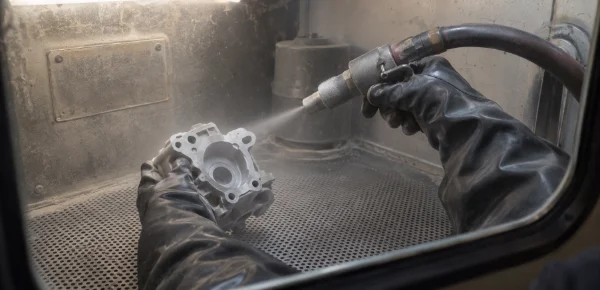
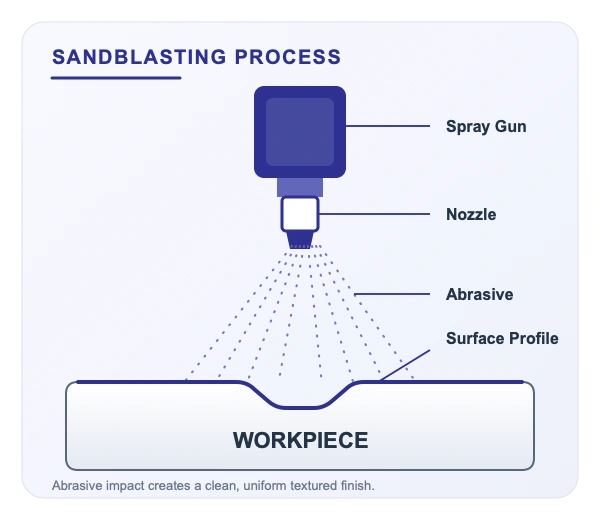
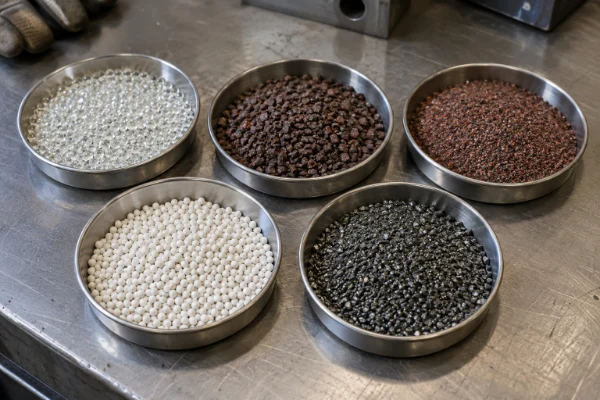
Sandblasting directs a controlled stream of abrasive media with compressed air or liquid to clean, texture, or prepare a component surface. Industrial media include glass bead, aluminum oxide, garnet, ceramic bead, and steel grit.
Bead blasting uses spherical media and produces a softer cutting action, making it well suited to precision parts and decorative satin finishes.
What Does Abrasive Blasting Achieve?
Surface Cleaning
Removes rust, scale, casting residue, and old coatings after grease and cutting fluids have been cleaned away.
Coating Profile
Creates a controlled anchor profile for paint, powder coating, and other protective finishes.
Uniform Appearance
Reduces glare and produces a consistent matte or satin texture across visible surfaces.
Light Deburring
Removes small loose burrs and surface residue while preserving the main part geometry.
How Should Blasting Media Be Selected?
Choose the abrasive according to substrate hardness, required texture, contamination limits, and the following finishing process.
| Abrasive | Surface Action | Typical Use |
|---|---|---|
| Glass Bead | Gentle impact and fine satin texture | Aluminum, stainless steel, brass and cosmetic parts |
| Aluminum Oxide | Aggressive cutting and profiling | Steel, stainless steel and coating preparation |
| Garnet | Efficient cleaning with a consistent profile | Steel structures, weldments and coating removal |
| Ceramic Bead | Refined texture with durable spherical media | Aluminum, titanium and precision metal parts |
| Silicon Carbide | High cutting ability on hard surfaces | Hard alloys, ceramics and specialized profiling |
| Steel Grit or Shot | High-impact reusable metallic media | Carbon steel, cast iron and forgings |
Which Materials Can Be Abrasive Blasted?
Carbon Steel & Cast Iron
Aluminum oxide, garnet, or steel media removes rust, scale, and casting residue before protective finishing.
Stainless Steel
Dedicated glass bead, ceramic bead, or aluminum oxide creates a uniform matte surface while controlling free-iron contamination.
Aluminum Alloys
Fine glass or ceramic bead produces satin finishes; fine aluminum oxide prepares surfaces for coating.
Copper, Brass & Zinc
Fine, low-impact media creates an even texture while preserving edges and identification marks.
Engineering Plastics
Plastic media or low-energy glass bead textures ABS, PC, and PC+ABS after sample approval.
Glass & Composites
Glass can receive permanent frosting; composite parameters are matched to the resin and fiber structure.

Which Areas Require Masking?
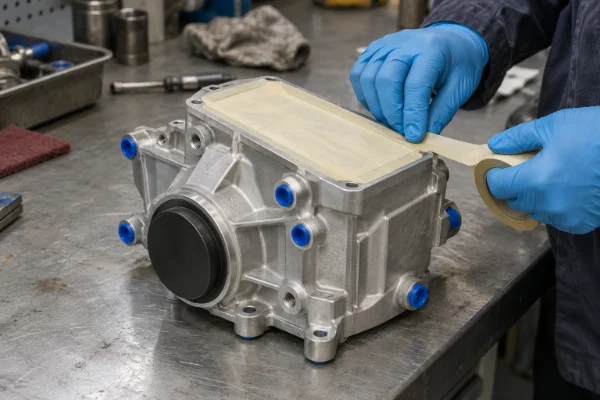
Silicone plugs, rubber stoppers, wear-resistant tape, protective caps, peelable coatings, and dedicated fixtures protect critical features.
- Bearing seats and sealing faces
- Internal and external threads
- Locating and dowel holes
- Electrical contact surfaces
- Identification and traceability marks
- Polished or previously coated surfaces
How Is the Sandblasting Process Controlled?
Review Requirements
Confirm the material, heat-treatment state, blasting areas, protected zones, target texture, and subsequent finish.
Degrease and Clean
Remove oil, coolant, adhesives, and loose contamination so the substrate is clean and dry.
Mask Critical Features
Protect threads, bores, sealing faces, and precision fits with plugs, tape, caps, or fixtures.
Set Media and Parameters
Define media, particle size, pressure, distance, angle, travel speed, and pass overlap.
Perform Controlled Blasting
Maintain consistent stand-off and travel speed; use balanced low-energy exposure on thin walls.
Clean and Inspect
Remove residual media and inspect appearance, profile, masking boundaries, and critical dimensions.
How Are Blasted Surfaces Inspected?
Surface Preparation Grade
Steel surfaces can be accepted to ISO 8501-1 preparation grades such as Sa 2, Sa 2½, or Sa 3.
Peak-to-Valley Depth
Coating profiles can be assessed with comparators, replica tape, or instruments to ISO 8503 or ASTM D4417.
Approved Visual Standard
Cosmetic parts are compared under defined lighting, distance, angle, gloss, and texture criteria.
Critical Feature Check
Bores, fits, thin walls, masking boundaries, and internal cleanliness are verified after processing.
Which Finishes Can Follow Sandblasting?
Powder Coating
Blasting removes scale and creates the profile required for reliable powder-coat adhesion.
Anodizing
Glass bead blasting creates a uniform matte base before decorative or protective aluminum anodizing.
Liquid Paint or E-Coat
A clean, specified profile supports consistent coating coverage and corrosion protection.
Stainless Passivation
Cleaning and passivation after dedicated-media blasting restore a clean corrosion-resistant surface.
Sandblasting, Shot Blasting, and Shot Peening
| Process | Equipment and Media | Primary Purpose |
|---|---|---|
| Sandblasting | Compressed air with glass bead, aluminum oxide, ceramic bead, or similar media | Precision cleaning, profiling, and decorative texture |
| Shot Blasting | Centrifugal wheel with steel shot or grit | Batch cleaning of castings, forgings, and steel structures |
| Shot Peening | Controlled shot impact with specified Almen intensity and coverage | Residual compressive stress and improved fatigue performance |
Review the equipment principles, performance changes, and selection criteria in the full comparison guide.
Read the Complete Comparison →Custom Parts Commonly Finished by Blasting
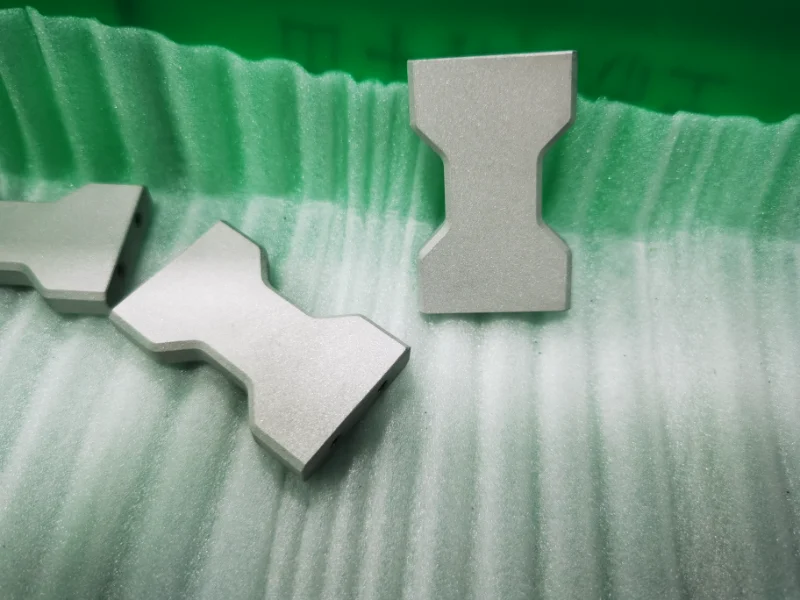
Aluminum Housings
Glass-bead matte texture before clear, black, or colored anodizing.
Carbon-Steel Weldments
Oxide removal and surface profiling before powder coating or paint.
Cast and Forged Parts
Scale, casting residue, and corrosion removal from housings and heavy components.
Stainless Components
Dedicated-media finishing for equipment panels, brackets, and covers.
Engineering Plastic Housings
Low-energy texturing for ABS, PC, and PC+ABS components.
Glass Panels
Permanent frosting with masking for optical and functional areas.
Why Choose Weldo for Sandblasting?
Sandblasting FAQs
What surface roughness does glass bead blasting produce?
How is a consistent finish maintained across production batches?
Can a previously blasted part be blasted again?
How should sandblasted parts be maintained?
What information is required for a sandblasting quote?
Request a Sandblasting Quote
Send your drawings, material, quantity, masking zones, and finish requirements for an engineering review and quotation.