
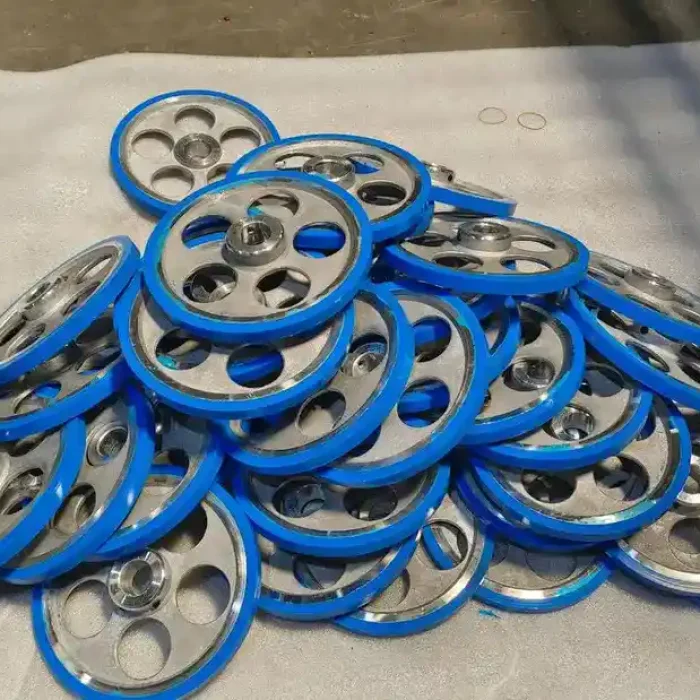
Maßgeschneiderte Umspritzdienstleistungen
Add grip, sealing, cushioning, or impact protection by molding a compatible layer onto a rigid plastic or metal substrate. Plan the material pairing, retention, tooling, and inspection around your part's functional requirements.
- Plastic & Metal Substrates
- Material Pairing Review
- Bond & Function Validation
Choose the Right Overmolding Route
Overmolding forms a second material around selected areas of a substrate. The route depends on the material pair, geometry, tooling, equipment, and production plan.
Einsatz-Umspritzung
A preformed plastic part or CNC-machined insert is positioned in an overmold tool before the second material is molded around it. Insert location, support, and preparation are key process inputs.
Zweistufen-Spritzguss
The substrate and second material are molded sequentially within a coordinated multi-material molding system. Tool layout and transfer are reviewed against the resin pair, component design, and required quantity.
Both routes require a compatible material system and validated attachment. The selected process is confirmed during tooling and engineering review.
Add Function Where the Part Needs It
Use a rigid substrate for structure and a selected overmold for the required contact, protection, or assembly function.
Griffigkeit und Ergonomie
Form a compliant contact surface with hardness and texture selected for the intended handling conditions.
Abdichtung und Schutz
Integrate local seals, lips, and protected edges around the required compression and service environment.
Impact and Vibration
Use suitable elastomer geometry to cushion contact and manage shock or transmitted vibration.
Integrierte Montage
Consolidate selected grips, seals, or covers into a multi-material component with fewer separate parts.
Material Pairings to Evaluate
Start with the substrate and intended function, then select exact supplier grades, hardness, additives, color, and attachment requirements.
ABS or PC + TPE / TPU
Soft-touch layers and local impact features on rigid plastic housings and handles.
View pairing details
- Typische Verwendung
- Grips, housings, control surfaces, and protective zones.
- Compatibility review
- Select an overmolding grade intended for the exact ABS, PC, or PC/ABS substrate, including its fillers and additives.
- Process and validation
- Confirm surface cleanliness, color system, temperatures, shrinkage, and the agreed adhesion or retention test.
PP + TPE / TPV
Flexible interfaces with polypropylene-specific elastomer selection.
View pairing details
- Typische Verwendung
- Handles, seals, flexible grips, and integrated covers.
- Compatibility review
- Use a grade designed for PP attachment; hardness and formulation affect adhesion and service behavior.
- Process and validation
- Review layer thickness, shutoffs, flow, ejection, and functional performance on approved samples.
PA + TPE / TPU
Wear-resistant structures combined with resilient contact or sealing features.
View pairing details
- Typische Verwendung
- Mechanical grips, housings, guides, and protected interfaces.
- Compatibility review
- Confirm the exact nylon grade, reinforcement, moisture state, and compatible elastomer system.
- Process and validation
- Control drying, substrate condition, heat exposure, and bond performance under the intended conditioning state.
PBT + TPE / TPC
Rigid engineering-plastic components with selected resilient interfaces.
View pairing details
- Typische Verwendung
- Electrical housings, industrial components, and protective or sealing features.
- Compatibility review
- Pair the exact PBT resin with a suitable TPE or thermoplastic copolyester grade; fillers and additives require review.
- Process and validation
- Evaluate preparation, flow, shrinkage, retention geometry, and specified adhesion or functional criteria.
Selected Plastics + LSR
Silicone interfaces on selected heat-compatible PC, PBT, or PA substrates.
View pairing details
- Typische Verwendung
- Sealing features, protected interfaces, and reviewed equipment components.
- Compatibility review
- Select an application-specific liquid silicone rubber system. Substrate heat resistance, cure conditions, and adhesion require validation.
- Process and validation
- Confirm tooling and cure route, surface preparation or bonding system, retention, and sample testing before production.
Metal + TPE
Resilient grips, covers, and protective features around prepared metal inserts.
View pairing details
- Typische Verwendung
- Machined inserts with soft-touch, cushioning, or protected-edge requirements.
- Compatibility review
- Attachment may rely on mechanical retention, a suitable bonding grade, or validated surface preparation and primer.
- Process and validation
- Review insert tolerances, cleanliness, loading, shutoffs, pull-out resistance, and the agreed functional acceptance.
Metall + TPU
Abrasion-resistant flexible grades for contact surfaces and protective layers.
View pairing details
- Typische Verwendung
- Handles, covers, impact zones, and reviewed wear-related interfaces.
- Compatibility review
- Confirm the TPU grade, metal surface condition, pretreatment, and retention geometry; material names alone do not establish a bond.
- Process and validation
- Control drying, insert location, molding conditions, and application-specific peel, pull-out, or wear checks.
Metal + Silicone
Selected silicone systems for compliant seals and protective or cushioning features.
View pairing details
- Typische Verwendung
- Metal-insert assemblies with specified sealing, flexibility, or service-temperature requirements.
- Compatibility review
- Confirm silicone grade, cure conditions, metal preparation, and a validated bonding or mechanical-retention method.
- Process and validation
- Review insert support, exposed surfaces, flash limits, and specified adhesion, leak, compression, or functional tests.
These are candidate combinations, not a guaranteed bonding chart. Adhesion depends on the exact grades, fillers, additives, color system, moisture, surface condition, and processing. Agree on retention geometry and application-specific tests before production.
Design for Reliable Attachment
Define the interface, layer transitions, shutoffs, locating surfaces, and flow path before mold construction.
Mechanische Retention
Use holes, grooves, undercuts, or wraparound features where loads or limited chemical adhesion require positive attachment.
Kontrollierte Schichtdicke
Keep the layer reasonably uniform, with gradual transitions to support filling and reduce shrinkage or cooling variation.
Protected Layer Edges
End the soft layer in a shoulder, recess, or defined groove to reduce vulnerable feathered edges and peeling.
Zugluft und Zugluftverschlüsse
Plan clean ejection and stable shutoff surfaces to manage flash at the material boundary and exposed features.
Stable Insert Location
Locate and support the substrate so injection pressure does not shift, crush, or distort critical areas.
Gates and Venting
Review flow length, gate position, vent access, and end-of-fill regions to control trapped air and incomplete filling.
Capabilities and Production Control
Dimension, substrate, attachment, and inspection requirements are reviewed together. Confirm the accepted criteria on the drawing and approved samples.
Drawing-Based References
| Dimensional reference | Etwa ±0,05 mm*Reviewed by feature, material, geometry, tooling, and measurement conditions. |
|---|---|
| Ausgewählte Präzisionsmerkmale | Auf ±0,02 mm* kalibriert*Selected rigid or locating features require separate feasibility and inspection review. |
| Part-envelope reference | Up to 500 × 400 × 200 mm*Subject to mold, machine, insert support, geometry, and handling requirements. |
| Metal insert weight | Bis zu 3 kg*Insert loading, location, support, heating, and tooling are confirmed for the project. |
| Soft-layer measurement | Define hardness, temperature, conditioning, measurement contact force, and the functional acceptance method. |
From Review to Release
1. Material and DFM Review
Confirm grades, hardness, retention, shutoffs, cosmetic areas, and functional tests.
2. Tool and Insert Preparation
Prepare the mold and substrate, control cleanliness, and protect surfaces that remain exposed.
3. First-Shot Validation
Review fill, flash, appearance, dimensions, attachment, and specified performance before approval.
4. Controlled Production
Manage conditioning, temperatures, insert position, molding parameters, and agreed sampling.
5. Final Inspection and Delivery
Verify approved criteria, complete secondary work, and protect the interface during packing.
*Quotation references, not universal guarantees. Maximum size, insert weight, and precision are reviewed separately and are not necessarily available together on every part.
Agree on dimensional, appearance, and attachment checks during quotation. Pull-out, peel, leak, compression, aging, or other functional tests are included when required by the application and approved inspection plan.
Custom Overmolded Parts and Applications
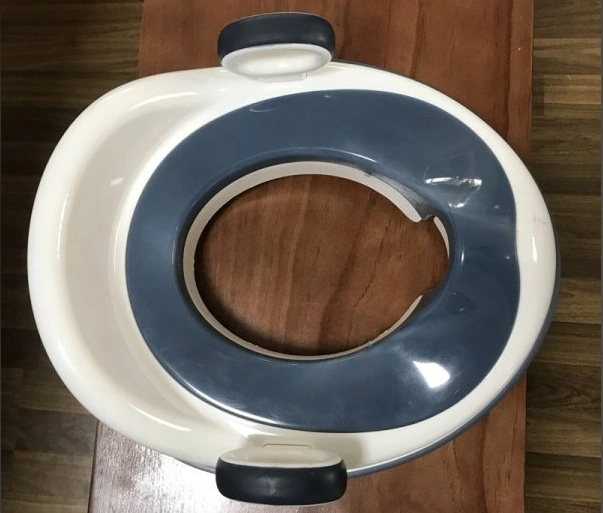
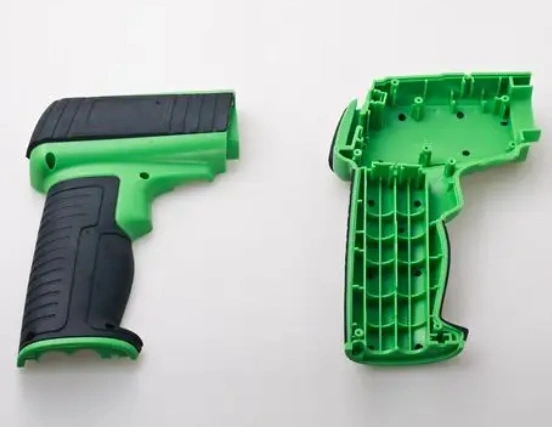
Rigid-plus-soft components combine structure with a defined contact, sealing, protection, or assembly function.
Handwerkzeuge und Bedienelemente
Grip zones, handle interfaces, and tactile contact surfaces.
Elektronikgehäuse
Protected edges, soft contact zones, and reviewed sealing interfaces.
Medizinische Geräte und Laborgeräte
Equipment handles, grips, and application-specified material combinations.
Schnittstellen für die Automobilindustrie
Soft-touch controls, protective features, and reviewed sealing details.
Industriesensoren
Protected housings, cable interfaces, and compliant features.
Konsumgüter
Grips, covers, cushioning, and integrated rigid-plus-soft components.
Overmolding Project Questions
Will the two material families bond automatically?
No. Attachment depends on the exact grades, fillers, additives, surface preparation, temperatures, and interface design. A suitable bonding formulation, mechanical retention, primer, or a combination may be needed. Samples are validated against the agreed requirement.
How should overmold hardness be specified?
State the Shore scale and target value, then connect them to grip, compression, sealing, wear, and service conditions. The chosen supplier grade and any hardness acceptance method are confirmed during review.
Can an existing insert be used?
Yes, after review of material, dimensions, locating and support features, cleanliness, temperature resistance, and exposed surfaces. Samples may be needed to evaluate loading, shutoffs, attachment, and finished function.
Can color, texture, and gloss be customized?
These can be reviewed with the selected material system. Define approved references and cosmetic zones before tooling release; the colorant and its carrier must be compatible with the overmold and attachment requirements.
Was beeinflusst die Kosten für Überformwerkzeuge?
Part size, cavities, insert loading, undercuts, side actions, shutoff complexity, runner system, surface finish, tool life, and validation requirements determine the tooling route and quotation.
Wie werden umspritzte Teile geprüft?
Check dimensions, appearance, flash, insert position, and attachment as specified. Add application-specific pull, peel, leak, compression, environmental, or functional tests with agreed methods and acceptance limits.