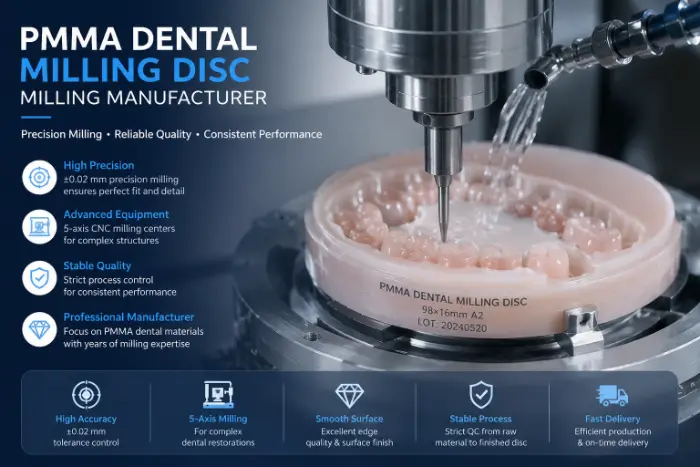
PMMA materials are widely used in the dental field. PMMA is also called acrylic, and in some regions it is referred to as organic glass. It is usually transparent in appearance and has a certain degree of hardness and toughness. Common accessories include crowns, dentures, base plates, and other transparent sheets commonly found in dental clinics,Below,I will elaborate on PMMA dental-related knowledge.
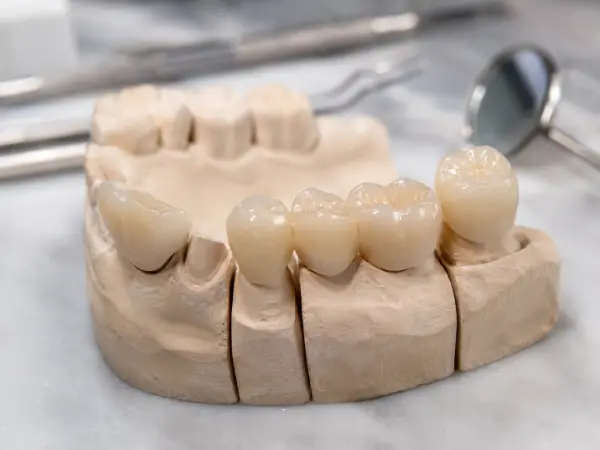
What Is PMMA in Dentistry?
PMMA (Polymethyl Methacrylate) is an acrylic resin material widely used in dentistry. It has relatively low cost, good hardness and toughness, good light transmittance, a density that is half that of glass, and impact resistance 8–10 times higher than inorganic glass. The material is slightly brittle, so machining parameters need to be adjusted properly during milling. Thanks to its excellent mechanical properties, PMMA is commonly used in dental clinic consumables and dentures.
Dental PMMA is of high purity, with compliant additives and has passed biosafety testing. Its performance is optimized for oral restoration. Consumer-grade PMMA contains industrial additives and does not meet dental safety standards. It is only suitable for industrial applications and is strictly prohibited from contact with the oral cavity.
Properties of PMMA Materials
Material Structure of PMMA
PMMA is a linear polymer formed by the polymerization of methyl methacrylate monomers. Its chemical formula is [CH2C(CH3)(CO2CH3)]n. It has a highly regular structure that provides good mechanical properties.
Density
The density of PMMA is generally between 1.15–1.19 g/cm³. Some dental PMMA materials may have a density close to 1.18–1.19 g/cm³ to ensure good mechanical properties and biocompatibility.
Chemical Stability
Water resistance: In the oral environment, modified/coated PMMA has good stability against water, saliva, and common food liquids. It is not easily dissolved or decomposed by water absorption and can maintain dimensional stability and strength for a long time.
Chemical corrosion resistance: It has certain resistance to weak acids, weak alkalis, and most organic solvents (such as ethanol and ether), but it is not resistant to strong oxidizing acids and strong alkalis. Hydrolysis or degradation may occur under strong acid or alkali conditions.
Thermal Properties
Glass transition temperature (Tg): Approximately 105°C. Above this temperature, the material changes from a glassy state to a highly elastic state, with good flexibility and processability; at oral temperature it remains in a glassy state, maintaining rigidity and stability.
Melting point: Approximately 160°C, but in dental applications curing is usually completed at lower temperatures through thermal or light polymerization to avoid high-temperature effects on oral tissues.
Biocompatibility
Residual monomers and leachables: A small amount of unreacted MMA monomers and additives (such as initiators and crosslinking agents) may remain after polymerization. These substances may leach out under certain conditions, but proper treatment can greatly reduce their toxicity.
Surface chemistry: The PMMA surface can be modified or functional groups (such as hydroxyl or amino groups) can be added to improve affinity with oral tissues, reducing chemical reactions with oral tissues.
The following table summarizes common property values of PMMA materials. The table content is partly from Sciencedirect.
| Property | Metric | English |
| Specific Gravity | 1.19 g/cc | 1.19 g/cc |
| Moisture Absorption | 0.40 -2.1% | |
| Hardness, Shore D | 90 | |
| Tensile Strength | 72.0 MPa | 10400 psi |
| Elongation at Break | 8.0 % | |
| Modulus of Elasticity | 3.215 GPa | 466.3 ksi |
| Charpy Impact Unnotched | 2.00 J/cm² | 9.52 ft-lb/in² |
| Dielectric Constant | 2.8 | |
| Dielectric Strength | 30.0 kV/mm | 762 kV/in |
| Dielectric Loss Index | 0.030 | |
| Thermal Conductivity | 0.190 W/m-K | 1.32 BTU-in/hr-ft²-°F |
| Melting Point | 106 °C | 223 °F |
| Maximum Service Temperature | 70.0 °C | 158 °F |
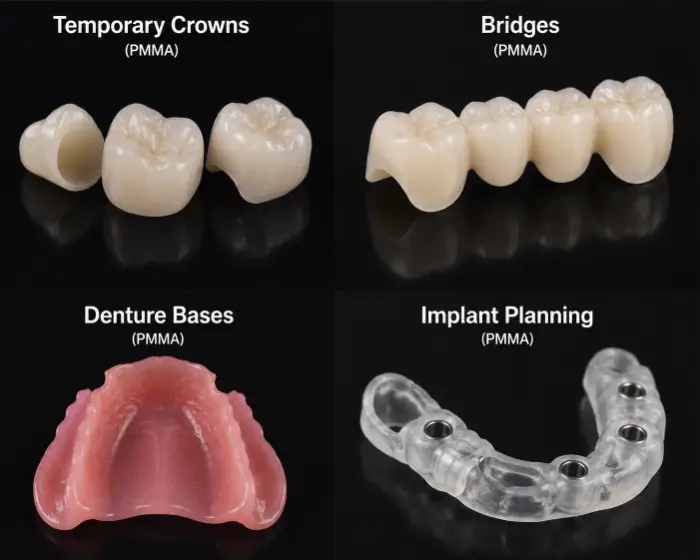
Common Applications of Dental PMMA
Temporary Crowns
PMMA can be used to produce temporary crowns through direct or indirect methods. It has low cost, good mechanical strength, high marginal fit, and adjustable color, making it a practical material for short-term dental restorations. However, it is prone to shrinkage and irritation during polymerization, so ventilation, shrinkage compensation, and irritation reduction treatments are necessary.
Bridges
PMMA materials can be used to make temporary dental bridges and cantilever adhesive bridges. These accessories can protect the gums and alveolar ridge while maintaining occlusal and chewing functions. Adhesive bridges produced through CAD/CAM design and milling are suitable for growing patients and offer good aesthetics. The material is easy to process, relatively low in cost, and has good biocompatibility, but it may deform or fracture during long-term use and therefore requires regular replacement.
Denture Bases
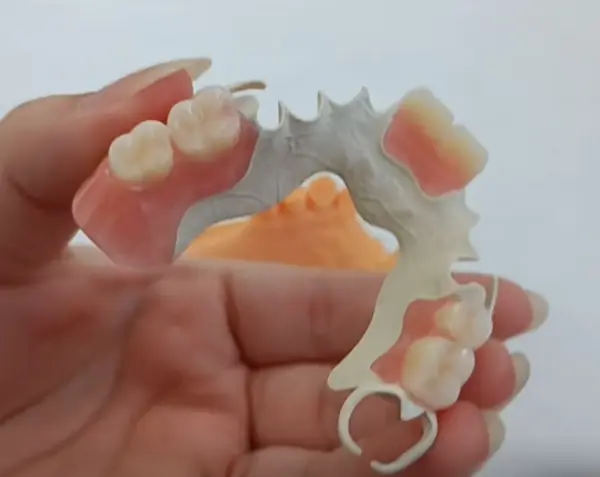
Polymethyl methacrylate is widely used for denture bases. Although PMMA has issues such as insufficient impact resistance and susceptibility to water absorption and aging, technologies such as fiber reinforcement, nanofillers, and antibacterial modification can greatly reduce water absorption and meet long-term usage requirements.
Implant Planning
PMMA materials are also commonly used in accessories for implant planning, such as radiographic guides, surgical guides, occlusal support blocks, instrument scan bodies, temporary crowns/temporary bridges, and retaining screws. These facilitate the use of dental hospital equipment and dental consumables.
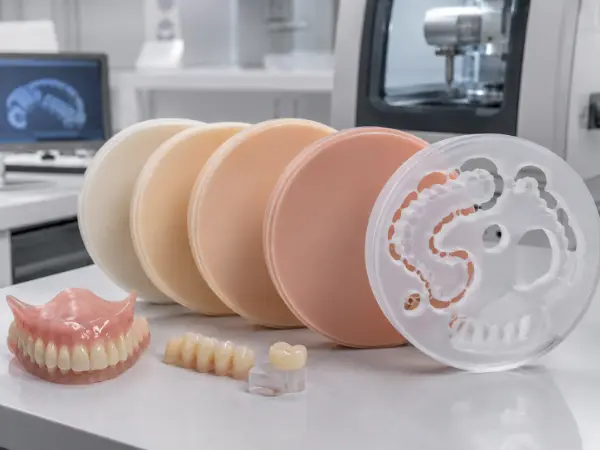
CAD/CAM Milling Discs
Medical-grade PMMA blanks can be milled into CAD/CAM milling discs. For example, last year a German client customized transparent acrylic milling discs with a required precision of ±0.01 mm and mandatory X-ray translucency verification. After satisfactory testing upon receipt, the client is now preparing a third order. However, acrylic discs require regular inspection for surface wear, polishing maintenance, or disposal.
Windows and Partition Panels
PMMA materials are relatively strong, wear-resistant, impact-resistant, and not easily scratched. Therefore, many clinics, hospitals, banks, and stations use ordinary civilian acrylic sheets as reception partition windows. These sheets have sufficient thickness and impact resistance, are less fragile than ordinary inorganic glass, burn slowly, provide decorative aesthetics, and help ensure personnel safety.
PMMA vs Other Dental Materials
PMMA vs Zirconia
Medical PMMA and zirconia ceramics are two core materials with completely different positioning in oral restoration: PMMA is mainly used for temporary restorations, while zirconia is mainly used for permanent fixed restorations. The two differ significantly in mechanical properties, processability, and durability.
PMMA is mainly used in clinics for temporary restorations, occlusal analysis aids, pediatric dental restorations, bone cement, and orthodontic auxiliaries.
Advantages of PMMA: Easy processing, comfortable wearing experience, good compatibility with gums and abutment teeth, and low cost. It also has a good balance of hardness and toughness, with very low water absorption, which can be further reduced after coating treatment.
Disadvantages: Relatively poor hardness and mechanical strength, prone to water absorption and discoloration, poor marginal sealing, and weak high-temperature resistance.
Zirconia materials are mainly used for all-ceramic crowns, fixed bridges, implant restorations, tooth restoration, and clear orthodontics.
Advantages: It is an inert ceramic with high strength, durability, and dimensional accuracy. No metal ions are released, it does not cause allergies, and it is suitable for long-term use.
Disadvantages: Extremely high hardness requires demanding milling parameters; poor elasticity may wear down natural teeth in contact; and the cost is relatively high.
PMMA vs PEEK
PEEK is mainly used in implant restorations for temporary abutments, healing components, denture frameworks, and root canal post materials.
Advantages of PEEK materials: Dental accessories made of PEEK have high strength and durability, can withstand high occlusal forces, have excellent biocompatibility, are suitable for patients allergic to metals, and offer good aesthetics without causing artifacts in X-ray, CT, or MRI examinations.
Disadvantages: High cost, high precision requirements for materials and manufacturing, difficult post-production adjustments, and high technical requirements for clinicians to ensure proper fitting.
PEEK materials are generally selected by experienced dentists when patients have a relatively high budget for oral restoration.
PMMA vs Composite Resin
Composite resin is mainly used for tooth restoration and veneers, pit and fissure filling, and bonding indirect restorations.
Advantages: Composite resin dental accessories have strong bonding ability, flexible operation, good biocompatibility, minimal wear on healthy tooth tissue during restoration, and are suitable for anterior teeth and restorations with high aesthetic requirements.
Disadvantages: Insufficient strength and wear resistance, polymerization shrinkage, aging and discoloration during long-term use, and the need for regular replacement. Operation also requires strict moisture isolation conditions, making it unsuitable for posterior teeth with high occlusal force or large tooth defects.
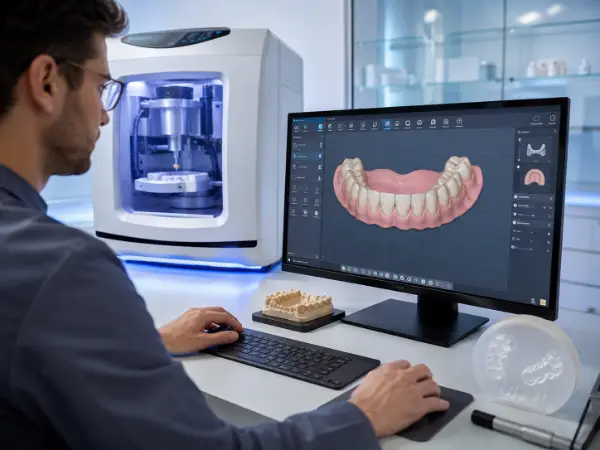
The following table summarizes the comparison among these four materials to help you choose suitable materials in the dental restoration industry:
| Key Dimension | PMMA | Zirconia | PEEK | Composite Resin |
| Core Positioning | Temporary restoration material | Permanent fixed restoration material | High-performance functional polymer | Minimally invasive aesthetic restoration material |
| Main Applications | Temporary crowns/bridges, dentures | All-ceramic crowns, fixed bridges, implant restorations | Healing abutments, denture frameworks, implant accessories | Veneers, fillings, pit and fissure sealing |
| Mechanical Properties | Lower strength, average wear resistance | Extremely high strength, best durability | High strength with elastic cushioning | Moderate strength, insufficient long-term wear resistance |
| Biocompatibility and Comfort | Good compatibility and comfortable wear | Inert ceramic, non-allergenic | Excellent biocompatibility, no imaging artifacts | Good biocompatibility, natural aesthetics |
| Processing and Clinical Requirements | Easy to process and adjust | Difficult milling process | High manufacturing precision and installation skill requirements | Flexible operation but strict moisture isolation requirements |
| Cost and Application Recommendations | Low cost, suitable for short-term restorations | High cost, suitable for long-term implant restorations | Relatively high cost, suitable for high-end solutions | Moderate cost, suitable for anterior tooth restoration |
How to Choose the Right PMMA Dental Disc
Because PMMA dental discs are customized according to the patient’s oral structure, multi-axis CNC machining is usually required, which demands higher processing accuracy and surface finishing standards. Below is a simple explanation based on the issues encountered in previous dental disc projects.
First, the disc size and thickness should be considered: common diameters include 98 mm (Open System) and 95 mm (ZZ System), while thickness depends on the type of restoration and clinical requirements.
Other customization options include color selection. For diagnostic or try-in purposes, transparent or gingiva-colored discs can meet the requirements. For long-term use, it is necessary to match natural tooth shades by selecting VITA 16 shades or multilayer gradient series to ensure aesthetic restorations.
In some cases, multilayer PMMA discs may also be used. Whether to choose single-layer or multilayer mainly depends on the budget:
- Multilayer PMMA discs provide color transitions closer to natural teeth, with better toughness and load-bearing performance. They are suitable for highly aesthetic, high-stress, and long-term restorations, although the machining difficulty and cost are relatively higher.
- Single-layer PMMA discs feature uniform color, easier machining, and lower cost, making them suitable for low-stress, short-term, and cost-effective simple restorations.
Dental discs are not only manufactured through milling processes, but semi-finished products can also be produced by 3D printing and injection molding:
- 3D Printing: FDM and SLA additive manufacturing processes can be used to produce highly complex and customized components, suitable for small-batch prototyping and testing. However, the surface quality and mechanical properties are generally inferior to milled products and may require post-milling finishing.
- Casting Molding: Raw materials are injected into molds for curing and shaping. This method is only suitable for mass production of simple components with relatively low precision requirements.
Why PMMA Is Popular for CAD/CAM Dental Milling?
PMMA (Polymethyl Methacrylate) is suitable for milling dental discs mainly for the following reasons:
Good Machinability
During milling, PMMA can be effectively cut by tools without excessive wear or chipping. Its relatively regular molecular structure allows smooth surface finishes after cutting. With advanced five-axis equipment, machining accuracy can reach ±2 μm.
Low Cutting Force Requirement
Compared with metal or ceramic materials, PMMA has lower hardness and causes less tool wear during milling, which helps extend tool service life.
Excellent Dimensional Stability
After milling, PMMA can maintain high dimensional accuracy and shape stability, ensuring proper matching between the dental disc and the patient’s oral structure, while meeting clinical fitting requirements for restorations.
High Biocompatibility
PMMA materials offer excellent biocompatibility and do not cause significant irritation or allergic reactions to human tissues. With a suitable elastic modulus, PMMA causes less wear on healthy teeth, making it appropriate for both temporary and long-term oral restorations while complying with dental material safety standards.
High Cost Efficiency
PMMA materials are relatively low-cost, and milling efficiency is high, enabling rapid production of qualified dental discs while reducing manufacturing costs for oral restorations. This makes PMMA suitable for large-scale clinical applications.
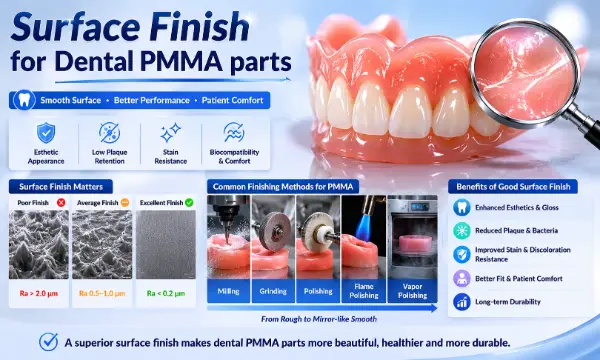
Surface Finish for Dental PMMA parts
Mechanical polishing:
Using abrasive tools of progressively finer grit, the PMMA denture base is polished step by step to remove surface burrs, uneven areas, and minor defects, reduce roughness, limit the adhesion of debris and bacteria, and improve overall appearance. However, this method alone cannot completely eliminate very fine surface depressions.
Chemical polishing:
With the aid of specialized chemical agents and light-activated treatment, the denture surface can be further refined to address small defects that mechanical polishing may miss, significantly improving surface smoothness. During the process, the concentration of the chemical agents and the reaction time must be carefully controlled to avoid corrosive damage to the PMMA material.
Coating:
Applying a biocompatible protective coating to the surface of the prosthesis can enhance gloss and appearance while also providing antibacterial and stain-resistant properties, reducing plaque accumulation and improving long-term performance.
Steam sterilization and cleaning:
Steam equipment is used to thoroughly clean and disinfect the denture base and finished denture, removing oil, dirt, and harmful microorganisms. This helps improve biosafety, reduce the risk of oral infection, and provide a cleaner surface for subsequent treatment.
Surface modification:
Techniques such as plasma treatment and ion implantation can regulate the physical structure and chemical composition of the material surface, improving hydrophilicity and bioactivity. This promotes closer adaptation between the denture and oral soft tissue, thereby enhancing wearing stability and comfort.
In clinical practice, combined treatment methods are commonly used. Mechanical or chemical polishing is first performed on the PMMA denture surface, followed by coating, steam sterilization, and other procedures to further improve the appearance, biocompatibility, and overall performance of the denture base.
FAQ
Chipping occurs when milling PMMA dental part with ordinary high-speed steel tools. How can this problem be solved?
For PMMA machining, it is recommended to use single-crystal diamond tools. These diamond tools have a low friction coefficient with PMMA and are less likely to cause material adhesion or built-up edge formation during machining, thereby reducing scratches, ripples, and other surface defects.
Diamond tools also feature high hardness and wear resistance, effectively extending tool life and reducing tool replacement frequency. In addition, their excellent thermal conductivity and thermal stability can quickly dissipate cutting heat, preventing deformation or discoloration of PMMA caused by high temperatures. This helps maintain consistent quality and stable processing across entire batches of dental discs.
How can ultra-low toxicity of PMMA materials in oral applications be achieved?
The low-toxicity control of PMMA materials in oral applications can mainly be achieved through material modification. For example, adding antibacterial materials such as nano-zirconia, nano-silver, or ZIF-8 into PMMA can reduce bacterial growth and inflammatory reactions while improving biocompatibility and material stability.
In terms of processing technology, increasing the polymerization degree is key to reducing toxicity. Using heat-polymerization or microwave-polymerization processes and properly controlling the powder-to-liquid ratio can reduce residual monomer release, thereby minimizing irritation to oral mucosa and improving the clinical safety of PMMA dental materials.
In addition, during practical use, pre-soaking treatment and regular cleaning maintenance can reduce the release of harmful substances and bacterial adhesion. This not only improves the comfort of PMMA dentures and restorations but also helps extend their service life in oral applications.
What is the newest type of denture?
Currently, there is no absolute “newest” single denture category in the field of oral restoration. The following four types represent the mainstream advanced restoration technologies in recent years, each with its own characteristics and suitable patient groups:
Suction Dentures: These dentures rely on edge sealing to form negative-pressure suction fixation without the need for metal clasps or implants. They provide strong retention, minimal foreign-body sensation, and good chewing performance. They are suitable for patients with severe alveolar bone resorption, loose conventional dentures, or those unwilling to undergo implant surgery.
Implant-Supported Overdentures: By placing 2–4 implants and fixing dentures through connectors, this solution combines the convenience of removable dentures with the stability of implants. It provides excellent chewing experience and is suitable for fully or partially edentulous patients with alveolar bone resorption who can accept minimally invasive implant procedures.
All-Ceramic Dentures: Made from ceramic materials such as zirconia, these dentures contain no metal and provide outstanding aesthetics, biocompatibility, and wear resistance. They do not cause gum discoloration or allergic reactions and are mainly used for anterior tooth restorations for patients with high aesthetic requirements.
3D Printed Customized Dentures: Manufactured according to oral scanning data, these dentures offer short production cycles and high fitting accuracy. They are suitable for patients with unique oral structures or high demands for wearing comfort and adaptability.
Conclusion
In summary, PMMA dental materials are widely used in digital dental restoration due to their excellent machinability, cost-effectiveness, and suitability for temporary restorations. At the same time, different dental materials also show significant differences in strength, aesthetics, service life, and processing methods.
Before customizing dental discs or dental restorations, patients are advised to undergo CT examinations at professional dental hospitals and choose qualified dental institutions or professional CNC milling manufacturers according to their actual budget. Through digital design and precision machining, more personalized and long-term restoration solutions can be achieved.
If you would like to learn more about PMMA dental discs, CAD/CAM dental milling, dental restoration material comparisons, or obtain quotation information for customized dental discs, please feel free to contact our professional support team for further assistance.