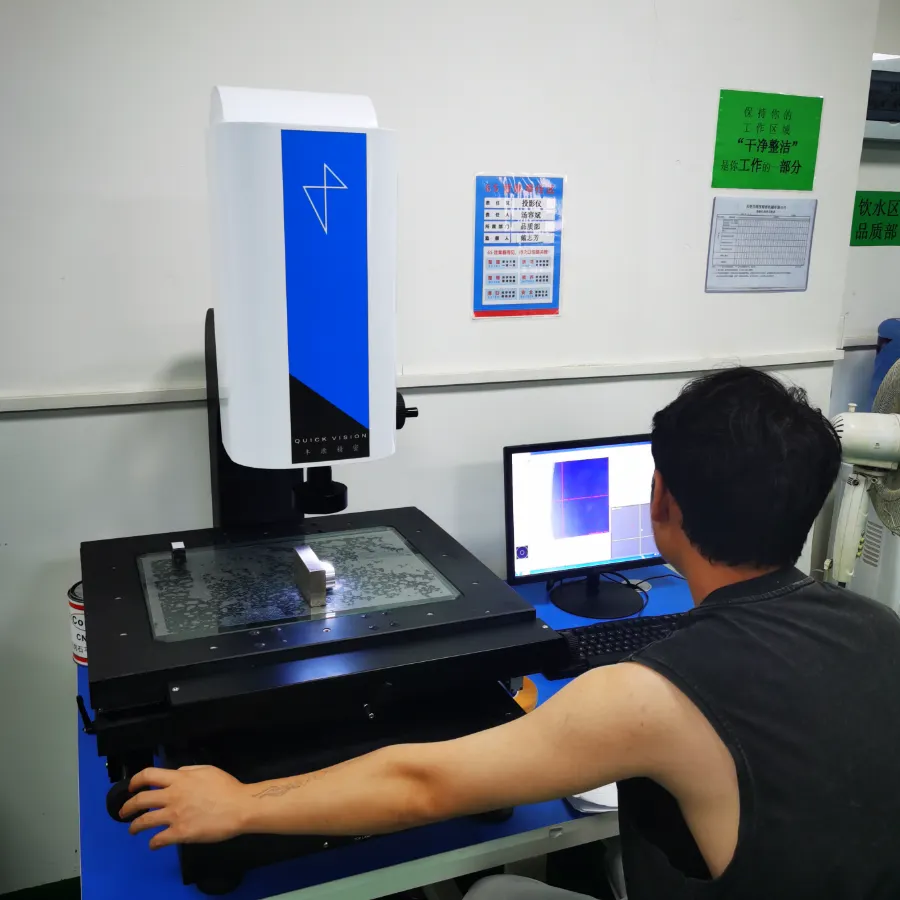
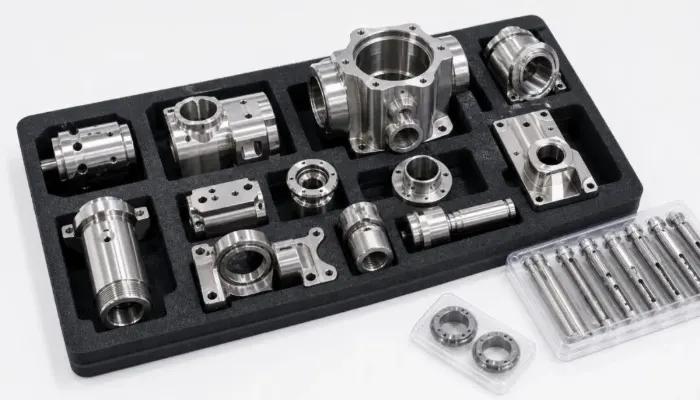
17-4 PH is a precipitation-hardening stainless steel whose strength and hardness can be increased through aging. It is also commonly designated Type 630, SUS630, or UNS S17400. It combines high strength, a degree of corrosion resistance, and well-balanced mechanical properties, and is commonly used in aerospace components, valves, pump bodies, drive shafts, fasteners, medical equipment, and load-bearing industrial parts.
However, the machinability of 17-4 PH changes significantly with the material condition. Condition A, H900, H1025, and H1150 differ in hardness, strength, toughness, and cutting performance. A supplier must not only have basic CNC milling and turning capabilities, but also understand heat-treatment sequencing, machining allowances, thin-wall deformation, and compensation for critical dimensions.
This article presents eight suppliers capable of handling 17-4 PH CNC machining. Each company can also machine other stainless steels, metals, or engineering plastics, but their quotation methods, equipment configurations, material ranges, heat-treatment conditions, and suitable order types differ.
Quick Comparison of 8 Trusted 17-4 PH CNC Machining Suppliers
| Company | In-House Machining Capabilities | Broader Material Capability | Main Feature |
| Xometry | CNC milling, turning, 5-axis machining, and EDM | Stainless steel, aluminum, steel, copper, titanium, and engineering plastics | Online quoting and a flexible manufacturing network |
| Protolabs | CNC milling, turning, and rapid prototyping | Various metals and engineering plastics | Automated quoting and DFM feedback |
| Fictiv | 3- to 5-axis machining, turning, and precision machining | Metals, engineering plastics, and specialty materials | Production management and quality documentation support |
| RapidDirect | 3- to 5-axis milling, turning, and wire EDM | Aluminum, steel, copper, titanium, and engineering plastics | Multi-axis machining and multi-process coordination |
| Weldo Machining | 3- to 5-axis milling, turning, wire EDM, grinding, and CMM inspection | More than 100 metals and engineering plastics | Multi-process coordination and direct engineering communication |
| eMachineShop | CNC milling, turning, 5-axis machining, and wire EDM | Various metals and engineering plastics | Free CAD design software and no minimum quantity requirement |
| Runsom Precision | Multi-axis milling, hard turning, honing, Swiss-type turning, and wire EDM | Stainless steel, alloy steel, aluminum, titanium, and engineering plastics | Machining of hardened materials and precision features |
| 3ERP | 5-axis milling, turning, EDM, wire EDM, and precision grinding | Various metals and engineering plastics | 5-axis machining, XRF, and CMM inspection |
Detailed Reviews of the 8 Suppliers
1. Xometry
Xometry is a digital manufacturing platform that provides CNC milling and turning for parts made from 17-4 PH, 304, 316, and other stainless steels through its manufacturing network. Its material range also includes aluminum alloys, alloy steels, tool steels, copper, brass, titanium, and various engineering plastics. After uploading a design file, customers can evaluate pricing and lead times, making the platform suitable for projects that need to start purchasing quickly.
Advantages:
The online quotation and ordering process is convenient, allowing machining costs and lead times to be compared quickly.
Its manufacturing network covers different equipment and production capacities, making it suitable for high-mix orders or orders with fluctuating quantities.
Material certificates, dimensional reports, first article inspection, and other quality documents can be selected according to the project level.
Potential Drawback:
Parts may be produced by different partner facilities, so the actual equipment, machining experience, and quality-control level must be confirmed for each project.
Best For:
17-4 PH part projects requiring fast quotations, flexible capacity, centralized purchasing of multiple materials, and production ranging from one-off prototypes to medium-volume orders.
2. Protolabs
Protolabs focuses on rapid prototyping and custom part production. Its CNC material list explicitly includes 17-4 PH, along with 303, 304, and 316 stainless steel; aluminum; copper; brass; titanium; alloy steel; and engineering plastics such as ABS, POM, nylon, PEEK, and PEI. After customers upload design files, they can receive quotations and manufacturability feedback, making the service suitable for rapid design validation during product development.
Advantages:
Automated quoting and design analysis are relatively fast, helping identify thin walls, deep cavities, and tool-access limitations in advance.
Standardized production processes are suitable for time-sensitive prototypes, fit-check parts, and small-batch components.
The selection of metals and engineering plastics is fairly comprehensive, making it convenient to source parts made from different materials within the same project.
Potential Drawback:
Special structures, non-standard processes, or extremely tight tolerances may be restricted by its standardized manufacturing rules.
Best For:
Projects that need rapid 17-4 PH design validation, functional testing, assembly trials, or small-batch development, especially for buyers who prioritize quotation speed and DFM feedback.
3. Fictiv
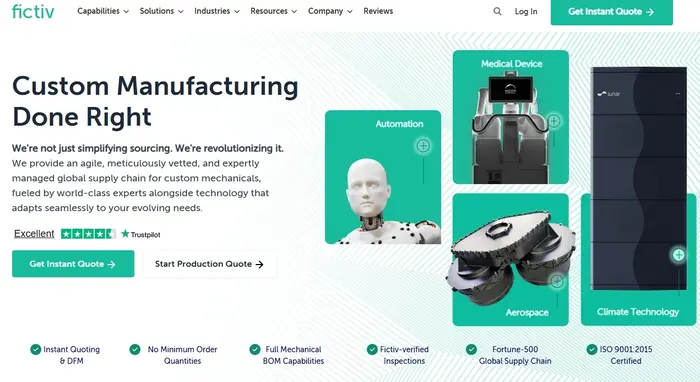
Fictiv is a digital manufacturing platform that explicitly offers 17-4 PH in the H900 and H1150 conditions. It also supports 304, 316, 420, 15-5 PH, A286, tool steel, copper alloys, titanium alloys, and various engineering plastics. The platform can coordinate quotations, production progress, and quality requirements, making it suitable for part orders with clearly defined material conditions and project-management requirements.
Advantages:
H900 and H1150 are explicitly listed, making it easier to select a condition based on the part’s strength, hardness, and toughness requirements.
It can coordinate prototypes, small-batch orders, and subsequent production, making it suitable for development projects that require continuous progress tracking.
Material certificates, dimensional inspection, first article inspection, and custom quality plans can be configured according to project requirements.
Potential Drawback:
Because it uses a platform-based supply chain, the actual production facility and equipment may change according to the order requirements.
Best For:
17-4 PH projects that specify the H900 or H1150 condition and place importance on quality documentation, production-progress management, and the transition from prototypes to volume production.
4. RapidDirect
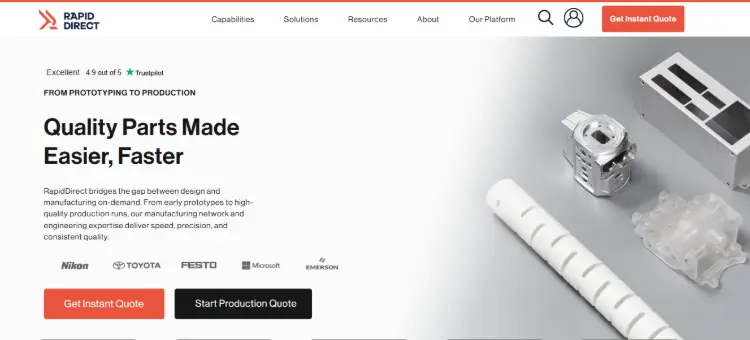
RapidDirect can machine SUS630/17-4 PH as well as 304, 316, 420, and other stainless steels. It also supports parts made from aluminum alloys, copper alloys, titanium alloys, alloy steels, and engineering plastics. Its processes cover 3- to 5-axis milling, CNC turning, and wire EDM, and it can also coordinate post-processing such as passivation, polishing, and electroplating, making it suitable for custom projects with relatively centralized process requirements.
Advantages:
5-axis milling and wire EDM can handle complex surfaces, deep cavities, small corner radii, and special profiles.
Its broad metal and engineering-plastic machining range supports centralized purchasing of multi-material parts used in the same product.
It can connect CNC machining, deburring, and surface finishing, reducing process transfers among multiple suppliers.
Potential Drawback:
The final aging condition and heat-treatment arrangement for 17-4 PH must be confirmed separately during the RFQ stage.
Best For:
17-4 PH parts with complex structures, 5-axis features, wire-EDM profiles, or multiple post-processing requirements, as well as projects that require simultaneous purchasing of other metal and plastic parts.
5. Weldo Machining
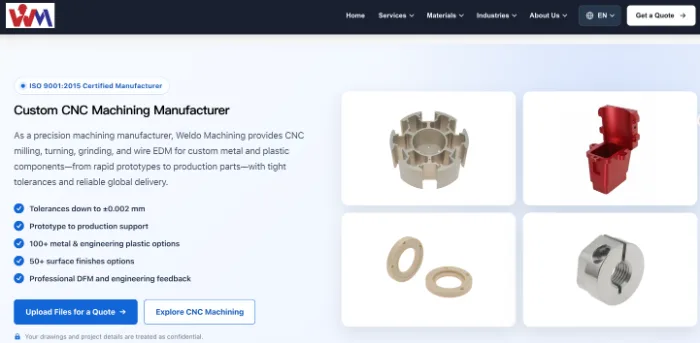
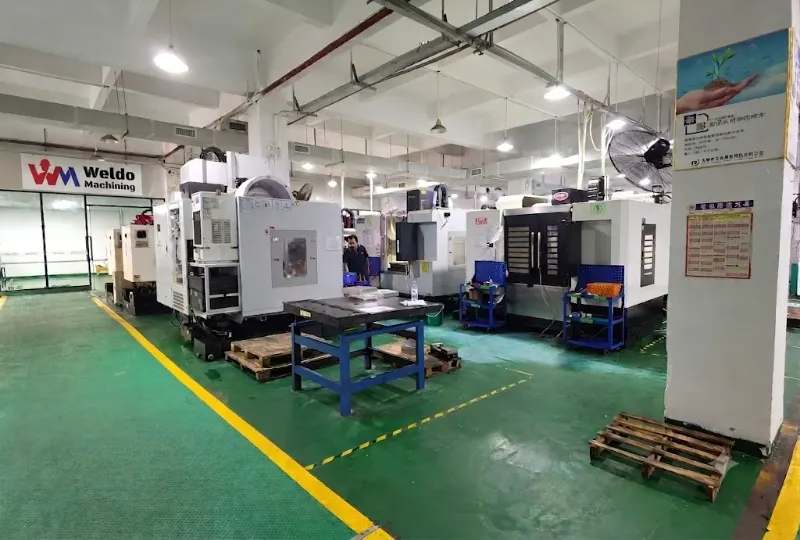
Weldo Machining is a precision CNC machining factory that supports common stainless steels such as 17-4 PH, 303, 304, 316, and 420. It can also process aluminum alloys, titanium alloys, copper alloys, carbon steels, alloy steels, and engineering plastics such as PEEK, POM, nylon, and PTFE, covering more than 100 machinable materials. Its processes include 3- to 5-axis milling, turning, wire EDM, precision grinding, and CMM inspection, together with a range of surface finishes.
Advantages:
It can machine more than 100 metals and engineering plastics, making centralized purchasing of multi-material parts more convenient.
Milling, turning, wire EDM, and grinding can be coordinated to reduce process outsourcing.
Customers can communicate directly with the factory’s engineering team to discuss tolerances, fixturing, machining allowances, and batch control.
Potential Drawback:
Quotations typically require engineers to review the drawings, so prices cannot be displayed instantly as they can on a digital platform.
Best For:
Projects involving 17-4 PH together with other metal or engineering-plastic parts, particularly when complex structures, tight tolerances, multi-process coordination, or repeat-batch consistency are required.
6. eMachineShop
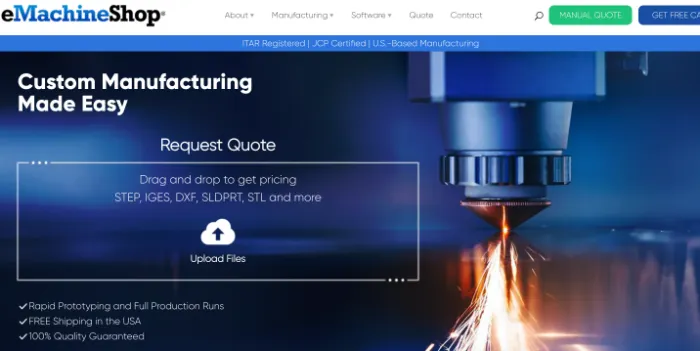
eMachineShop is an online custom parts manufacturer capable of machining precipitation-hardening stainless steels such as 17-4 PH, as well as austenitic, ferritic, martensitic, and duplex stainless steels. In addition to stainless steel, its material options include aluminum, carbon steel, alloy steel, copper, brass, and engineering plastics. Customers can either upload CAD files or use its free design software for modeling and manufacturability checks.
Advantages:
The free CAD software is suitable for buyers without a complete set of design tools, allowing them to check manufacturing conditions while modeling.
It supports milling, turning, 5-axis machining, wire EDM, and other custom manufacturing processes.
There is no strict minimum order quantity, so it can accept one-off prototypes and production orders in different quantities.
Potential Drawback:
For parts with complex heat-treatment routes or those requiring repeated engineering discussions, the online design and ordering process offers relatively limited flexibility.
Best For:
17-4 PH parts whose design, quotation, and ordering are to be completed online, especially one-off prototypes, design-validation parts, and custom orders with variable quantities.
7. Runsom Precision
Runsom Precision provides machining for 17-4 PH as well as 304, 316, and other stainless steels. It can also process aluminum alloys, titanium alloys, nickel-based alloys, copper alloys, tool steels, and engineering plastics. Its published case studies include a 17-4 PH H900 housing, a precision nozzle, and a gear plate involving eccentric turning, hard turning, honing, 4-axis milling, and wire EDM, demonstrating precision machining capabilities for hardened materials.
Advantages:
It has case studies involving 17-4 PH H900 parts, with relatively clear material conditions and machining processes.
Hard turning, honing, and EDM can be used for small holes, precision internal diameters, and complex features after hardening.
Multi-axis milling, precision turning, and Swiss-type turning can cover parts of different sizes and structures.
Potential Drawback:
Special industry standards, heat-treatment documentation, and inspection plans still need to be confirmed in advance for each specific project.
Best For:
17-4 PH parts with demanding requirements for small holes, long deep holes, precision internal diameters, complex surfaces, or machining in the hardened condition, particularly medical and industrial-equipment components.
8. 3ERP
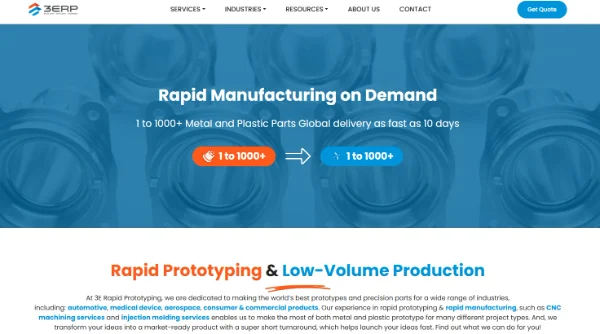
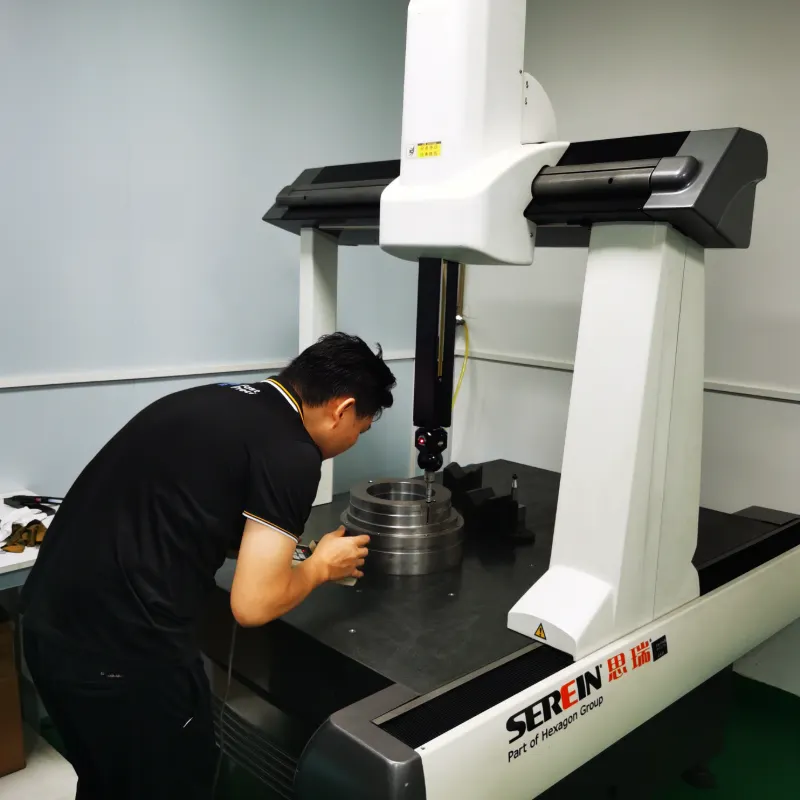
3ERP provides rapid prototyping and precision CNC machining for metals and engineering plastics. Its material list explicitly includes annealed 17-4 PH/1.4542, together with 304, 316, 420, 440C, 15-5 PH, duplex stainless steels, aluminum, copper, titanium, and various plastics. Its capabilities include 5-axis milling, turning, EDM, wire EDM, and precision grinding, with inspection performed using a Hexagon CMM and Olympus XRF equipment.
Advantages:
Annealed 17-4 PH is explicitly listed, making it easier to plan a process route involving machining first, aging afterward, and final finish machining.
5-axis machining, EDM, and precision grinding can handle complex structures and high-precision critical dimensions.
XRF can assist with verifying material composition, while CMM inspection can measure dimensions and geometric tolerances.
Potential Drawback:
Final conditions such as H900, H1025, and H1150, together with responsibility for heat treatment, must be confirmed before the project begins.
Best For:
Prototype and low-volume projects that begin with annealed 17-4 PH and require 5-axis machining, EDM, precision grinding, material identification, or CMM inspection.
How to Choose a Reliable Machining Partner
When fast quotations and DFM feedback are required, Xometry or Protolabs can be selected.
For orders involving many part types and substantial quantity fluctuations, Xometry, Fictiv, or Weldo Machining may be considered. Their supply chains and production capabilities make it easier to coordinate capacity, schedules, and quality documentation.
When reliable lead times and direct engineering communication are priorities, Weldo Machining or RapidDirect may be preferred. Both can coordinate multi-axis machining and related post-processing, making them suitable for multi-process projects.
When seeking stronger overall cost performance, Weldo Machining, RapidDirect, and 3ERP should be compared closely. Weldo Machining supports 17-4 PH and more than 100 metals and engineering plastics, making it suitable for both prototype and production orders.
For machining hardened conditions such as H900, or precision internal bores and deep holes, Runsom Precision or Weldo Machining may be considered. Their capabilities include precision processes such as hard turning, honing, and wire EDM.
For parts with complex surfaces, multi-angle features, or strict inspection requirements, 3ERP’s 5-axis machining, EDM, precision grinding, XRF, and CMM capabilities are more specifically aligned with these needs.
For one-off prototypes, small-batch orders, or online CAD design, eMachineShop or Weldo Machining may be selected. Their design, quotation, and custom-machining processes are relatively convenient.
Common 17-4 PH Machining Challenges and Solutions
The strength, hardness, and machinability of 17-4 PH change with its heat-treatment condition. To maintain stable control of tool life, dimensional accuracy, and surface quality, the following five issues require particular attention during machining.
1. Work Hardening and Tool Wear
17-4 PH is prone to work hardening when the tool rubs repeatedly or the feed is unstable, increasing cutting resistance and accelerating tool wear. Sharp, wear-resistant carbide tools should be used, with continuous cutting and a stable feed maintained to prevent the tool from dwelling or rubbing against the workpiece surface without cutting.
2. Cutting Heat and Chip Control
Machining heat can become concentrated in the cutting zone, while long chips may wrap around the tool or scratch the part surface. Chip breaking can be improved through appropriate chip-breaker geometry, depth of cut, and feed rate, while accurately directed coolant should be used to remove heat and chips promptly.
3. The Heat-Treatment Condition Affects Machining Difficulty
High-hardness conditions such as H900 increase cutting forces and raise the risk of tool wear and edge chipping. Where conditions allow, most material removal can be completed in Condition A before aging, while an appropriate final finishing allowance is retained on critical dimensions.
4. Thin-Walled Parts Are Prone to Deformation
Thin-walled 17-4 PH parts are easily affected by clamping forces, cutting forces, and residual stress, causing dimensions or geometric tolerances to fall outside specification. Low-stress fixturing, symmetrical toolpaths, and staged material removal should be used, and the part should be released and reclamped after rough machining.
5. Dimensional Changes After Heat Treatment
Aging may cause slight dimensional changes in precision holes, mating surfaces, and thin-walled structures. The supplier should plan the heat-treatment sequence in advance, retain a finishing allowance, and remeasure critical dimensions after aging. Corrections should be made through grinding or finish machining where necessary.
What to Check Before Choosing a Supplier
When selecting a 17-4 PH CNC machining supplier, buyers should not compare only unit price and lead time. They should also confirm the supplier’s capabilities in material identification, heat-treatment coordination, precision machining, and quality control.
1. Material and Heat-Treatment Management
Confirm whether the supplier can distinguish among 17-4 PH, SUS630, Type 630, and UNS S17400 and procure the material according to the drawing requirements. The raw-material condition, final aging condition, party responsible for heat treatment, and available material and heat-treatment certificates must also be clarified.
2. Machining and Dimensional Compensation Capabilities
Determine whether the supplier can adjust tools, cutting parameters, and machining sequences according to Condition A, H900, or other conditions. For thin walls, precision holes, and tight geometric tolerances, also confirm whether the supplier has capabilities in staged machining, allowance control, grinding, or finish machining after heat treatment.
3. Inspection and Quality Control
Confirm whether the supplier has CMM, hardness-testing, surface-roughness-testing, and material-identification capabilities. For demanding projects, also verify whether it can provide first article reports, material certificates, heat-treatment reports, dimensional reports, and batch traceability records.
4. Volume Production and Delivery Capabilities
An approved prototype does not necessarily mean that volume production will be stable. Buyers need to understand how the supplier manages tool life, in-process inspection, dimensional compensation, and nonconformance traceability, and should confirm whether outsourced heat treatment and post-processing will affect the overall lead time.
How to Prepare a 17-4 PH Machining RFQ
A complete RFQ package helps suppliers accurately evaluate the machining route, cost, and lead time. For 17-4 PH parts, the RFQ should focus on the following four categories of information.
1. 2D Drawings and 3D Models
Provide 2D drawings with dimensions, tolerances, and technical requirements, together with a 3D model in STEP or STP format. The 2D drawings are used to confirm critical requirements, while the 3D model allows the supplier to analyze the part structure, programming approach, and material usage.
2. Material Standard and Heat-Treatment Condition
In addition to specifying 17-4 PH, state the applicable ASTM, AMS, or other material standard, as well as the original supply condition and final aging condition, such as Condition A, H900, or H1150. Also specify whether the supplier or the buyer is responsible for heat treatment.
3. Tolerances, Surface Roughness, and Post-Processing
Clearly identify critical dimensions, geometric tolerances, surface-roughness requirements, and hardness requirements, and specify passivation, grinding, polishing, deburring, or other post-processing. Reasonable tolerances should be applied to non-critical features to avoid cost increases caused by unnecessarily strict requirements.
4. Quantity, Lead Time, and Quality Documentation
Specify the prototype quantity, volume requirement, target lead time, and expected repeat-purchasing plan. If material certificates, heat-treatment reports, hardness reports, first article inspection, or CMM inspection reports are required, they should also be requested during the RFQ stage.
Conclusion
The key to choosing a 17-4 PH CNC machining supplier is not to find a company that leads in every respect, but to ensure that its material management, heat-treatment coordination, machining processes, and quality-control capabilities match the specific project requirements.
Regardless of which company is ultimately selected, buyers should request quotations using the same drawings, material standards, heat-treatment conditions, order quantities, and inspection requirements. Before placing a formal order, they should also confirm material certificates, heat-treatment responsibility, the control plan for critical dimensions, quality documentation, and the actual lead time, thereby reducing the risks of rework, dimensional deviations, and volume-delivery problems.