
Carbon fiber composites are not stronger than steel in every situation. Continuous carbon fiber reinforced polymer composites (CFRP) usually provide higher specific strength and specific stiffness in the primary fiber direction, making them suitable for lightweight, directionally loaded, and low-thermal-expansion structures; steel, however, provides more stable properties in all directions, ductility, and impact tolerance.
When selecting CFRP or steel, first confirm the load direction, impact risk, joining method, service environment, and cost target instead of comparing only one tensile-strength value.
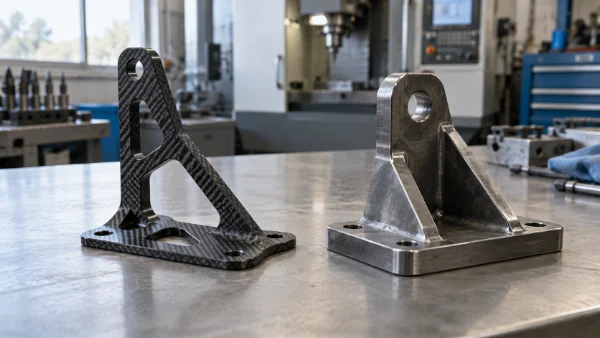
The Fundamental Difference Between Carbon Fiber and Steel
Steel is a homogeneous, isotropic material. Its strength, stiffness, and thermal-expansion behavior do not change substantially with load direction, making it suitable for multidirectional loads, welded assemblies, heavy-duty frames, and impact-resistant structures.
CFRP is made of carbon fibers and a resin matrix and is an anisotropic material. The fibers carry the main tensile loads, while the resin provides interlaminar bonding, shear transfer, and shape stability. Part performance depends on fiber grade, resin system, fiber volume fraction, layup direction, thickness, and connection-area design.
0° plies mainly carry axial tension; 90° plies improve transverse stability; and ±45° plies carry shear and torsional loads. When fiber direction does not match the primary load path, CFRP strength and stiffness decrease significantly. NASA composite-design guidance also states that final composite structural strength is determined by the fiber, resin, fiber orientation, and fiber volume fraction. NASA composite design guidance
Comparison of Key Mechanical Properties
| Onroerend goed | CFRP | Constructiestaal |
|---|---|---|
| Treksterkte | 600–1,500 MPa* | 370–630 MPa |
| Elasticiteitsmodulus | 50–150 GPa* | 200–210 GPa |
| Weight efficiency | Hoog | Matig |
| Failure behavior | Sudden failure possible | Yields before fracture |
| Impact tolerance | Requires validation | Over het algemeen hoger |
*Depends on fiber type, layup, resin system, and load direction.
CFRP provides high load-carrying capability per unit weight rather than outperforming steel in every failure mode. High-performance composite structures can significantly reduce mass, but actual weight savings depend on load type, structural layout, and manufacturing method. NHTSA technical assessment
Comparison of Key Physical Properties
| Onroerend goed | CFRP | Constructiestaal |
|---|---|---|
| Dichtheid | 1.5–1.8 g/cm³ | 7.85 g/cm³ |
| Warmtegeleidingsvermogen | Direction-dependent | 40–60 W/(m·K) |
| Thermal expansion | Low along fibers | 11–13 × 10⁻⁶/K |
| Magnetisme | Niet-magnetisch | Usually magnetic |
| Corrosie | Does not rust | Requires protection |
Advantages of Carbon Fiber Reinforced Polymer
Significant Weight Reduction
CFRP density is typically about one-fifth that of steel. For UAV components, robotic moving parts, racing brackets, and portable equipment frames, weight reduction can reduce inertia, drive load, and energy consumption.
Performance Can Be Designed for the Load Direction
Steel relies on uniform material properties for load carrying. CFRP can place fibers along tensile, bending-tension, or torsional load paths. For parts with clear load directions, CFRP can achieve the required stiffness at lower weight.
It Does Not Develop Steel Rust
CFRP does not form red rust as carbon steel does and is suitable for general humid and outdoor environments. However, the resin may still be affected by ultraviolet exposure, heat and moisture, chemical media, and long-term fatigue environments. Outdoor parts should use weather-resistant resin, clear protective coatings, paint systems, or edge-sealing solutions according to the service conditions.
Low Thermal Expansion Can Be Achieved
CFRP can achieve low thermal expansion along the primary fiber direction, making it suitable for vision-system supports, positioning frames, sensor structures, and precision inspection equipment. Thermal expansion in transverse and thickness directions is still affected by resin and layup, so low thermal expansion should not be treated as a fixed property in every direction.
Limitations of Carbon Fiber Reinforced Polymer
It Is Not Suitable for High-Impact Structures Without Validation
CFRP does not have the plastic-deformation capability of steel. Under overload, drops, or collisions, parts may develop cracks, fiber breakage, or interlaminar delamination, and some damage may not be visible from the surface.
For structures subject to frequent impacts, heavy collisions, or high-energy impact, steel should be considered first, or CFRP should be used only after dedicated composite structural design and validation.
Hole Edges and Joint Areas Are Critical
Drilling, bolt preload, insert installation, and local contact pressure can cause hole-edge crushing, delamination, or resin cracking. CFRP parts should not directly copy the hole locations, edge distances, and tightening torques used for steel parts. Connection loads, hole sizes, edge distances, and fastening methods should be defined during design and quotation.
Galvanic Corrosion Must Be Prevented at Metal Interfaces
When CFRP directly contacts aluminum alloy, carbon steel, or other corrosion-prone metals in humid, salt-spray, or condensation environments, galvanic-corrosion conditions may develop; aluminum alloys are usually more sensitive. Insulating pads, nylon bushings, sealants, coatings, or isolation layers should be used, and moisture should not be allowed to remain at the joint interface. ISO 8057:2024 provides testing guidance for galvanic corrosion in CFRP and protective-coated metal assemblies. ISO 8057:2024
Advantages and Limitations of Steel
Steel offers high stiffness, ductility, impact resistance, and a mature manufacturing system. Ordinary steel parts can be machined, drilled, tapped, ground, welded, and repaired in the field, making steel suitable for equipment frames, heavy-duty brackets, protective structures, and welded assemblies.
The main limitations of steel are weight and corrosion risk. Ordinary carbon steel should use painting, powder coating, electroplating, galvanizing, or other corrosion-protection methods in humid, salt-spray, or outdoor environments. For general structural parts that do not require major weight reduction, steel is usually the lower-cost and more mature option.
How Do Costs Compare?
CFRP cost includes more than raw material. It also includes layup or forming, specialized tooling, dust extraction, hole-edge finishing, edge sealing, and quality inspection. It is suitable for projects where lower weight, high specific stiffness, non-magnetism, or low thermal expansion creates higher part value.
Steel is generally more economical for fixed frames, general supports, high-volume welded structures, and cost-sensitive parts. If weight reduction does not reduce system energy use, drive-system size, or transportation cost, CFRP often has no sufficient cost advantage.
How Does Thermal Performance Compare?
The thermal conductivity of conventional CFRP is strongly directional. It can conduct some heat along the fiber direction, while heat transfer through the thickness is usually limited by resin layers. Different fiber types, resins, fiber contents, and layups produce significant variation, so projects with defined thermal requirements should use supplier data or sample testing.
Heat sinks, heat-exchange plates, high-heat-flux mounting seats, and primary heat-source structures usually use aluminum, copper, or metal structures. CFRP can be used for lightweight support structures around heat sources, but it should be paired with metal heat-spreading inserts, thermal pads, or independent heat-transfer paths.
CNC Machining Performance of CFRP and Steel
CNC Machining of CFRP
Cured CFRP sheets, tubes, and profiles can be CNC milled, profile cut, drilled, slotted, and edge finished. The key machining concerns are delamination, fiber pull-out, hole-edge damage, dust, and tool wear.
PCD or diamond-coated tools are commonly used with stable workholding and effective dust extraction. For critical holes, supporting the entry and exit surfaces, controlling feed parameters, and optimizing drilling sequence can reduce hole-edge damage. After machining, deburring, edge sealing, insert installation, and cleaning can be completed according to the drawing.
CNC Machining of Steel
Steel supports CNC frezen, turning, drilling, tapping, grinding, and welding. Key concerns are cutting heat, tool life, stress distortion, and subsequent corrosion protection. Low-carbon steels are generally economical to machine; high-strength steels, thick-wall parts, or precision-fit parts may require separated roughing and finishing operations, stress relief, and final machining of critical dimensions.
How Should CFRP Parts Be Designed Around Connection Areas?
CFRP parts should define the primary load direction before the layup and joint areas are designed. Providing only external dimensions without material, thickness, layup, or installation conditions prevents the supplier from accurately evaluating hole-edge load capacity, stiffness, and machining risk.
Bolt-joint areas usually require washers, bushings, inserts, or local reinforcement to distribute bearing pressure. Adhesive bonding is suitable for large-area joints and can reduce local stress concentration, but the adhesive, surface preparation, curing conditions, and service environment must be specified. Critical structures usually require prototype or structural validation before the final design is approved.
Which Parts Are Suitable for Carbon Fiber?
UAV and Lucht- en ruimtevaart Equipment
Mounting plates, arm joints, electronics trays, sensor brackets, and lightweight structural panels are often weight- and stiffness-sensitive and are suitable for CFRP evaluation.
Robotica and Automation Equipment
Robot end-effector plates, moving-mechanism brackets, vision-system supports, and lightweight fixtures can use CFRP to reduce moving mass and improve dynamic response.
Racing and Sports Equipment
Instrument panels, mounting brackets, seat accessories, covers, and lightweight fasteners can use CFRP. The design should focus on fastening areas, vibration loads, and impact risk.
Precision Inspection Equipment
Low thermal expansion, non-magnetism, and high specific stiffness make CFRP suitable for vision-equipment supports, sensor frames, inspection-platform accessories, and portable instrument structures.
When Is Steel the Better Choice?
Steel is more suitable for projects involving high impact, multidirectional heavy loads, welding, the need for plastic-deformation warning, or strong cost sensitivity. Heavy-duty frames, protective structures, field-repairable equipment, frequently impacted parts, and structures operating continuously above the long-term temperature limit of the resin system should generally use steel first.
Weldo Custom Carbon Fiber CNC Machining Services
Weldo supports drawing-based CNC machining of custom CFRP parts, including carbon fiber plates, brackets, panels, mounting plates, and lightweight structural components. We can evaluate the machining route according to material type, thickness, fiber orientation, critical holes, joining method, and service environment, then arrange profile machining, drilling, edge finishing, insert installation, and drawing-required dimensional inspection.
For custom carbon fiber CNC parts, please provide the drawing, material or layup information, quantity, critical dimensions, joining method, and service loads. Weldo will evaluate manufacturability, hole-edge treatment, edge-sealing requirements, and inspection priorities accordingly.
Veelgestelde vragen
Can CFRP Parts Be Tapped Directly?
This is not recommended. The resin matrix in CFRP cannot provide stable long-term thread load capacity, and repeated assembly may damage the thread or cause interlaminar damage. Metal inserts, threaded bushings, or separate metal connection components should be used where threads are required.
Can Carbon Fiber Parts Be Used for Electrical Grounding?
They should not be assumed to do so. CFRP resistance varies with fiber direction, layup, resin system, and contact location. When grounding, shielding, or current-carrying performance is required, a separate metal conductive path should be designed and tested for electrical resistance.
Can Carbon Fiber Parts Be Painted or Printed?
Yes. CFRP can receive surface cleaning, primer, paint, clear protective coatings, and marking printing. The selected process must be compatible with the resin system and must avoid critical bonding areas, insulation areas, and precision-fit regions.
How Can Internal Damage in CFRP Parts Be Inspected?
Visual inspection can identify burrs, hole-edge damage, surface cracks, and obvious delamination. For internal delamination, fiber breakage, or critical structural defects, tap testing, ultrasonic inspection, thermography, or CT inspection should be selected according to project requirements.
How Should Woven and Unidirectional Carbon Fiber Sheets Be Selected?
Woven carbon fiber sheets are suitable for parts with higher cosmetic requirements and more balanced in-plane loading. Unidirectional carbon fiber sheets are suitable for structures with clear load directions that require higher strength or stiffness in a specific direction. The final selection should be based on load direction, part geometry, and joining method.