
Usinage CNC et fabrication de tôles résoudre divers problèmes de fabrication. L'usinage CNC est adapté aux structures massives, aux repères de précision, aux formes tridimensionnelles complexes et aux tolérances locales strictes, tandis que la tôlerie convient aux grandes structures à parois minces, aux boîtiers d'équipements, aux panneaux, aux supports et aux assemblages légers.
Les pièces pouvant être dépliées en plans à épaisseur constante doivent être fabriquées par tôlerie. Les pièces nécessitant des perçages de précision, des sections épaisses ou des structures porteuses intégrées doivent être usinées par commande numérique (CNC). Les assemblages comportant ces deux types de caractéristiques doivent faire l'objet d'une approche de fabrication hybride.
Une solution de fabrication adaptée permet non seulement de réduire le coût unitaire, mais aussi de minimiser les erreurs cumulées lors du montage sur gabarit, du soudage, de l'assemblage et du contrôle. Les acheteurs devraient procéder à une analyse de la fabrication dès la phase de conception, plutôt que d'attendre que le plan soit finalisé et de se baser sur les devis pour déterminer le mode de fabrication.
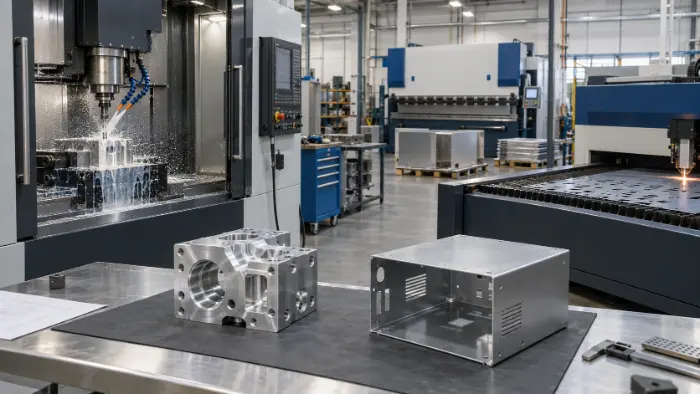
Quels sont les procédés utilisés dans l'usinage CNC et la tôlerie ?
L'usinage CNC ne se résume pas à une seule opération de fabrication, et la transformation de la tôle ne se limite pas au pliage. Comprendre les processus spécifiques propres à chaque méthode de fabrication aide les acheteurs à déterminer si un plan est réalisable, combien d'opérations sont nécessaires et quels sont les facteurs qui influencent le devis.
Procédés courants d'usinage CNC
Fraisage CNC: Les outils de coupe rotatifs enlèvent de la matière dans plusieurs directions afin de réaliser des surfaces planes, des poches, des rainures, des alésages, des paliers et des contours tridimensionnels complexes. L'usinage à trois axes convient aux surfaces et aux poches à orientation fixe, tandis que l'usinage à quatre et cinq axes permet de réduire les changements de configuration répétés pour les pièces complexes. Parmi les applications typiques, on peut citer les boîtiers de précision, les socles de montage, les gabarits et les composants structurels.
Tournage CNC: La pièce tourne autour de la broche tandis que les outils de coupe réalisent des diamètres extérieurs, des alésages intérieurs, des faces d'extrémité, des cones, des rainures et des filetages. Ce procédé convient aux arbres, goupilles, manchons, douilles, raccords et autres composants rotatifs. Les machines de fraisage-tournage équipées d’outils motorisés et de sous-broches peuvent également réaliser des alésages transversaux, des méplats, des alésages excentriques et des usinages sur la face arrière.
Perçage et taraudage : Le perçage permet de réaliser des trous de fixation, des trous de repérage et des passages de fluide, tandis que le taraudage permet de réaliser des filetages intérieurs. Le fait de réaliser le profil principal, le perçage et le taraudage en un seul serrage permet de réduire les erreurs de positionnement dues aux changements de référence.
Alésage et alésage à la broche : L'alésage permet de corriger la position, la rectitude et le diamètre d'un trou, tandis que l'alésage de précision garantit des cotes d'ajustement stables et une qualité de surface optimale. Ces procédés sont principalement utilisés pour les alésages de roulements, les trous de repérage, les alésages de soupapes et les trous d'assemblage de précision.
Meulage de précision: La rectification permet un contrôle plus précis du diamètre extérieur, de la circularité, de la cylindricité, de la planéité et de la rugosité de surface. Les pièces en acier trempé doivent prévoir une marge de rectification avant le traitement thermique, afin que les cotes critiques puissent être rétablies lors de la rectification finale.
Procédés courants de travail de la tôle
Découpe au laser de tôles: Un faisceau laser suit un programme CNC pour découper le profil de la pièce, ainsi que les trous, les fentes et les ouvertures. Ce procédé ne nécessite pas de matrices de découpage spécifiques, ce qui le rend adapté aux prototypes, aux commandes en petites séries et aux pièces en tôle présentant de fréquentes variations de conception. La qualité de la découpe dépend du matériau, de l'épaisseur de la tôle, de la puissance du laser, du gaz d'assistance et des paramètres de découpe.
Poinçonnage à tourelle CNC : Une poinçonneuse à tourelle utilise des outils standard ou sur mesure pour réaliser des trous ronds, carrés ou oblongs, des persiennes, des motifs en relief et des motifs de ventilation. Le poinçonnage à tourelle permet de réduire les délais de production lorsqu'une pièce comporte de nombreux trous répétitifs ou des motifs standard.
Pliage : Une presse plieuse à commande numérique utilise une matrice supérieure et une matrice inférieure pour plier une tôle plate selon un angle défini. Les structures tridimensionnelles des boîtiers d'équipements, des supports, des châssis et des capots sont principalement réalisées par pliage. La résistance du matériau, l'épaisseur de la tôle, le rayon de pliage et l'ouverture de la matrice déterminent la force de pliage nécessaire et le retour élastique.
Laminage et cintrage de tôles : Les rouleaux modifient en continu la courbure de la tôle afin de fabriquer des cylindres, des carters courbés, des protections et des structures tubulaires. L'usine doit compenser le retour élastique en fonction du rayon souhaité et contrôler la courbure finale au moyen de plusieurs passages de laminage.
Soudage : Le soudage TIG, le soudage MIG, le soudage par points et le soudage au laser permettent d’assembler plusieurs pièces en tôle. Une fois le soudage terminé, il faut nettoyer les soudures, corriger les dimensions et contrôler la qualité des assemblages. Les assemblages soumis à des exigences dimensionnelles strictes nécessitent également des gabarits spécifiques pour maîtriser le retrait et le gauchissement liés au soudage.
Installation des pièces de fixation par emboîtement : Les écrous à sertir, les goujons et les écrous flottants constituent des solutions d'assemblage fiables dans les tôles fines. Les caractéristiques techniques de la fixation, le diamètre du trou de montage et l'épaisseur de la tôle doivent être compatibles. Une combinaison inadaptée peut entraîner une rotation, un desserrage ou une déformation de la tôle.
Les machines de découpe de tôles, les poinçonneuses à tourelle et les presses plieuses utilisent également des systèmes CNC. Par conséquent, la différence entre l'usinage CNC et la fabrication de tôles ne réside pas dans l'utilisation ou non de la commande numérique. La distinction tient à la méthode de fabrication : l'usinage CNC consiste principalement à enlever de la matière à partir d'un bloc solide, tandis que la fabrication de tôles consiste à découper, former et assembler des tôles.

Comparaison des compétences clés : usinage CNC et tôlerie
| Facteur de comparaison | Usinage CNC | Fabrication de tôles |
|---|---|---|
| Matière première | Barres, tôles épaisses, billettes, pièces moulées et pièces forgées | Tôle et bobine d'épaisseur constante |
| Structure de la pièce | Pièces pleines, pièces à parois épaisses et structures tridimensionnelles complexes | Boîtiers, panneaux, supports et châssis à parois minces |
| Contrôle dimensionnel | Convient aux alésages de précision, aux surfaces de référence et aux tolérances locales strictes | Nécessite la maîtrise du retour élastique après cintrage, de la déformation due au soudage et de l'accumulation des tolérances |
| Caractéristiques de résistance à la charge | Convient aux charges concentrées, aux assemblages de précision et aux structures monoblocs | Convient pour obtenir une rigidité optimale tout en conservant la légèreté grâce à des rebords et des nervures de renfort |
| Utilisation des matériaux | Les structures à haut taux d'enlèvement génèrent davantage de copeaux | Un imbrication efficace des plans plats permet une meilleure utilisation des matériaux |
| Modifications de la conception | La plupart des paramètres peuvent être modifiés en modifiant le programme et la trajectoire d'usinage | Les plans de dépliage, les programmes de pliage et l'outillage doivent être mis à jour simultanément |
| Produits typiques | Corps de vannes, embases de montage, dispositifs de fixation, arbres, et des boîtiers de précision | Boîtiers, couvercles, protections, supports et panneaux de fixation |
Ce tableau définit les grandes lignes préliminaires du processus. La solution de fabrication définitive doit être déterminée à l'issue d'une étude technique portant sur la nuance du matériau, les dimensions, les tolérances, la quantité, la méthode d'assemblage et les critères de réception.
Comment choisir un procédé de fabrication en fonction de la géométrie de la pièce ?
Le choix du procédé doit se fonder en priorité sur la fonction et la géométrie de la pièce, plutôt que sur une simple comparaison des prix unitaires. Un procédé de fabrication inadapté entraîne une augmentation de la consommation de matière, du nombre d'étapes de fabrication et des erreurs d'assemblage, ce qui se traduit au final par des retouches, des rebuts et des retards de livraison.
Quand opter pour l'usinage CNC ?
La pièce comporte des alésages de précision et des surfaces d'ajustage critiques : Les alésages de roulements, les trous de centrage, les surfaces d'étanchéité et les ajustements glissants exigent une précision dimensionnelle et géométrique stable. L'usinage CNC permet de réaliser des alésages, des faces d'extrémité et des géométries externes à partir d'un repère commun, ce qui réduit les erreurs de positionnement entre les éléments. Les alésages de dimensions serrées peuvent être réalisés par alésage, alésage de précision, honage ou rectification.
La pièce présente une géométrie tridimensionnelle complexe : Les cavités profondes, les surfaces courbes, les gradins, les alésages inclinés et les éléments locaux présentant des orientations multiples ne peuvent pas être réalisés par pliage de tôles. L'usinage à trois, quatre ou cinq axes enlève de la matière conformément au modèle tridimensionnel et contrôle les relations de position entre des surfaces complexes.
La pièce nécessite des sections épaisses ou une structure porteuse intégrée : Les pièces soumises à des charges concentrées, à des chocs, à des forces de serrage ou à une pression interne nécessitent des sections de matériau continues. L'usinage monobloc élimine les soudures et les interfaces d'assemblage mécanique, empêchant ainsi que les zones affectées par la chaleur et les fixations desserrées ne deviennent des points faibles de la structure.
Les tolérances locales et les exigences en matière de finition sont strictes : L'usinage CNC doit définir des repères précis lorsque la planéité, la concentricité, la circularité, la position ou la rugosité de surface ont une incidence directe sur l'assemblage ou le mouvement. Les pièces en acier ayant subi un traitement thermique nécessitent également un meulage pour atteindre la précision finale requise.
Les fonctionnalités complexes nécessitent des modifications rapides de la conception : L'usinage CNC permet de réaliser des trous, des rainures, des poches et des contours tridimensionnels en modifiant le programme et la trajectoire d'outil, sans avoir recours à de nouveaux outils d'estampage. Il convient à la fabrication de prototypes fonctionnels en petites séries présentant des structures complexes.
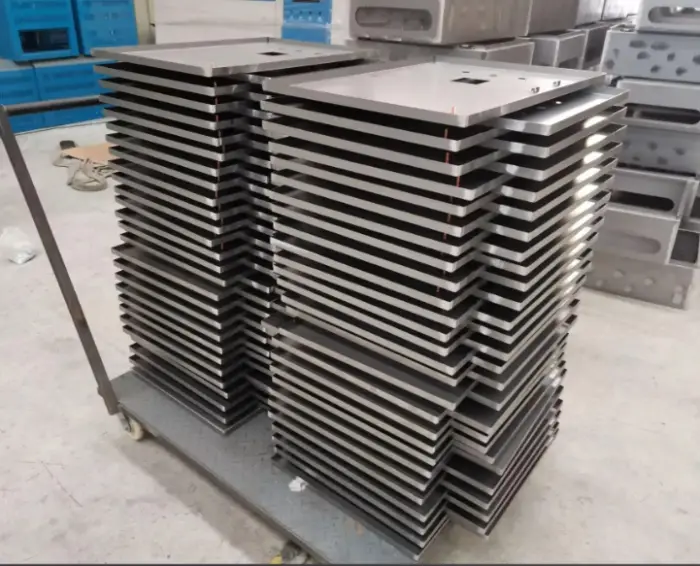
Quand opter pour la tôlerie ?
La pièce est principalement constituée de parois d'épaisseur constante : Une pièce pouvant être dépliée en un patron plat se prête bien à la découpe laser de tôle, suivie d'un pliage pour lui donner sa forme tridimensionnelle. Ce procédé évite d'enlever de grandes quantités de matière à partir d'un ébauche pleine et convient particulièrement aux assemblages de grande taille à parois minces.
Le produit est un boîtier, un panneau ou un support : Les boîtiers d'équipement, les armoires de commande, les protections, les châssis et les supports de fixation ont principalement pour fonction d'assurer le recouvrement, le maintien et la fixation. Les brides, les rebords et les moulures de renfort garantissent une rigidité suffisante tout en réduisant le poids.
La structure comporte de nombreuses ouvertures dans les tôles : Les trous d'aération, les passages de câbles, les trous de fixation et les zones de refroidissement peuvent être découpés ou poinçonnés alors que la tôle reste à plat. Les trous doivent être positionnés en dehors des zones de déformation dues au pliage et respecter des distances suffisantes par rapport aux bords et aux plis.
Le poids total doit être contrôlé : La tôle utilise des rebords, des moulures de renfort et des plaques de renfort locales pour améliorer la rigidité structurelle sans augmenter l'épaisseur de l'ensemble de la pièce. Cette construction convient aux équipements électroniques légers, aux systèmes d'automatisation et aux équipements de transport.
La conception est finalisée en vue de la production : Une fois la conception finalisée, l'usine peut optimiser l'imbrication des tôles, les séquences de pliage, les gabarits de soudage et les processus d'assemblage. Un processus de fabrication bien défini permet de répartir les coûts de programmation et d'outillage tout en améliorant la régularité de la production.
Les grands boîtiers à parois minces ne doivent pas être usinés à partir de blocs massifs, et les structures de précision présentant des relations de référence strictes ne doivent pas être adaptées de force à des conceptions en tôle soudée composées de plusieurs pièces. Le procédé doit être au service de la fonction de la pièce plutôt que d'un simple devis.
Quelles sont les différences en matière de tolérance, de résistance et d'aspect de surface ?
Contrôle de la tolérance
L'usinage CNC permet de réaliser directement des alésages de précision, des surfaces d'ajustage et des repères de contrôle, ce qui le rend particulièrement adapté aux pièces présentant des dimensions locales strictes et des tolérances géométriques serrées. La précision finale dépend à la fois de l'état des outils, de la stabilité thermique de la machine, de la rigidité du dispositif de fixation et des méthodes de contrôle.
Les pièces usinées par CNC à parois minces sont soumises à la force de serrage, à la chaleur de coupe et aux contraintes résiduelles. L'usine doit maîtriser la déformation grâce à une découpe par couches, un enlèvement symétrique de matière, un serrage à faible contrainte et un desserrage intermédiaire. Le fait d'enlever une grande quantité de matière d'un seul côté en une seule opération perturbe l'équilibre initial des contraintes, ce qui entraîne des variations de planéité, d'épaisseur de paroi et de position des trous.
Les dimensions des tôles dépendent de l'épaisseur, du sens de laminage, du rayon de pliage, de l'ouverture de la matrice et du retour élastique. Chaque pliage supplémentaire ajoute une nouvelle source de variation à la chaîne dimensionnelle. Dans les structures comportant plusieurs plis, les dimensions clés doivent provenir d'un repère commun, afin d'éviter que plusieurs dimensions non critiques ne forment une chaîne de tolérances cumulées complexe.
Le soudage entraîne une dilatation et une contraction thermiques localisées. Les assemblages soumis à des exigences dimensionnelles strictes nécessitent des gabarits spécifiques, un soudage symétrique, un soudage par intermittence et un apport de chaleur contrôlé. Après le soudage, l'assemblage doit être redressé avant que les alésages de précision et les surfaces d'accouplement ne soient usinés par commande numérique.
Force et poids
Une structure usinée d'un seul tenant par commande numérique (CNC) présente une section continue et est adaptée aux charges concentrées, aux chocs, aux forces de serrage et à la pression interne. Certaines sections locales peuvent conserver une épaisseur plus importante, tandis que les transitions arrondies réduisent la concentration des contraintes.
Les structures en tôle offrent un rapport rigidité/poids élevé. Les rebords, les ourlets, les moulures de renfort et les nervures augmentent la rigidité à la flexion sans alourdir significativement la pièce. La capacité de charge d'une pièce en tôle est déterminée par l'épaisseur de la tôle, la résistance du matériau, le sens de pliage, le procédé d'assemblage et le chemin de charge réel.
Il est erroné de supposer que les pièces usinées par CNC sont toujours plus résistantes ou que les pièces en tôle sont toujours plus légères. Une comparaison correcte consiste à évaluer deux conceptions répondant aux mêmes exigences en matière de charge, de déformation, de durée de vie et de coefficient de sécurité avant de comparer leur poids et leur coût.
Aspect de la surface
Les pièces usinées par CNC conservent des traces d'outils directionnelles après l'usinage. Le grenaillage, le brossage, le polissage, l'anodisation, la passivation, la galvanoplastie et le revêtement de conversion chimique peuvent améliorer l'aspect, la résistance à la corrosion et la résistance à l'usure. Les plans doivent distinguer les surfaces esthétiques, les surfaces d'accouplement, les zones à masquer et les emplacements de serrage autorisés.
Les pièces en tôle présentent des arêtes de coupe, des marques de pliage et des zones soudées. Le meulage des soudures, le brossage, le grenaillage, le revêtement par poudre, le revêtement électrophorétique et la peinture permettent d'obtenir un aspect homogène. Les critères d'acceptation esthétique doivent définir les surfaces visibles, la couleur, la brillance, le sens du grain et les défauts admissibles, afin que l'acheteur et l'usine appliquent la même norme d'inspection.
Comment se comparent le coût, la quantité et le délai de livraison ?
Ces deux procédés reposent sur des structures de coûts différentes ; par conséquent, les prix des matériaux ou les tarifs horaires des machines ne suffisent pas à eux seuls à établir une comparaison valable. Le coût total comprend la préparation des matériaux, l’usinage, l’outillage, le post-traitement, le contrôle, l’assemblage, l’emballage et le risque de non-conformité.
Facteurs influant sur le coût de l'usinage CNC
Matériau et volume à enlever : Plus l'écart entre le volume de la pièce finie et celui de la matière première est important, plus il faut enlever de matière, ce qui augmente la durée d'usinage, l'usure des outils et les coûts de matière. Pour les boîtiers à cavités profondes, il convient d'envisager l'utilisation d'ébauches « near-net-shape » (proches de la forme finale) ou d'une structure hybride associant tôle et usinage CNC afin de réduire l'enlèvement de matière inutile.
Durée d'usinage et nombre de réglages : Chaque direction d'usinage supplémentaire nécessite davantage d'axes sur la machine, un nouveau réglage ou un dispositif de fixation dédié. Les réglages multiples augmentent la charge de travail et sont source d'erreurs de transfert de points de référence. L'usinage à quatre axes, à cinq axes et l'usinage fraisage-tournage permettent de réduire le nombre de réglages tout en améliorant la précision et l'efficacité.
Caractéristiques complexes et contraintes liées à l'outillage : Les alésages profonds, les rainures étroites, les petits rayons internes et les poches à rapport d’aspect élevé nécessitent des outils longs et effilés, ainsi que des paramètres de coupe réduits. Une rigidité moindre de l’outil entraîne une augmentation du nombre de passes de réduction, d’opérations de nettoyage des angles et de passes de finition.
Tolérances et contrôle : Les tolérances serrées nécessitent des passes de finition supplémentaires, une compensation dimensionnelle et un contrôle. Les exigences de haute précision ne doivent s'appliquer qu'aux cotes qui influent sur l'ajustement, l'étanchéité, le positionnement et le mouvement. Pour les cotes non fonctionnelles, il convient d'utiliser des tolérances générales pratiques.
Facteurs influant sur le coût de la fabrication de tôles
Découpe au laser et imbrication : Les coûts de découpe laser de la tôle sont déterminés par la longueur totale de découpe, le nombre de perçages, le matériau et l'épaisseur de la tôle. Un imbrication efficace améliore l'utilisation de la tôle et réduit les chutes. La présence de nombreux petits trous et de profils complexes augmente le temps nécessaire au perçage et à la découpe.
Nombre de plis et de réglages d'outillage : Chaque pliage nécessite un positionnement, une réorientation et une compensation d'angle. Les pièces présentant de nombreuses directions de pliage ou présentant des interférences avec l'outillage nécessitent un outillage spécial, des manipulations manuelles supplémentaires ou un découpage en plusieurs composants.
Soudage et redressage après soudage : Les soudures plus longues entraînent une augmentation des besoins en main-d'œuvre, en gaz de protection, en métal d'apport et en meulage. Le retrait de soudure provoque également un gauchissement ; c'est pourquoi les assemblages de précision nécessitent des gabarits spécifiques, des séquences de soudage contrôlées et un redressage après soudage.
Matériel et montage : Les écrous, goujons, charnières et autres composants à serrage automatique impliquent un surcroît de matière et d'opérations de montage. Les acheteurs doivent comparer le coût de l'ensemble fini plutôt que de se limiter au prix des ébauches découpées au laser.
L'influence de la quantité et du délai de livraison
Au cours de la phase de prototypage, ni l'usinage CNC ni la découpe et le pliage au laser ne nécessitent de grands outils de production spécifiques. L'usinage CNC permet de modifier rapidement des formes tridimensionnelles complexes, tandis que la tôlerie permet d'apporter rapidement des modifications aux plans de découpe et à la géométrie des plis.
En ce qui concerne les volumes de production, les coûts liés à l'usinage CNC sont réduits grâce à l'optimisation des parcours d'outils, des dispositifs de fixation et de la durée des cycles. Les coûts liés à la tôlerie sont réduits grâce à l'amélioration de l'imbrication, de l'enchaînement des pliages, des dispositifs de soudage et du flux d'assemblage. La disponibilité des matériaux, la quantité à produire, la finition de surface et les exigences en matière de contrôle doivent être définies lors de l'établissement du devis afin de mettre en place un plan de production stable.
La fabrication de tôles permet de réduire le poids des matériaux et le temps de découpe pour les grands boîtiers à parois minces. L'usinage CNC réduit les coûts de retouche liés au soudage, à l'assemblage et aux erreurs cumulées pour les pièces présentant des interfaces de précision, des sections épaisses ou une géométrie interne complexe.
Dans quels cas faut-il associer l'usinage CNC et la tôlerie ?
La fabrication hybride offre un meilleur équilibre entre coût et performances lorsqu’un ensemble comporte à la fois une grande structure à parois minces et des interfaces locales de haute précision. Le fait de vouloir réaliser l’ensemble du montage selon un seul et même procédé entraîne un gaspillage de matière, une complexité structurelle ou une précision insuffisante.
Carrosserie en tôle avec des éléments de fixation de précision usinés par CNC : Les boîtiers, châssis et structures des équipements sont découpés au laser et pliés, tandis que les logements de roulements, les blocs de positionnement, les rails et les interfaces de connexion sont usinés par commande numérique. La tôle détermine les dimensions et le poids globaux, tandis que les composants usinés par commande numérique assurent un positionnement précis et la résistance aux charges.
Interfaces critiques de la machine après le soudage : Les faces de bride, les surfaces d'étanchéité et les alésages de montage de précision ne doivent pas faire l'objet d'un usinage de finition avant le soudage. La séquence correcte est la suivante : découpe, pliage, soudage, redressage, puis usinage CNC des interfaces critiques. Cette séquence permet d'éliminer les effets dimensionnels du retrait de soudure.
Utilisez des raccords mécaniques pour réduire la déformation thermique : Les assemblages sensibles aux déformations dues au soudage peuvent faire appel à des goupilles de positionnement, des boulons, des fixations à sertissage et des épaulements de positionnement usinés par CNC. Les assemblages mécaniques simplifient le démontage et la maintenance tout en évitant les déformations thermiques étendues provoquées par les soudures continues.
Définir des repères communs d'assemblage : Les composants usinés par CNC et les pièces en tôle doivent comporter des trous de repérage, des épaulements, des surfaces de référence ou des goupilles de repérage bien définis. Les trous de boulons standard ne permettent pas à eux seuls d'assurer un positionnement de précision.
La fabrication hybride ne se résume pas à l'assemblage de deux types de pièces. Les fonctions doivent être réparties dès la phase de conception : les pièces en tôle assurent la protection, le soutien et la légèreté de la structure, tandis que les composants usinés par CNC garantissent le positionnement, l'ajustement, l'étanchéité et la capacité de charge locale.
Comment choisir un fournisseur de services de fabrication ?
Un fournisseur qui propose séparément l'usinage CNC et la tôlerie ne dispose pas automatiquement des compétences techniques nécessaires pour intégrer ces deux processus. Les acheteurs doivent s'assurer que l'usine est en mesure de gérer les repères d'usinage, les tolérances de pliage, la déformation due au soudage, la finition de surface et le contrôle de l'assemblage dans le cadre d'un flux de travail unique et contrôlé.
Capacités d'usinage CNC : Vérifiez que l'usine propose des services de fraisage, de tournage, d'alésage, de taraudage et de rectification de précision. Pour les pièces critiques, il convient également de vérifier la course des machines, la configuration des axes, les performances de la broche, les méthodes de fixation et les équipements de contrôle. Le nombre de machines ne suffit pas à lui seul à refléter la capacité de production réelle ; l'expérience acquise avec des pièces similaires et la maîtrise des processus sont tout aussi importantes.
Capacités de découpe au laser et de pliage de la tôle : Vérifiez les matériaux, les épaisseurs de tôle, les dimensions des tôles et les longueurs de pliage que le fabricant est en mesure de traiter. Pour les grandes enceintes, il convient également de vérifier la puissance de la presse plieuse, la précision de la butée arrière et la disponibilité d’un outillage spécial. L’usine doit évaluer les interférences entre les outils, la longueur minimale des rebords et la distance entre les trous et les plis avant le lancement de la production.
Soudage et contrôle de la déformation : Le fournisseur doit choisir entre le soudage TIG, MIG, par points ou au laser en fonction du matériau, de l'épaisseur et des exigences esthétiques. Les assemblages de précision nécessitent des gabarits de soudage spécifiques, des séquences de soudage contrôlées et un contrôle dimensionnel après soudage. Le redressage manuel ne suffit pas à lui seul à garantir la cohérence de la production à long terme.
Gestion des points de référence inter-processus : Les composants usinés par CNC et les pièces en tôle au sein d’un assemblage hybride doivent utiliser des repères d’assemblage communs. Avant la production, le fabricant doit définir la méthode de positionnement, la chaîne dimensionnelle et la procédure de contrôle. Cela évite que différents services n’usinent selon des repères distincts, ce qui peut donner lieu à des pièces acceptables individuellement mais qui présentent des défauts lors de l’assemblage.
Coordination du post-traitement : L'anodisation, le placage, la passivation, le revêtement par poudre et la peinture modifient l'état de la surface et les dimensions locales. Le fournisseur doit tenir compte de l'épaisseur du revêtement, des zones de masquage, de la protection des filetages et des jeux nécessaires à l'assemblage après finition. La mise en place des pièces par emboîtement à la presse et les opérations de soudage doivent également être planifiées en fonction de la séquence de finition.
Qualité et traçabilité : Le contrôle du premier article doit porter sur les cotes critiques, le matériau et l'état de surface. La production nécessite des contrôles en cours de fabrication et des contrôles finaux, les lots de matériaux, les registres de fabrication et les résultats des contrôles devant être conservés. Les ensembles complets doivent également faire l'objet d'un montage d'essai, d'un contrôle esthétique et de vérifications fonctionnelles.
Avant le lancement de la production, l'usine doit procéder à une analyse DFM (conception pour la fabrication) et à la validation du premier article. L'analyse DFM doit préciser le choix des procédés, les repères d'usinage, la séquence de pliage, le contrôle de la déformation due au soudage, les effets du post-traitement et les méthodes d'inspection. Ce n'est qu'une fois ces éléments validés que le devis, les exigences de qualité et les délais de livraison peuvent constituer un plan de production réalisable.
Conclusion
L'usinage CNC et la tôlerie permettent de résoudre différents problèmes de fabrication. L'usinage CNC est adapté aux structures pleines, aux repères de précision, aux formes tridimensionnelles complexes et aux tolérances locales strictes. La tôlerie est quant à elle adaptée aux grandes structures à parois minces, aux boîtiers d'équipements, aux panneaux, aux supports et aux assemblages légers.
Les pièces pouvant être dépliées en plans à épaisseur constante doivent être fabriquées par tôlerie. Les pièces nécessitant des perçages de précision, des sections épaisses ou des structures porteuses intégrées doivent être usinées par commande numérique (CNC). Les assemblages comportant ces deux types de caractéristiques doivent faire l'objet d'une approche de fabrication hybride.
Une solution de fabrication adaptée permet non seulement de réduire le coût unitaire, mais aussi de minimiser les erreurs cumulées lors du montage sur gabarit, du soudage, de l'assemblage et du contrôle. Les acheteurs devraient procéder à une analyse de la fabrication dès la phase de conception, plutôt que d'attendre que le plan soit finalisé et de se baser sur les devis pour déterminer le mode de fabrication.
Vous hésitez entre l'usinage CNC et la tôlerie ?
Envoyez votre dessin à Weldo pour une étude technique. Nos ingénieurs évalueront la géométrie, les tolérances, le matériau, la quantité et les exigences de finition, puis recommanderont l'usinage CNC, la tôlerie ou une solution de fabrication hybride.