
SETTIMANA (polyetheretherketone) is a semi-crystalline, aromatic, high-performance engineering thermoplastic. The aromatic rings, ether linkages, and ketone groups in its molecular backbone give it a combination of heat resistance, mechanical properties, and chemical stability. PEEK is worth considering for parts that must meet several requirements at once, such as high temperatures, mechanical loads, wear resistance, or cleanliness.
However, “PEEK” does not describe a material with one fixed set of properties. Unreinforced, glass-fiber-reinforced, carbon-fiber-reinforced, wear-resistant, and medical-use grades differ in stiffness, toughness, electrical properties, and compliance documentation. Material selection therefore requires more than identifying the polymer: the specific grade, stock condition, and operating conditions also matter.
This article examines six key properties of PEEK from the perspective of CNC machining and custom part procurement. For each property, it explains which parts it suits, what to consider during machining, and what to specify when purchasing.
The values provided here help explain material behavior and compare grades. Properties measured on standardized resin test specimens may differ from those of extruded rods, plates, and finished machined parts. Actual designs should use the technical documentation and validation results for the material being purchased.
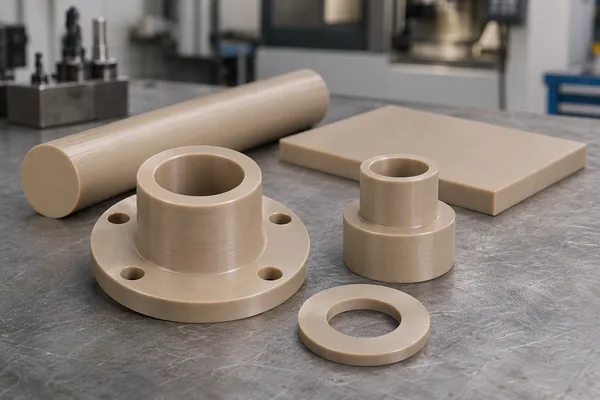
1. Heat Resistance: Distinguish Thermal Ratings from Actual Operating Temperature
PEEK is often described as suitable for continuous use at approximately 250–260°C. However, this statement must be understood in the context of the grade, the property being assessed, and the operating conditions. For example, the VICTREX 450G datasheet lists an electrical Relative Thermal Index, or RTI, of 260°C, a mechanical strength RTI of 240°C, and a mechanical impact RTI of 180°C. A thermal rating of 260°C does not mean a part can withstand any load at that temperature. These indices also do not replace service-life validation for a specific part.
For 450G, the glass transition onset temperature is approximately 143°C, the melting temperature is approximately 343°C, and the heat deflection temperature under a stress of 1.8 MPa is 152°C. Above the glass transition range, the crystalline regions of PEEK continue to provide support, but stiffness decreases, while thermal expansion and creep require greater attention. Melting point, heat deflection temperature, and long-term thermal ratings describe different phenomena and cannot be used interchangeably.
Glass or carbon fiber reinforcement can improve stiffness and heat deflection temperature, but it does not raise PEEK’s normal service temperature to 400°C. PEEK also has good inherent flame resistance, although the flammability rating and applicable thickness should be checked against the specific product documentation. Low smoke and low-toxicity emissions do not mean combustion produces no harmful gases.
Suitable parts: High-temperature sensor housings, valve components, motor insulation bobbins, process equipment supports, and high-temperature sealing components.
Machining considerations: PEEK’s heat resistance does not eliminate dimensional changes caused by cutting heat. Keep cutting edges sharp, remove chips promptly, and prevent localized overheating. Both air cooling and suitably verified liquid coolants can be used. Deep holes and thick sections, where heat is harder to dissipate, require particular attention to cooling and tool retraction for chip removal. Air cooling should not be prescribed for every operation.
Purchasing considerations: Specify the continuous operating temperature, peak temperature, exposure duration, and corresponding loads. For parts carrying loads at elevated temperatures over long periods, review creep and thermal expansion data before comparing unreinforced and reinforced grades. Do not order solely on the assumption that “unreinforced PEEK is for temperatures below 150°C, while carbon-fiber-reinforced PEEK is for temperatures above 260°C.”
2. Mechanical Properties: Consider Strength, Stiffness, and Long-Term Deformation Together
Unreinforced PEEK offers a good combination of strength and toughness. Adding glass or carbon fiber generally increases stiffness and strength, while elongation at break may decrease. These changes create different design trade-offs for thin-walled parts, snap fits, load-bearing brackets, and sliding components.
The following table shows typical properties at 23°C for three common VICTREX grades:
| Proprietà | 450G: Unreinforced | 450GL30: 30% Glass Fiber Reinforced | 450CA30: 30% Carbon Fiber Reinforced |
|---|---|---|---|
| Densità | 1.30 g/cm³ | 1.51 g/cm³ | 1.40 g/cm³ |
| Tensile stress | 98 MPa at yield | 179 MPa at break | 265 MPa at break |
| Modulo di elasticità | 4.0 GPa | 11.5 GPa | 28.0 GPa |
The tensile properties in the table are measured using the ISO 527 series of test methods, with yield and break values identified separately. These values come from standardized manufacturer test specimens and should not be used directly as allowable stresses for finished parts in every direction.
Another reason to consider PEEK is its good creep and fatigue performance. However, it still deforms under sustained loads. For precision mating components, fasteners, and supports under continuous compression, deformation must be assessed against the operating temperature, stress, and required service life. Room-temperature tensile strength alone is insufficient.
Reinforced grades also exhibit directional behavior. For example, when fibers align with the molding flow direction, stiffness and thermal expansion behavior in that direction may be better than in the transverse direction. The manufacturing route from resin to stock shape to finished part also affects performance assessment.
Suitable parts: Supports, bearing cages, gears, connecting components, fasteners, and certain lightweight structural parts.
Machining considerations: Glass and carbon fiber fillers increase tool wear. Select carbide or PCD tools according to production volume, tolerances, and surface requirements. Watch for burrs around hole edges, fiber pullout, and dimensional drift as tools wear. Thin-walled parts also require controlled clamping forces to prevent springback after unclamping.
Purchasing considerations: Load-bearing parts may use either unreinforced or reinforced PEEK, depending on stress, deformation, and service-life requirements. When replacing metal with PEEK, reassess the structure and joining methods. Lower density does not mean the same dimensions will deliver the same stiffness.
3. Chemical and Hydrolysis Resistance: Account for the Medium, Concentration, and Temperature
PEEK resists many oils, organic solvents, alkaline solutions, and certain acids, making it suitable for functional parts exposed to chemicals. However, the claim that it “resists almost everything except concentrated sulfuric acid” is too broad.
Victrex’s chemical compatibility table shows that concentrated nitric acid, aqua regia, and certain other media can also interact severely with PEEK. The same chemical may receive different ratings at different concentrations and temperatures. For example, the table classifies 30% nitric acid at 23°C as causing slight interaction, so it should not be described as fully compatible. Compatibility tables are useful for initial screening, while long-term exposure under pressure, mechanical stress, or mixed-chemical conditions requires further validation.
PEEK also offers good resistance to hydrolysis and steam, supporting its use in hot water, steam, and repeated sterilization environments. However, hydrolysis resistance does not mean every property remains unchanged in high-temperature steam. Thermal expansion, residual stress relief, mechanical loads, and seal design can still affect the part.
Suitable parts: Pump impellers, valve components, seal backup rings, chemical analysis instrument parts, and connecting components for oil and gas equipment.
Machining considerations: Select coolants and cleaning agents according to the specific grade, temperature, contact duration, and cleanliness requirements. Solvents such as acetone and ethyl acetate should not all be classified as causing stress cracking in PEEK. Nor should a single annealing cycle be treated as a safeguard for every cleaning process. For critical parts, use sample parts to verify dimensions, appearance, and residues after cleaning.
Purchasing considerations: Specify chemical names, mixture proportions, concentrations, operating temperature, pressure, and the type of contact. Include cleaning agents and disinfectants as well. If PEEK is unsuitable, reassess the chemical resistance and load-bearing capability of alternative materials rather than assuming PPS or PTFE can serve as a direct replacement.
4. Wear Resistance and Low Friction: Select Wear Grades for the Tribological System
PEEK can be used for sliding components such as bearings, gears, and seals. Specialized wear-resistant formulations are often selected for dry running or higher loads. For example, VICTREX 450FC30 contains carbon fiber, graphite, and PTFE at a combined filler content of 30%. Its intended uses include tribological applications requiring higher strength.
The coefficient of friction, wear rate, and limiting PV value all depend heavily on test conditions, including the counterface material, surface roughness, load, speed, temperature, and lubrication. A “limiting PV value of 4 MPa·m/s” from a particular test therefore cannot be presented as a universal capability of all wear-resistant PEEK grades.
PV is the product of contact pressure P and sliding velocity V. Even when two operating conditions have the same PV value, their frictional heat, heat dissipation, and wear mechanisms may differ. Part design must also consider the allowable pressure and speed separately, followed by service-life testing to assess actual performance.
Low friction and good dry-running capability do not mean every PEEK sliding component can operate without lubrication. Vacuum, food, medical, and cleanliness-sensitive equipment also require assessment of outgassing, wear particles, fillers, and contact compliance requirements.
Suitable parts: Plain bearings, thrust washers, piston rings, guides, gears, and certain dry-running sliding components.
Machining considerations: Focus on the dimensions, roundness, roughness, and machining lay of mating surfaces. For fiber-filled formulations, monitor exposed fibers and tool wear. Acceptance requirements for sliding surfaces should match the actual material pairing. “The smoother, the better” is not a universal rule, and a fixed approach of increasing spindle speed while reducing feed should not be adopted without validation.
Purchasing considerations: Specify the full grade designation and operating conditions, including the counterface material, pressure, speed, operating temperature, lubrication method, continuous running time, and allowable wear. Before comparing friction data from different suppliers, confirm that the test conditions are consistent. Specifying only “wear-resistant PEEK” does not ensure that different suppliers will deliver the same material.
5. Biocompatibility: Distinguish Implant Grades from Non-Implant Medical Applications
With appropriate material selection and validation, PEEK can be used in implants and non-implant medical devices. Materials intended for medical use are not a single category. For example, Invibio’s product documentation lists separate grades for long-term and short-term implantation. Purchasing specifications must match the particular product and contact conditions.
Features of medical-use PEEK include a choice of stiffness levels and good X-ray radiolucency in unreinforced materials. Unreinforced PEEK typically has a modulus of a few GPa, while reinforced materials can have higher values. A value of “15 GPa” should not be presented as universal for all PEEK materials. Lower stiffness provides design flexibility for load sharing, but the mechanical behavior of an implant also depends on its geometry, fixation method, and loading conditions. The material name alone cannot support a promise to eliminate stress shielding or promote healing. Imaging performance must also be assessed in the context of fillers, radiopaque markers, and the complete device.
Biocompatibility documentation for a raw material does not mean the finished medical device has been cleared or approved for use. The FDA evaluates finished medical devices and explicitly states that it does not approve or clear individual materials used in their manufacture. Machining, cleaning, sterilization, and associated residues all affect the final evaluation. A material report therefore should not be presented as “FDA-certified for implantation.”
Suitable parts: Implantable device components that have undergone the required design and validation, surgical instrument handles, dental tool components, and medical analysis equipment parts.
Machining considerations: Manage material traceability, cross-contamination, burrs, and cleaning residues according to the device’s intended use, and record critical processes. Cleanliness levels, cleaning procedures, and sterilization processes should be defined by the product requirements. Not all medical PEEK parts require the same cleanroom classification or polishing specification.
Purchasing considerations: First define whether the part will contact the human body, the contact location and duration, the sterilization method, and the target market. Then specify the appropriate grade and supply chain requirements. Determine the applicable scope of ISO 10993 biological evaluation documentation, USP Class VI documentation, and quality management system records according to the intended use. USP Class VI does not replace a complete biological evaluation of the device. The permitted number of repeated steam sterilization cycles must also be established from the material, device design, and test results.
6. Electrical Insulation and Radiation Resistance: Confirm the Grade’s Intended Function First
Unreinforced PEEK offers good electrical insulation properties. For example, the manufacturer’s datasheet for 450G lists a volume resistivity of 10¹⁶ Ω·cm at 23°C and also provides data showing a decrease in resistivity as temperature rises. Dielectric properties must be interpreted in relation to temperature, frequency, specimen thickness, and environmental conditions. Datasheet dielectric strength should not be converted directly into a part’s operating voltage rating.
Fillers change electrical behavior. Adding carbon fiber, graphite, or other conductive fillers can significantly reduce resistivity, so insulating, static-dissipative, and conductive grades must be selected for different objectives. Surface resistance, surface resistivity, and volume resistivity are also different measurements. Purchasing documents should identify what is being measured, the test method, and the test conditions.
PEEK has good resistance to gamma rays and X-rays. However, the allowable cumulative dose depends on factors such as dose rate, temperature, surrounding media, part geometry, and mechanical stress. The statement that PEEK “only becomes brittle after exposure to 10⁷ Gy” should not be used as a universal threshold for all grades and parts.
Semiconductor applications also require attention to metal ions, particles, outgassing, and residues after cleaning. Different processes may call for high-purity materials, wear-resistant materials, or materials with stable static-dissipative properties. A grade cannot be selected solely on the label “for semiconductor use.”
Suitable parts: Insulating supports, connector components, wafer equipment carriers, CMP equipment components, static-dissipative tooling, and functional parts for specific radiation environments.
Machining considerations: Control metal debris, oil contamination, particles, and cleaning residues. For insulating parts, prevent surface contamination that could create leakage paths. For static-dissipative parts, repeat measurements after machining and cleaning using the agreed method. Cleaning procedures, clean packaging, and the use of ultrasonic cleaning should be determined by the part geometry and end-use requirements.
Purchasing considerations: Specify insulation or static-control objectives, contaminant limits, test methods, and radiation conditions separately. High-purity requirements should be tied to specific test items and reports rather than judged solely by whether a material is “unfilled” or “imported.” For example, VICTREX 150FC30 contains carbon fiber, graphite, and PTFE and is formulated for tribological applications. It should not be used as an example of an ultra-high-purity unfilled grade.
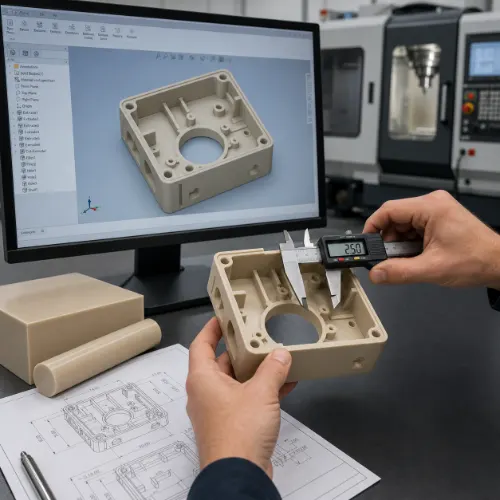
When PEEK Is Worth Considering
PEEK’s value usually comes from combining several requirements. The following conditions can indicate that PEEK deserves evaluation, but the specific grade, design, and testing must still confirm its suitability.
| Combined Requirements | Material Options to Evaluate | Priority Checks |
|---|---|---|
| Sustained high temperatures with mechanical loading | Unreinforced or reinforced PEEK | Stiffness, creep, and service life at operating temperature |
| Chemical exposure with load-bearing requirements | A PEEK grade compatible with the medium | Chemical concentration, temperature, pressure, and mixture effects |
| High-temperature sliding or dry running | Specialized wear-resistant PEEK | Material pairing, PV, frictional heat, wear, and particles |
| Repeated sterilization or human body contact | Medical-use materials matched to the contact conditions | Biological evaluation, sterilization validation, and traceability |
| High-temperature insulation or radiation exposure | Insulating grades with relevant supporting data | Voltage-withstand design, resistance changes, and radiation aging |
| Lightweighting combined with functional integration | Unreinforced or reinforced PEEK | Structural stiffness, joint design, and machining cost |
If operating conditions are relatively mild, or only one property is especially important, other materials may be worth comparing first. The following table provides initial screening options rather than a list of direct replacements.
| Application Requirements | Materials to Compare | Key Comparison Points |
|---|---|---|
| Structural or power transmission parts at moderate temperatures | POM, PA, and similar materials | Moisture absorption, dimensional changes, loads, and wear |
| Combined heat and chemical resistance | PPS, PEI, and similar materials | Compatibility with specific chemicals, toughness, and long-term deformation |
| Primarily chemical resistance or low friction | PTFE and similar materials | Creep, load-bearing capability, and supporting structures |
| Sliding parts at moderate temperatures | POM, UHMWPE, and similar materials | Pressure, speed, heat dissipation, and service life |
Material selection should not be based on an unqualified price per kilogram or a fixed price ratio. Resin brand, filler system, stock dimensions, and certification documentation all affect price. Custom parts also involve material utilization, tool wear, fixturing, inspection, cleaning, and rejection rates.
Purchasing Guide for Custom PEEK Parts
What Information Should Be Defined Before Ordering?
| Articolo | Information to Specify |
|---|---|
| Application and operating conditions | Temperature, loads, chemicals, sliding conditions, radiation, and expected service life |
| Material identification | Manufacturer, full grade designation, filler types and percentages, and whether substitutions are permitted |
| Stock source and condition | Rod, plate, or other form; stock manufacturer; batch; and heat treatment condition |
| Dimensions and tolerances | Drawing revision, datums, critical dimensions, geometric tolerances, and fit requirements |
| Requisiti relativi alla superficie | Roughness at specified locations, burrs, exposed fibers, cleanliness, and appearance |
| Special properties | Insulation, static dissipation, wear, extractables, or other functional criteria and test methods |
| Documentazione e tracciabilità | Material certificates, compliance documentation, batch records, and industry-specific documents |
| Acceptance conditions | Measurement environment, dimensional stabilization period, first-article approval, and inspection report requirements |
| Quantity and delivery | Samples, production quantities, packaging, lead time, and consistency requirements for repeat orders |
For CNC-machined parts, specifying only the resin grade may still be insufficient. Rods or plates made from the same resin can differ in manufacturing process, residual stress, and fiber orientation. For critical parts, specify the stock product and the necessary batch documentation as well.
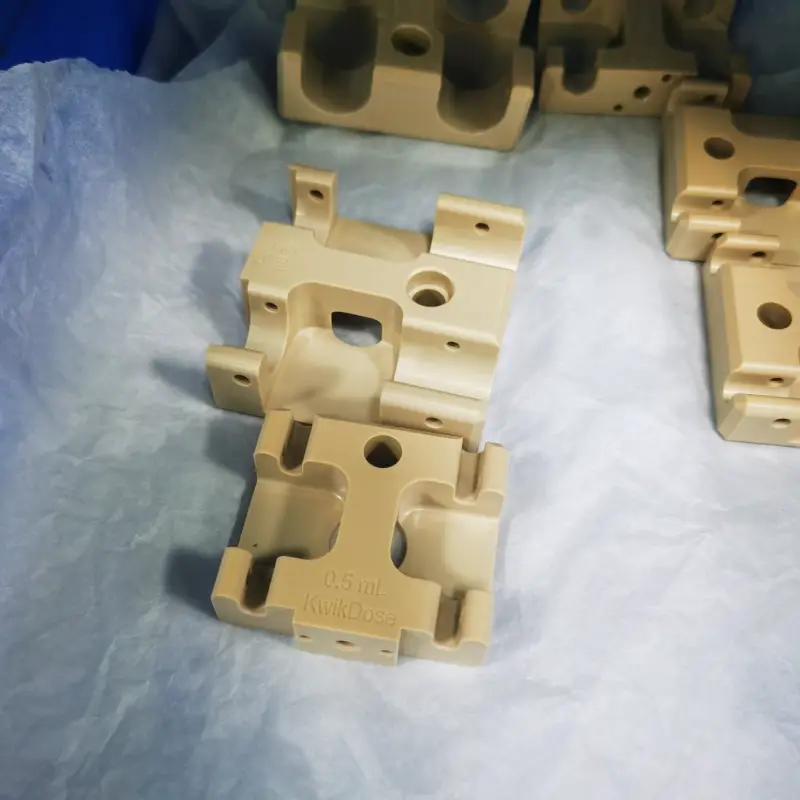
How to Distinguish Common Grade Types
| Tipo | Example or Identification Method | Applicazioni tipiche | Purchasing Considerations |
|---|---|---|---|
| Unreinforced | Material based on a grade such as VICTREX 450G | Structural parts, insulating parts, and functional components | Stock condition, dimensions, and sustained loads |
| Glass fiber reinforced | Material based on a grade such as VICTREX 450GL30 | Supports requiring greater stiffness | Directional behavior, toughness, and surface fibers |
| Carbon fiber reinforced | Material based on a grade such as VICTREX 450CA30 | High-stiffness parts, lightweight components, and certain sliding parts | Directional behavior, electrical properties, and tool wear |
| Resistente all'usura | Material based on a grade such as VICTREX 450FC30 | Bearings, washers, guides, and sealing components | Material pairing, wear, lubrication, and fillers |
| Medical-use materials | Selected according to contact conditions, such as an appropriate PEEK-OPTIMA product | Implantable or other medical device components | The specific product’s intended use and traceability |
| Static dissipative or conductive | Specialized products selected by electrical performance requirements | Static-control tooling and similar applications | Test conditions, resistance consistency, and cleanliness |
| Semiconductor-use materials | Specialized stock shapes or formulations selected for the process | Carriers, rings, and process equipment components | Purity, particles, wear, and electrical requirements |
The grade examples illustrate material categories and should not be treated as equivalent products across manufacturers. A resin grade designation is also not the same as a stock product designation.
How to Assess a Supplier’s Machining Capabilities
In addition to price and lead time, focus on the following five areas:
- Material traceability. Can the material and stock documentation be linked to the batch of delivered parts? Have substitute materials been approved through the agreed process?
- Understanding of plastic deformation. Can the supplier explain its fixturing, roughing and finishing sequence, stress-relief treatment, and measurement arrangements rather than simply listing machine models?
- Experience with similar parts. Thin-walled rings, deep-hole components, fiber-reinforced parts, and cleanliness-sensitive components present different challenges. Look for experience with similar geometries and applications.
- Inspection matched to function. Critical mating surfaces, geometric tolerances, and any required electrical or cleanliness criteria should have clearly defined inspection methods and reports.
- Quotations based on the same conditions. Check the material, stock, quantity, tolerances, post-processing, inspection, and documentation scope before assessing price differences.
For parts involving substantial material removal, asymmetric geometry, or tight tolerances, discuss intermediate annealing after rough machining with the supplier. The temperature, holding time, and cooling process should be established according to the material and section dimensions, with sufficient allowance left for finishing. “Holding at 200°C for one hour” should not be treated as a universal procedure for all PEEK parts.
Lead times should be confirmed after checking stock availability, sample validation, inspection, and documentation requirements. A fixed number of days should not be applied to every order.
Key Points for PEEK Selection and Procurement
PEEK suits parts that must meet several demanding performance requirements, but the final choice must be tied to a specific grade and operating conditions. Evaluate temperature together with load, chemicals together with concentration, and wear-resistant formulations together with the tribological system.
Before purchasing custom PEEK parts, complete these three steps:
- Define the material and stock. Agree on the manufacturer, full grade designation, filler system, stock product, and substitution rules.
- Define operating conditions and acceptance criteria. Provide the operating environment, critical tolerances, surface requirements, and any necessary functional test conditions.
- Approve samples before finalizing production requirements. Once critical parts have passed dimensional, assembly, and operating-condition validation, include the material, process, and inspection requirements in the documentation for repeat orders.
If you need custom PEEK parts, contact Weldo for a quote and machining advice. Provide your part drawings or 3D models, order quantity, and operating conditions, along with critical tolerances and surface requirements. This allows us to offer recommendations on material grade selection and Lavorazione CNC approaches, together with a custom quotation based on your requirements.
Fornitore citazioni are comparable when operating conditions, materials, machining, and acceptance criteria are aligned. This also makes it easier for the delivered PEEK parts to achieve the expected performance.