UHMW-PE plastic is a relatively common machining material. This material is also a frequent presence in the manufacturing field. It has relatively good comprehensive performance, especially wear resistance and impact resistance. In low-temperature environments, it can still ensure dimensional stability, and it has better performance advantages than most plastics. Below, I will give a brief overview of this material from dimensions such as its physical properties, machining methods, and applications, helping you better use this material in the field of machining and manufacturing.
What Is UHMW-PE material
UHMW-PE is an engineering plastic with impact resistance, wear resistance, good self-lubricating performance, and excellent low-temperature performance.
It is a thermoplastic engineering plastic with an average molecular weight greater than 1.5 million, formed by polymerization of ethylene and butadiene monomers under the action of a catalyst. This material can work for a long time under conditions from -269 to +80℃ and is called an “amazing” engineering plastic.
It is the “ceiling” material with the best performance in the polyethylene (PE) family. Together with carbon fiber and aramid, it is known as one of the “world’s three major high-performance fibers”. Some plastic processing industries refer to it as UPE.
Chemical Structure and Chemical Composition of UHMW-PE
UHMW-PE (ultra-high-molecular-weight polyethylene) has a very simple chemical composition, composed only of carbon (C) and hydrogen (H). It is formed by repeatedly linking ethylene (C₂H₄) monomers through coordination polymerization, contains no other heteroatoms or functional groups, and its basic structure can be expressed as -(-CH₂-CH₂-)-n-.
Its core feature is an extremely high molecular weight, usually reaching 1.5 million to 6 million, or even higher, and the molecular chain length far exceeds that of ordinary HDPE. Because the ultra-long molecular chains are highly entangled with each other and form a certain crystalline structure, UHMW-PE therefore has excellent wear resistance, impact resistance, self-lubricating properties, and chemical stability.
Characteristics of UHMW-PE
Density
The density of UHMW-PE is very low, usually between 0.93 and 0.97 g/cm³. It is one of the materials with the lowest density among common engineering plastics (lighter than water and able to float on the water surface), only about 1/8 of the density of steel. This low-density characteristic gives it significant advantages in lightweight application scenarios.
Melting Point
The melting point is usually between 130℃ and 136℃ (commonly around 136℃). Its heat deflection temperature (0.46 MPa) is about 85℃. However, because its molecular weight is extremely high, its fluidity after melting is very poor. Even when heated above the melting point, it is not as easy to injection mold as ordinary plastics. Therefore, ordinary injection molding processes are usually not used; instead, it is mostly made into raw materials such as sheets or rods by molding, sintering, ram extrusion, and other methods.
Color and Weather Resistance
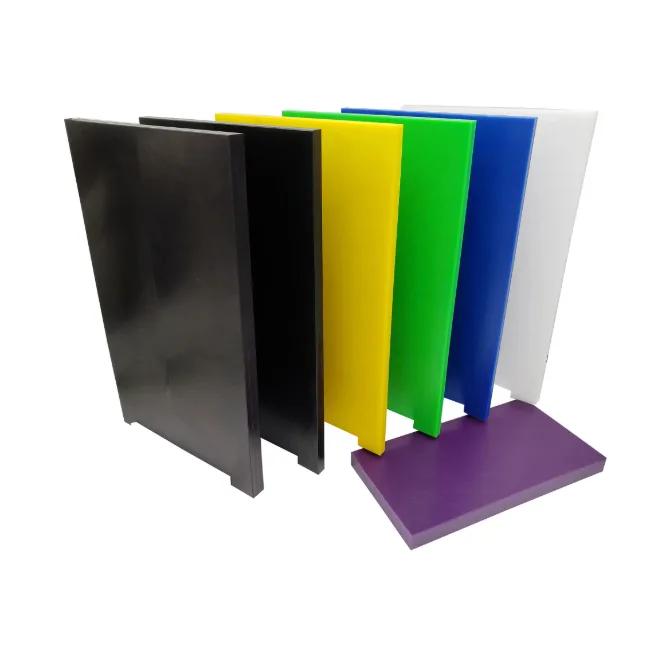
The conventional colors of UHMW-PE include white, black, blue, green, etc. Among them, pure material grades such as PE-1000 are mostly natural white or black. At the same time, color customization is also supported, with different colors such as red, purple, yellow, and gray made by adding color powder.
In terms of weather resistance, UHMW-PE has good ultraviolet resistance, aging resistance, low-temperature resistance, and outdoor adaptability. After about 1,500 hours of sunlight exposure, its strength can still remain above 80%. By adding anti-aging agents or carrying out UV modification, its outdoor stability and service life can be further improved, and some modified materials can be used outdoors for 50 years without aging. At the same time, UHMW-PE has excellent low-temperature performance, still has ductility at -269℃, has a heat deflection temperature of about 85℃, and can work for a long time within the range of -269℃ to 80℃.
Hardness
The hardness of UHMW-PE (ultra-high-molecular-weight polyethylene) is relatively low, which is one of its main performance shortcomings. Compared with engineering plastics such as polycarbonate and nylon, UHMW-PE has lower surface hardness and rigidity, and it is more likely to creep under long-term stress.
Common hardness parameters include: Shore hardness Shore D of about 62-66, with some grades reaching 69, and low-hardness grades or different test conditions possibly being 60-62; Rockwell hardness HRM of about 40-60; ball indentation hardness ≥40 N/mm². These values will vary depending on material grade, test method, and test conditions.
Friction Coefficient
Self-Lubricating Friction Coefficient
UHMW-PE has an extremely low friction coefficient and excellent self-lubricating properties, and it can maintain good sliding performance even under non-lubricated conditions. Its friction coefficient varies depending on test conditions and material state: the dry friction/static friction coefficient is usually 0.07-0.12, the dynamic friction coefficient is usually 0.10-0.22, and under water-lubricated or oil-lubricated conditions, the friction coefficient can be further reduced to 0.05-0.08.
Friction Coefficients with Other Materials
Based on comprehensive material tribology test data, the approximate ranges of the friction coefficient of UHMW-PE on different metals are as follows:
1. Against steel/carbon steel
Dry friction: about 0.07-0.22 (common test values are between 0.07 and 0.11).
Water lubrication/oil lubrication: the friction coefficient decreases significantly, about 0.05-0.08.
2. Against brass
Dry friction: about 0.07-0.11.
Water lubrication/oil lubrication: about 0.05-0.08.
3. Against aluminum alloy
Dry friction: about 0.10-0.20.
4. Against cast iron
Dry friction: about 0.10-0.20.
Yield Strength
The yield strength of UHMW-PE (ultra-high-molecular-weight polyethylene) is usually around 20-22 MPa. It has relatively good toughness. When bearing complex alternating loads or local stress, it can disperse stress through slight plastic deformation, achieving a mechanical protection effect of “overcoming hardness with softness”.
Tensile Strength
The tensile strength of common engineering sheets of UHMW-PE / ultra-high-molecular-weight polyethylene is approximately 19-25 MPa, meaning that each square millimeter of cross-sectional area of this material can withstand a maximum tensile force of 19-25 N. This value is at a medium-to-low level, indicating that UHMW-PE is more suitable for wear-resistant functional parts rather than high-strength load-bearing parts.
Elastic Modulus
The elastic modulus of UHMW-PE varies greatly depending on its form:
Conventional sheets/rods are about 600 MPa, while biaxially stretched films are about 2,600 MPa, indicating that the resistance to deformation is significantly improved after orientation. Gel-spun/ultra-drawn fibers can reach 100-172 GPa, indicating that their axial rigidity is extremely high and that they are extremely difficult to deform in the tensile direction.
UHMW-PE is suitable for parts that require a certain degree of flexibility and impact deformation resistance, while highly oriented films and fibers are suitable for requirements with higher demands for high rigidity, lightweighting, low elongation, and dimensional stability.
Chemical Resistance
The microscopic state of UHMW-PE is a nonpolar, saturated molecular structure, so it is not easy to react with most chemical media. It can remain stable in environments such as hydrochloric acid, sulfuric acid, alkali solutions, salt spray, and seawater. At the same time, UHMW-PE also shows high chemical stability toward many organic solvents, water, detergents, and weakly corrosive media, with little change in appearance and physical properties after long-term contact. However, its tolerance to strongly oxidizing acid liquids (such as concentrated nitric acid, etc.) is relatively weak, so it should be used cautiously in strongly oxidizing environments.
Water Absorption
UHMW-PE (ultra-high-molecular-weight polyethylene) has an extremely low water absorption rate, usually less than or as low as 0.01%, and it can still maintain good dimensional stability in humid, underwater, or high-humidity environments. Because it hardly absorbs water, it usually does not need drying treatment before processing, and it can maintain stable mechanical properties, dimensions, and appearance for a long time.
Coefficient of Thermal Expansion
The linear expansion coefficient of UHMW-PE is usually about 1.5×10⁻⁴/℃ to 2.5×10⁻⁴/℃, and the specific value is affected by factors such as molecular weight and crystallinity. UHMW-PE is sensitive to temperature changes, and obvious dimensional expansion and contraction can easily occur when the temperature difference is large. In actual design and assembly, expansion and contraction gaps should be reasonably reserved, and problems that may be caused by thermal expansion and contraction, such as jamming, dead locking, excessive gaps, deformation, or excessive installation stress, should be fully considered.
Material Grades and Classification of UHMW-PE
The material grades of UHMW-PE are mainly classified according to molecular weight, modification type, and application field. The specific grade classifications are as follows:
1. Classification by Molecular Weight Grade (Core Grade)
PE-500 (medium molecular weight): The molecular weight is between 500,000 and 1.5 million, mainly used for general industrial components with relatively moderate mechanical performance requirements.
PE-1000 (standard UHMW-PE): The molecular weight is between 3 million and 5 million. It is the most widely used and most basic grade, with excellent comprehensive performance (high wear resistance and high impact resistance), and is widely used in industrial wear-resistant parts (such as coal bunker liners and chain guides) and general mechanical components.
PE-1000 high-end version: The molecular weight is between 5 million and 7 million, and its performance (especially wear resistance and impact resistance) is better than standard PE. It is suitable for high-end industrial scenarios with extremely high material performance requirements.
UHMW-PE fiber grade: The molecular weight is between 7 million and 10 million, mainly used to produce high-strength, high-modulus fibers (such as bulletproof materials and aerospace materials).
2. Classification by Modification Type and Functional Grade
Pure material/purity grade: With no additives or very few other components added, it retains the most original properties of UHMW-PE and is mainly used in fields with extremely high requirements for material purity, such as orthopedic implants (artificial joints) and food-grade contact components.
Vitamin E (α-tocopherol) modified grade: Vitamin E is added on the basis of pure material to improve the antioxidant performance of the material, prevent oxidative aging of the material during irradiation sterilization or in vivo use, and it is mainly used for high-end orthopedic implants.
Antistatic grade (ESD-UHMW-PE): By adding conductive carbon black and other modifications, it has antistatic performance and is suitable for the electronics industry (such as wafer transfer chains) and clean workshops.
Flame-retardant grade: Modified by adding flame retardants to meet specific flame-retardant standards (such as UL94 grade), suitable for scenarios with explosion-proof requirements such as coal mines (such as coal bunker liners).
Wear-resistant/self-lubricating grade: Optimized through specific processes or additives to further reduce the friction coefficient, suitable for high-wear, low-lubrication environments (such as filling line guide rails and injection molding machine components).
UHMW-PE vs HDPE / PTFE / Nylon / POM
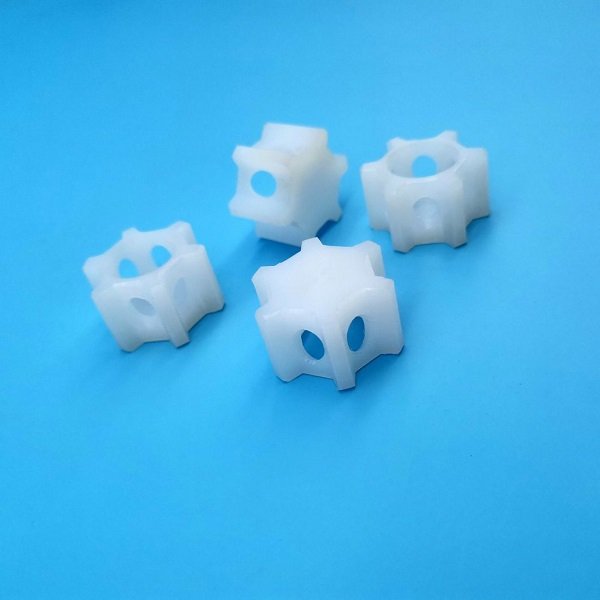
1. UHMW-PE vs HDPE (High-Density Polyethylene)
- Advantages and disadvantages comparison:
The advantages are excellent wear resistance (the sand slurry abrasion index is extremely low, and the wear resistance is several times better than HDPE), extremely strong impact resistance (impact strength is more than 4 times that of HDPE, and it still maintains toughness at liquid nitrogen temperature), excellent self-lubricating properties, and excellent low-temperature resistance.
The disadvantages are relatively limited mechanical strength (tensile strength is lower than HDPE, but toughness is better), average temperature resistance (long-term service temperature is lower than HDPE), and difficult processing (melt viscosity is extremely high, requiring powder pressing and sintering).
- Application scenarios: UHMW-PE is suitable for high-impact and high-wear environments (such as hopper liners, conveyor idlers, and mechanical wear-resistant parts); HDPE is suitable for conventional packaging, hollow containers, water pipes, and low-wear environments.
2. UHMW-PE vs PTFE (Polytetrafluoroethylene)
Advantages and disadvantages comparison:
UHMW-PE has better toughness, moderate cost, and low density (far lower than the density of PTFE: 2.15 g/cm³).
The disadvantages are poor temperature resistance (easy creep at high temperature) and a slightly higher friction coefficient relative to PTFE (PTFE is 0.04-0.10).
Application scenarios: UHMW-PE is suitable for high-impact, heavy-load, low-speed friction environments (such as bearing seats, guide rails, and agricultural machinery); PTFE is suitable for high-temperature, strongly corrosive environments and environments requiring extremely low friction (such as chemical seals, electrical insulation parts, and non-stick coatings).
3. UHMW-PE vs Nylon (Nylon, Taking PA66 as an Example)
Advantages and disadvantages comparison:
UHMW-PE has better wear resistance than PA66, stronger impact resistance (impact strength is 10 times that of Nylon 66), better self-lubricating properties (friction coefficient is lower than nylon), better low-temperature resistance (-269℃), and lower water absorption than nylon (<0.01%, while nylon water absorption is 1%-2.5%).
The disadvantages are that its mechanical strength (tensile strength 20-30 MPa) and rigidity are lower than nylon, its surface hardness is low, and its temperature resistance is not as good as nylon (≤80℃, while the heat deflection temperature of Nylon 66 is 120℃).
UHMW-PE is suitable for low-friction, high-wear, and low-temperature environments (such as sliding bearings and wear-resistant liners);
Nylon is suitable for high-load, high-rigidity, and fatigue-resistant environments (such as gears, cams, and automotive parts).
4. UHMW-PE vs POM

Advantages and disadvantages comparison:
UHMW-PE has better impact resistance than POM (POM is prone to fracture when notched, while UHMW-PE has no notch sensitivity), better self-lubricating properties (friction coefficient 0.05-0.11, while POM is 0.1-0.3), better low-temperature resistance (-269℃), and extremely low water absorption (POM water absorption 0.2%-0.25%).
The disadvantages are that its mechanical strength (tensile strength 20-30 MPa) and rigidity are far lower than POM (POM tensile strength 60-70 MPa, with extremely high rigidity), its temperature resistance is average (≤80℃, while POM heat deflection temperature is 110-124℃), and its surface hardness is low.
Application scenarios: UHMW-PE is suitable for high-impact, low-friction, and low-temperature environments (such as snowboard bases and bulletproof materials); POM is suitable for high-rigidity, high-wear-resistance, and high-load precision mechanical parts (such as gears, bearings, and automotive pump components).
The above content is briefly summarized in the following table:
| Material Compared | UHMW-PE Advantages | Other Material Advantages | Application Choice |
| HDPE | Better wear resistance, impact resistance, self-lubrication, and low-temperature performance | Easier to process, higher rigidity, lower cost | UHMW-PE for wear liners and rollers; HDPE for pipes, containers, and packaging |
| PTFE | Better toughness, impact resistance, lower cost, and lower density | Better high-temperature resistance, chemical resistance, and lower friction coefficient | UHMW-PE for guide rails and bushings; PTFE for seals, insulation parts, and non-stick components |
| Nylon | Better wear resistance, impact resistance, lower water absorption, and better low-temperature performance | Higher strength, better rigidity, and better heat resistance | UHMW-PE for sliders and liners; Nylon for gears, cams, and structural parts |
| POM | Better impact resistance, self-lubrication, low-temperature resistance, and less brittleness | Higher strength, better rigidity, and better dimensional stability | UHMW-PE for impact-resistant sliding parts; POM for precision gears, bearings, and pump components |
UHMW-PE Processing Capabilities
The processing capability of UHMW-PE is mainly reflected in two dimensions: forming processing and post-processing (including CNC machining). Due to its high melt viscosity and extremely poor flowability, UHMW-PE has strict requirements for processing strategies.
Primary Forming Processing
Compression-sintering molding: The most original and most widely used processing method, formed through heating, pressurizing, and sintering, suitable for manufacturing large and thick-walled parts (such as sheets and liners), but with relatively low production efficiency.
Extrusion molding: Dedicated single-screw/twin-screw extruders or ram extruders are used, and high pressure is used to overcome the high viscosity of the material, realizing the continuous extrusion of pipes, rods, sheets, and profiles; it needs to be combined with low-shear screws and lubrication technology.
Injection molding: A high-pressure, high-rigidity special injection molding machine is used, combined with large-size gates and a high-pressure, low-speed process. It is suitable for manufacturing small and medium-sized parts with complex shapes and high precision requirements (such as gears, bearings, and artificial joints), but jetting or degradation is very likely to occur due to high shear, so process control requirements are extremely high.
Blow molding: Taking advantage of the good sag resistance of UHMW-PE melt, it is suitable for manufacturing large hollow containers (such as fuel tanks and large barrels) and high-performance films.
Other special forming: Such as gel spinning (used to produce high-strength and high-modulus fibers), solid-state extrusion, radio-frequency processing, etc., suitable for specific high-value-added products.
CNC Machining
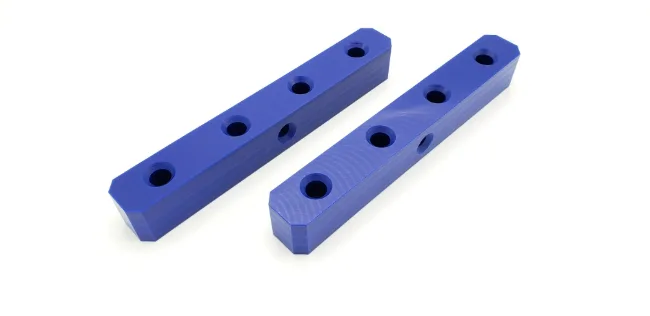
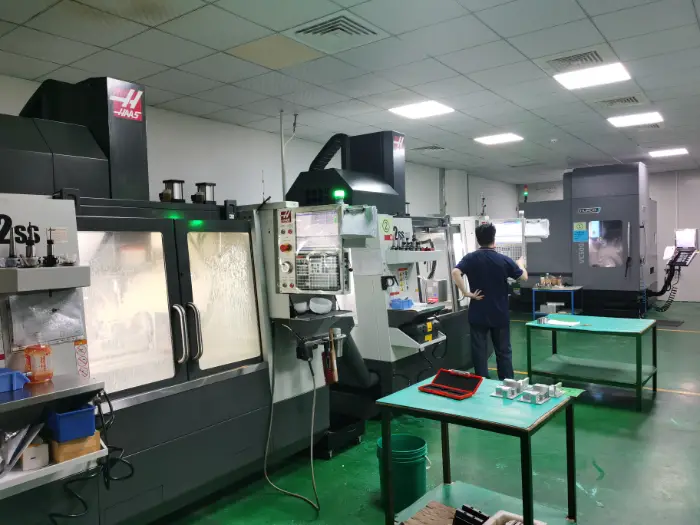
UHMW-PE initially formed parts can be processed by CNC machine tools. Common processes include milling, turning, drilling, slotting, chamfering, and special-shaped contour cavity machining; complex part designs can use 4-axis or 5-axis machining to reduce accumulated clamping errors.
Turning and milling can remove excess material to complete roughing and finishing, and grinding is mostly used for batch/local precision improvement or deburring. During machining, cutting speed must be controlled and heat dissipation must be monitored to avoid overheating, softening, and deformation. Common parts include wear-resistant liners, guide rail strips, sliders, rollers, shaft sleeves, bushings, scrapers, and custom special-shaped parts.
Applications of UHMW-PE Materials
Silo, Hopper, Slide, and Chute Linings
UHMWPE sheets are widely used for silo, hopper, slide, and chute linings for powdered or granular materials such as coal, lime, cement, mineral powder, salt, and grain. They can effectively reduce material adhesion, blockage, and bridging, making discharging smoother and more stable. Their excellent wear resistance, impact resistance, and low-temperature resistance also enable them to adapt to complex working conditions such as humidity and high wear, extending the service life of equipment.
Conveying Pipelines and Wear-Resistant Components of Conveying Systems
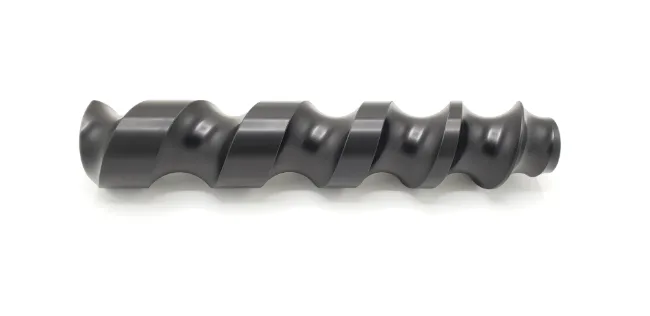
UPE material can be used for conveying pipelines for flowing sand, slurry, tailings, powder, and granular materials, as well as components such as conveyor guide rails, chain guide rails, curved rails, slide strips, retaining strips, star wheels, and spiral guide parts. This material has a low friction coefficient and strong wear resistance, which helps reduce conveying energy consumption and component wear, improves system operation stability, and is widely used in mining, power plants, metallurgy, dredging, chemical engineering, bulk material conveying, food packaging equipment, and other fields.
Wear-Resistant Liners and Industrial Protective Parts
UHMWPE is also often processed into industrial protective parts such as wear-resistant liners, slide plates, guard plates, backing plates, scrapers, and anti-collision blocks, and is used in mining machinery, port equipment, conveyor lines, engineering machinery, and packaging machinery. Its good wear resistance and impact resistance can effectively protect metal structural parts, reduce noise, and reduce downtime for maintenance.
Marine Engineering and Rope/Cable Products
UHMWPE fibers can be made into high-strength ropes, cables, fishing gear, and ship-related components. Their light weight, high strength, and corrosion resistance make them suitable for marine platforms, ship mooring, towing, underwater engineering, and other scenarios.
Construction and Composite Materials
This material can be used in walls, partition boards, reinforced composite materials, and impact-resistant structural parts, helping improve material toughness, wear resistance, and impact resistance.
Sports Goods
PE-UHMW can be used in safety helmets, snowboards, windsurfing boards, fishing rods, rackets, bicycle parts, and lightweight sports equipment, offering the advantages of light weight, wear resistance, and impact resistance.
Defense and Aerospace Applications
Due to its light weight, high strength, and good impact resistance, UHMWPE can be used in protective materials, composite structural parts, ropes, lightweight components, and other fields.
Medical Field
In the medical field, UHMWPE can be used for medical implants, dental tray materials, suture materials, and related medical devices, and has good biocompatibility and durability.
Common Forms of UMHMW-PE
Sheets and Plates
Thin sheets, medium plates, thick plates, and ultra-thick plates, with thicknesses ranging from 2-200mm, and common specifications such as 1220×2440mm and 1500×3000mm. Common UMHMW-PE sheets include industrial wear-resistant gaskets, liners, and fender boards; vehicle carriage slide plates; mechanical guard plates and sound insulation boards; food-processing cutting and preparation table boards and chopping boards.
Rods and Tubes
Round rods (diameter 10mm-250mm) and tubes (various pipe diameters).
Mainly used to produce mechanical wear-resistant parts, flange gaskets,; industrial tubes such as trench cover plates; low-temperature sealing parts, etc.
Fibers and Rope Nets
Common shapes: monofilaments, multifilaments, tapes, and woven fabrics (such as ropes, cables, fishing nets, and cut-resistant fabrics).
Main uses: high-performance ropes and cables (such as deep-sea mooring cables, tow cables, climbing ropes, sail ropes, and fishing lines, using their light weight, high strength, wear resistance, and corrosion resistance);
Protective equipment (such as bulletproof vests, stab-resistant clothing, and cut-resistant gloves, using their high specific strength, impact resistance, and cut resistance);
Fishing nets and aquaculture net cages (using their light weight, wear resistance, and seawater corrosion resistance).
Filter Materials (Porous)
Common shapes: filter elements, filter tubes, and filter plates (made through a sintering process).
Main uses: industrial liquid filtration (such as vacuum feeding, fuel/mechanical oil filter elements) and gas dust filtration (such as factory ventilation and air purifier filter elements); medical filtration (such as oxygen concentrator and hemodialysis filter elements).
FAQ of UHMW-PE material
How is UHMW-PE made?
UHMW-PE is mainly synthesized through a coordination polymerization process. The commonly used catalyst is a metallocene catalyst: Ziegler-Natta (Z-N); under the action of the catalyst, ethylene monomers polymerize to form linear long-chain UHMW-PE resin.
Is UHMWPE bulletproof?
UHMWPE is a leading material for ballistic protection because it combines an ultra-low density of about 0.97 g/cm³ with excellent strength and energy absorption. It is widely used in body armor, ballistic helmets, stab-resistant equipment, and composite armor systems thanks to its lightweight structure and strong impact resistance. Its main limitation is a relatively low melting point of around 138°C, so for high-velocity rifle protection it is often paired with ceramic strike plates in hybrid armor designs.
Summary:
The above is all of my explanation of this material this time. Perhaps at this moment you already have a broader and deeper understanding of the future plastic processing landscape. I hope it can help your polymer polyethylene material processing project proceed smoothly. If you want to learn more information about this material or want to find a reliable factory for outsourced processing quotation, you can contact the engineers at Weldo machining.