
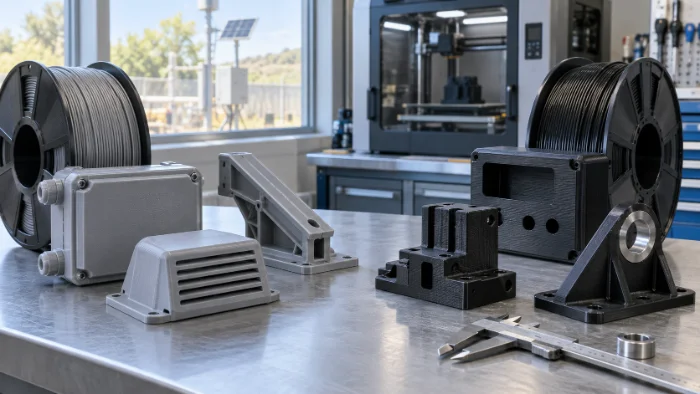
ASA and ABS are both engineering-grade 3D printing filaments used for functional parts, but they address different material-selection priorities. In the ASA vs ABS filament comparison, ASA is the preferred choice for long-term exposure to sunlight, rain, and outdoor temperature changes, while ABS is better suited to indoor functional prototypes, fixtures, housings, and cost-sensitive projects.
Both materials undergo significant shrinkage during cooling. Stable printing requires an enclosed chamber, a heated build platform, and controlled cooling. For custom part buyers, the material name is only the starting point. Print orientation, layer height, wall count, infill, chamber temperature, post-processing, and acceptance methods determine the actual performance of the finished part.
ASA vs ABS Filament: How Should You Choose?
Outdoor weather resistance is the clearest difference between ASA and ABS. ASA provides better retention of color, surface condition, and mechanical properties, while ABS is more suitable for indoor functional parts because of its mature supply chain, balanced toughness, and lower cost.
| Selection Condition | ASA Filament | ABS Filament |
|---|---|---|
| Primary advantage | UV stability and outdoor weather resistance | Cost, toughness, and mature printing processes |
| Long-term outdoor use | Bevorzugt | Requires weather-resistant modification or surface protection |
| Indoor functional parts | Geeignet | Bevorzugt |
| Hitzebeständigkeit | Gut | Gut |
| Stoßfestigkeit | Gut | Gut |
| Warping tendency | Significant | Significant |
| Enclosed chamber | Empfohlen | Empfohlen |
| Materialkosten | In der Regel höher | In der Regel niedriger |
| Typische Bauteile | Outdoor housings, brackets, and automotive exterior prototypes | Indoor housings, fixtures, and control panels |
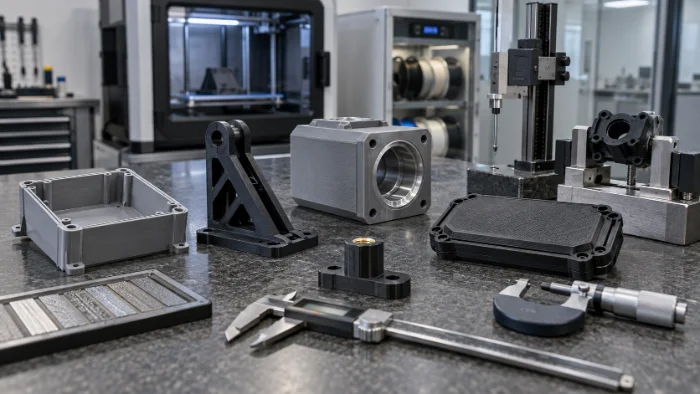
If a part contains locating holes, bearing bores, sealing grooves, or strict assembly dimensions, the main body can be printed in ASA or ABS before the critical features are completed through CNC machining. This route preserves the geometric freedom of 3D printing while improving bore size, flatness, roundness, and fit accuracy.
What Are ASA and ABS?
ASA and ABS are both styrenic thermoplastics with similar printing temperatures and basic mechanical properties. Their main difference comes from the rubber phase: ASA uses acrylic rubber to improve UV and weather stability, while ABS uses butadiene rubber to provide impact toughness and balanced processability.
ASA Filament
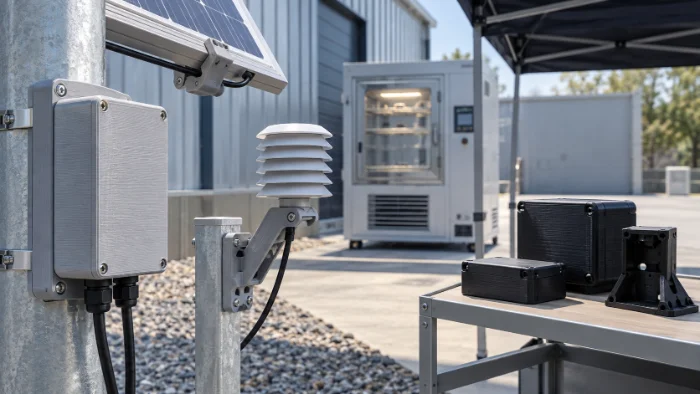
ASA is a copolymer composed of acrylonitrile, styrene, and acrylate. It offers better property retention under sunlight, rain, humidity, and temperature changes, making it suitable for:
- Outdoor sensor housings
- Solar-equipment brackets
- Surveillance and communication equipment housings
- Functional automotive exterior prototypes
- Agricultural equipment guards
- Outdoor lighting and signage components
- Power and utility components
ASA’s suitability for outdoor use does not make it easy to print. It still experiences significant shrinkage and requires a stable heated bed, enclosed chamber, and gradual cooling. Large flat surfaces, sharp corners, and uneven wall thicknesses are particularly susceptible to warping.
ABS Filament
ABS is composed of acrylonitrile, butadiene, and styrene. It provides a good balance of toughness, rigidity, heat resistance, cost, and post-processing capability, making it suitable for:
- Indoor equipment housings
- Automatisierungsvorrichtungen
- Control panels
- Robotic guards
- Automotive interior prototypes
- Assembly and functional validation parts
- Low-volume industrial components
Standard ABS can fade, chalk, and lose impact performance after prolonged UV exposure. Outdoor applications should use weather-resistant ABS or a validated UV-resistant coating.
What Are the Key Performance Differences Between ASA and ABS?
ASA and ABS have similar mechanical performance ranges, but ASA provides significantly better outdoor weather resistance. Print orientation must be considered when evaluating part strength because FDM parts are generally weaker across layers than within layers.
The following data comes from technical datasheets for specific printed materials and is intended only to illustrate typical performance levels. Differences in equipment, print orientation, specimen dimensions, and test standards mean these values cannot be used directly as acceptance criteria across different brands.
| Eigentum | ASA Reference Value | ABS Reference Value | Auswirkungen auf Bauteile |
|---|---|---|---|
| Zugfestigkeit | Approximately 49 MPa | Approximately 19–38 MPa | ABS values vary significantly with print orientation |
| Zugmodul | Approximately 2.1 GPa | Approximately 1.70–1.96 GPa | Affects rigidity and deformation under load |
| Biegefestigkeit | Approximately 78 MPa | Approximately 21.5–61.1 MPa | Affected by print orientation and interlayer bonding |
| Biegemodul | Approximately 2.3 GPa | Approximately 1.32–1.47 GPa | Affects the deflection of brackets and housings |
| Heat deflection temperature | Approximately 96°C | Approximately 86.6°C | Corresponds to specific loads and specimen conditions |
| UV stability | Ausgezeichnet | Limited for standard grades | Determines suitability for long-term outdoor use |
| Printing shrinkage | Significant | Significant | Affects warping, flatness, and hole position |
| Elektrische Isolierung | Gut | Gut | Suitable for insulating housings and supports |
MakerBot Precision ASA reference data includes approximately 49 MPa tensile strength, a 2.1 GPa tensile modulus, and a heat deflection temperature of 96°C. UltiMaker ABS printed specimens show tensile strength at break decreasing from approximately 35 MPa to 19 MPa depending on orientation, directly demonstrating the effect of interlayer direction on finished-part strength.
When purchasing custom printed parts, specify the following parameters:
- Filament brand, grade, and color
- Print orientation
- Layer height and nozzle diameter
- Number of perimeter walls or effective wall thickness
- Infill pattern and infill percentage
- Temperature-control and cooling method
- Specimen orientation and test standard
Mechanical property data is directly comparable only when the material, equipment, specimen orientation, and test method are consistent.
Is ASA the Strongest 3D Printing Filament?
ASA is not the strongest general-purpose filament. Its main value is its balance of mechanical performance, heat resistance, surface quality, and outdoor weather resistance.
“Strongest” must be separated into different performance categories:
- PLA: Usually offers higher rigidity and easy printing, but has limited heat and impact resistance.
- PETG: Provides good toughness and less warping, but high-temperature rigidity and long-term creep must be evaluated by grade.
- PC: Offers higher heat and impact resistance but requires higher nozzle and chamber temperatures.
- Nylon: Provides good fatigue and wear resistance but readily absorbs moisture and requires strict drying before printing.
- Carbon-fiber-reinforced filament: Can improve rigidity and dimensional stability but wears standard nozzles, while interlayer strength still depends on the base polymer and printing process.
Outdoor parts should not be selected only by tensile strength. UV exposure, temperature, impact, sustained loads, creep, and interlayer bonding must also be evaluated.
What Are the Advantages and Limitations of ASA and ABS?
Advantages of ASA
- Outdoor weather resistance: Suitable for long-term exposure to sunlight, rain, and environmental temperature changes.
- Color retention: Compared with standard ABS, it experiences less fading and surface degradation after prolonged UV exposure.
- Balanced mechanical performance: Suitable for housings, brackets, guards, and general load-bearing structures.
- Heat resistance: Can be used in equipment environments above room temperature, with the exact limit depending on the grade, load, and geometry.
- Flexible post-processing: Supports sanding, painting, adhesive bonding, mechanical assembly, and controlled chemical smoothing.
Limitations of ASA
- Significant warping: Large flat surfaces, sharp corners, high infill, and uneven wall thickness increase the failure rate.
- Higher equipment requirements: Stable production usually requires an enclosed chamber, heated platform, and controlled cooling.
- Higher material cost: ASA filament and outdoor color management usually cost more than standard ABS.
- Emissions must be controlled: Melt-extrusion printing should use ventilation, local exhaust, or a validated filtration system.
Advantages of ABS
- Balanced performance: Its strength, toughness, heat resistance, and cost suit most indoor functional parts.
- Mature supply chain: A wide range of colors, brands, and modified grades is available.
- Convenient post-processing: Supports sanding, painting, adhesive bonding, inserts, and acetone smoothing.
- Suitable for functional validation: Commonly used for fixtures, housings, assembly samples, and low-volume parts.
Limitations of ABS
- Limited outdoor weather resistance: Standard grades undergo color and property changes after prolonged sunlight exposure.
- Large parts are susceptible to warping: Large or thick-walled parts require a stable chamber temperature and suitable geometry.
- Interlayer strength depends on orientation: Parts are more likely to fail when loads directly pull apart the layer interfaces.
- Printing requires ventilation: ABS also releases volatile substances and ultrafine particles during printing.
Which Is Better for Outdoor Use, ASA or ABS?
ASA is better for long-term outdoor use. It provides greater resistance to UV radiation and weather changes, helping retain color, surface condition, and mechanical properties. Standard ABS is more suitable for indoor or surface-protected environments.
Stratasys and UltiMaker both position ASA for outdoor commercial equipment, infrastructure, agricultural equipment, transportation, and utility components.
ASA does not have a single universal outdoor service life. Actual service life depends on:
- The specific ASA grade and color
- UV intensity and exposure direction
- Operating temperature and thermal cycling
- Part wall thickness and printing porosity
- Sustained loads and impact
- Rainwater, salt spray, and chemical exposure
- Surface coating and maintenance condition
A darker color or thicker wall does not automatically mean that a part can carry loads outdoors for an extended period. Load-bearing brackets, electrical housings, and safety-related parts should be supported by accelerated-weathering data or tested as actual parts under UV exposure, thermal cycling, and functional loading.
ABS can also be used outdoors for short periods, but standard grades require coatings, shading, or a scheduled replacement plan. For long-term outdoor projects, selecting ASA directly is usually more economical than correcting ABS aging problems later.
Why Is ASA Difficult to Print?
The main reasons ASA is difficult to print are cooling shrinkage and temperature differences within the part. The lower layers are restrained by the heated bed while the upper layers continue to cool and shrink. This restricted shrinkage creates warping, layer separation, and dimensional deviation.
ABS presents similar printing problems, so both materials require stable chamber temperatures, reliable bed adhesion, and controlled cooling.
Verziehen
Parts with large bottom surfaces, sharp corners, and high infill are most susceptible to warping. Once the lower edges lift away from the build platform, flatness, hole position, and overall height can all be affected.
Die Lösungen umfassen:
- Use an enclosed or actively heated chamber
- Maintain a stable bed temperature
- Add a brim or other adhesion structure around the base
- Replace sharp external corners with radii
- Maintain consistent wall thickness
- Reduce unnecessary solid infill
- Optimize print orientation to shorten the dimension most affected by shrinkage
Interlayer Cracking
Interlayer cracking usually results from a low chamber temperature, direct drafts, or excessively rapid cooling between layers. Tall and thin parts, upper regions far from the heated bed, and abrupt cross-section transitions are particularly susceptible.
The solution is to stabilize the ambient temperature, reduce unnecessary fan cooling, and avoid repeatedly opening the chamber during printing.
Maßabweichung
Hole diameter, long dimensions, flatness, and mounting datums are all affected by material shrinkage. Holes often print undersized, while thin walls and flat panels can bend.
Precision parts should begin with dimensional test specimens to establish compensation values. Locating holes, bearing bores, sealing surfaces, and high-precision datums can be printed with machining allowance and then reamed, bored, or CNC milled.
Surface Defects
Moist filament, fluctuating nozzle temperatures, and unsuitable retraction settings can cause:
- Bubbles and popping marks
- Stringing and oozing
- Rough surfaces
- Local discoloration
- Sagging overhangs
- Unstable interlayer bonding
The filament should be dried according to the supplier’s requirements, and separate printing parameters should be established for each brand, color, and batch.
How Can ASA and ABS Be Printed Reliably?
Reliable printing requires control of material condition, bed adhesion, nozzle temperature, chamber temperature, and cooling. Simply increasing the nozzle temperature will not solve every warping problem. Excessive temperature can also increase stringing, odor, and material degradation.
The following temperatures are common starting ranges only. Actual settings should follow the filament datasheet and equipment-validation results.
| Parameter | Typical ASA Starting Range | Typical ABS Starting Range |
|---|---|---|
| Nozzle temperature | Approximately 240–270°C | Approximately 230–260°C |
| Bed temperature | Approximately 90–110°C | Approximately 90–110°C |
| Build chamber | Enclosed with a stable temperature | Enclosed with a stable temperature |
| Fan | Low speed or controlled according to geometry | Low speed or controlled according to geometry |
Before Printing
- Dry the filament: Follow the temperature and time specified in the filament datasheet, and keep the material dry in a sealed filament box during printing.
- Clean the build platform: Remove grease and old adhesive, then use an adhesion method compatible with the build surface.
- Verify equipment capability: Confirm that the nozzle, heated bed, and chamber can stably reach the required temperatures.
- Optimize part geometry: Add radii to large bases, maintain consistent wall thickness, and reduce abrupt changes in cross-section.
- Print test specimens: Verify hole size, shrinkage, overhangs, and interlayer bonding before manufacturing the final parts.
During Printing
- Keep the chamber closed and avoid drafts or repeated opening.
- Set the nozzle and bed temperatures according to the specific filament datasheet.
- Use a stable print speed to reduce layer-to-layer temperature fluctuations.
- Control fan speed to balance interlayer bonding and overhang quality.
- Orient the primary load within the layer plane to reduce forces that directly separate the layer interfaces.
- Use suitable wall counts and infill for large parts to prevent internal stress concentration.
After Printing
- Allow the part to cool gradually inside the chamber.
- Remove the part from the platform only after it has fully cooled.
- Inspect flatness, hole position, and overall dimensions in a free state.
- Check for interlayer cracks, missing material, voids, and localized overheating.
- Perform secondary machining on critical mating surfaces.
Are There Safety Risks When Printing ASA and ABS?
Printing ASA and ABS requires control of volatile organic compounds and ultrafine particles. Odor intensity does not indicate the actual level of exposure, and ASA should not be considered safer than ABS simply because its smell may be less noticeable.
Recommended measures include:
- Place the printer in a separate, well-ventilated area.
- Use a fully enclosed printing chamber.
- Prioritize local exhaust that vents outdoors.
- Use a filtration system suitable for both particles and volatile gases.
- Reduce the time personnel spend near operating printers.
- Follow the filament SDS and printer manufacturer’s safety instructions.
- Evaluate cumulative emissions when multiple printers operate simultaneously in production.
HEPA filtration primarily controls particles. Volatile gases require a suitable adsorption medium or exhaust to the outdoors. Standard room air conditioning does not replace a local exhaust system.
NIOSH states that 3D-Druck involves potential exposure to ultrafine particles and chemicals and recommends enclosures, ventilation, and engineering controls to reduce risk.
What Post-Processing Options Are Available for ASA and ABS?
ASA and ABS both support sanding, painting, adhesive bonding, and mechanical assembly. Chemical smoothing can reduce layer lines, but it also changes edges, hole sizes, and local details. Precision mating surfaces should therefore be masked in advance or reserved for secondary machining.
ASA Post-Processing
- Support removal and edge finishing: Removes support marks, burrs, and sharp edges.
- Sanding and mechanical polishing: Reduces layer lines and improves visible surfaces.
- Painting and outdoor coatings: Unifies color and adds surface protection.
- Screen printing and laser marking: Adds port labels, scales, and product information.
- Adhesive bonding and mechanical fastening: Suitable for multi-part prints and large assemblies.
- Acetone smoothing: Can produce a smoother surface but reduces sharp edges and fine details.
- CNC finishing: Used for locating holes, sealing grooves, and critical mounting surfaces.
ABS Post-Processing
- Sanding, filling, and painting: Suitable for display parts, housings, and cosmetic prototypes.
- Screen printing, pad printing, and laser marking: Used for product identification and operating information.
- Acetone vapor smoothing: Reduces layer lines but changes local dimensions.
- Heat-set inserts: Improve thread strength and repeated assembly performance.
- Adhesive bonding and mechanical assembly: Suitable for multi-part structures.
- CNC finishing: Used for locating holes, bearing bores, sealing surfaces, and critical mating features.
Acetone and coating processes should be performed in a ventilated environment and must follow the relevant chemical safety requirements. Sealing surfaces, threads, O-ring grooves, and thin-walled functional surfaces are unsuitable for uncontrolled chemical smoothing.
How Should ASA and ABS 3D-Printed Parts Be Maintained?
ASA and ABS printed parts should be protected from incompatible solvents, sustained high temperatures, and excessive fastening loads. They should also be inspected regularly for interlayer cracking, permanent deformation, and loose inserts. The maintenance interval should be based on the operating environment, load, and surface treatment.
Routine Cleaning
Use a soft cloth, clean water, or a neutral detergent to remove dust and oil, then dry the part thoroughly. Ketones, aromatic hydrocarbons, strong solvents, and highly concentrated cleaners can cause softening, whitening, or stress cracking. Compatibility should be tested on a specimen from the same production batch before regular use.
Acetone should be used only for controlled smoothing or bonding processes. It should not be used as a routine cleaner because it dissolves the surface of ASA and ABS and changes edges, hole sizes, and surface dimensions.
Outdoor ASA Parts
Outdoor ASA parts should be cleaned regularly to remove dust, salt, oil, and chemical deposits. Inspect them for:
- Surface fading and chalking
- Cracks around mounting holes
- Interlayer separation
- Bending caused by sustained loads
- Coating peeling or wear
- Standing water inside cavities and blocked drainage holes
Large parts should include thermal-expansion clearance during installation, and screw torque should be controlled. Printed surfaces contain layer lines and small voids. Outdoor housings should therefore include effective drainage features to prevent standing water from entering internal passages and threaded areas.
Indoor ABS Parts
Standard ABS parts should be protected from prolonged sunlight and continuous exposure to heat sources. Equipment housings, clips, and brackets require particular inspection around screw holes, sharp corners, thin-wall transitions, and interlayer interfaces.
ABS parts with heat-set inserts should be assembled using the specified torque. If an insert rotates, sinks, or causes cracking in the surrounding material, the part should be replaced or the insert design should be reassessed rather than applying additional tightening torque.
Replacement Criteria
Parts should be replaced when any of the following conditions appear:
- Through-cracks or significant delamination
- Permanent warping that affects assembly
- Loose threads or inserts
- Worn or leaking sealing surfaces
- Softening and swelling caused by chemical exposure
- Stress whitening in load-bearing areas
- Continued substrate aging after coating failure
Load-bearing, sealing, and safety-related parts should not remain in service after only a surface adhesive repair. Spare parts should be stored in a dry, clean environment without sustained loads. ABS spares should also be protected from direct sunlight.
Can ABS and ASA Be Mixed in the Same Print?
ABS and ASA can be printed together with some equipment and material combinations, but the interface strength cannot be calculated as though the structure were made from one material. The two materials have similar processing temperatures but may have different shrinkage rates, thermal expansion, and interlayer bonding performance.
Non-load-bearing decorative components can be evaluated with small test specimens. Load-bearing, sealing, or safety-related parts should be tested for:
- Interfacial tensile strength
- Peel strength
- Bond condition after thermal cycling
- Interfacial cracking after outdoor aging
- Shrinkage deformation in different directions
Compatible material systems from the same brand are generally easier to process reliably. If the supplier does not provide interface test data, the ABS and ASA combination should be treated as a multi-material structure requiring separate validation.
How Should You Choose Among ASA, ABS, PETG, and PLA?
Materials should be selected according to the operating environment and failure risk rather than by simply deciding which one is “stronger.”
| Bewerbungsvoraussetzung | Empfohlenes Material | Grund für die Auswahl |
|---|---|---|
| Long-term outdoor and UV exposure | ASA | Better weather resistance and color retention |
| Indoor heat-resistant functional parts | ABS | Ausgewogene Leistung und geringere Kosten |
| Easier printing and general humid environments | PETG | Less warping and a wider processing window |
| High rigidity and rapid concept validation | PLA | Easy to print with clear dimensional detail |
| Higher heat or impact resistance | PC | Higher heat resistance and strength |
| Wear- and fatigue-resistant structures | Nylon | Good toughness, fatigue resistance, and wear resistance |
| High-rigidity and low-shrinkage structures | Fiber-reinforced materials | Fibers can reduce shrinkage and increase modulus |
PETG and ASA do not have an absolute strength ranking. ASA is more suitable for long-term UV exposure and higher-temperature environments, while PETG is easier to print and provides good toughness and water resistance. PLA may be more rigid than ASA, but its heat and impact resistance are generally lower.
Suitability for food or drinking-water contact cannot be determined from the material names “PETG,” “ASA,” or “ABS” alone. Filament certification, colorants, nozzle material, printer contamination, part porosity, and cleaning methods must also be confirmed.
How Can the Dimensions and Acceptance Quality of 3D-Printed Parts Be Controlled?
Custom printed parts must be accepted according to the complete manufacturing process rather than by checking only their external dimensions. Print orientation, perimeter walls, infill, and secondary machining must be included in the technical requirements. Otherwise, different batches may have similar dimensions but different strength.
Drawings and technical agreements should specify:
- Filament brand, grade, and color
- Print orientation
- Layer height and nozzle specification
- Number of perimeter walls or effective wall thickness
- Infill pattern and infill percentage
- Critical dimensions, tolerances, and inspection datums
- Cosmetic surfaces, support surfaces, and post-machined surfaces
- Inserts, adhesive bonding, and assembly requirements
- Operating temperature, load direction, and outdoor exposure
- First-article and batch-inspection requirements
Finished-part inspection should focus on:
- Length, hole diameter, hole spacing, and assembly dimensions
- Flatness, warping, and profile deviation
- Interlayer cracks, missing material, and visible voids
- Support removal and edge quality
- Surface color and texture consistency
- Insert position and pull-out risk
- Dimensions and roughness of secondarily machined surfaces
Injection-molding data, raw-pellet data, and FDM printing data cannot be used interchangeably. Parts that carry loads or operate outdoors for extended periods should be approved through printed test specimens with the same orientation or through actual-part testing.
How Can the Cost and Lead Time of ASA and ABS Parts Be Controlled?
The key to reducing cost is minimizing failed prints and unnecessary processing rather than simply lowering the infill percentage. Material cost, equipment time, failure rate, post-processing, and inspection should be evaluated within the same quotation.
- Validate samples first: Confirm shrinkage, assembly dimensions, surface quality, and function before starting batch production.
- Optimize wall thickness and infill: Improve strength through perimeter walls, ribs, and load orientation before adding infill that provides no functional value.
- Select a suitable print orientation: Consider strength, support quantity, appearance, and access for secondary machining.
- Use radii and uniform wall thickness: Reduce stress concentration, warping, and interlayer cracking.
- Consolidate production: Group parts with the same material, color, and parameters to reduce material changes and equipment setup.
- Define post-processing in advance: Sanding, painting, inserts, adhesive bonding, and CNC machining should be confirmed before quotation.
- Finish critical dimensions after printing: Avoid reprinting the entire part to correct a single hole or mating surface.
- Approve the first article before batch production: Lock the filament batch, print orientation, program, and inspection method.
How Should You Choose a Reliable ASA or ABS Printing Supplier?
A reliable supplier must consistently reproduce the material condition, print orientation, temperature, and post-processing route. Producing the correct shape alone does not guarantee batch consistency for functional parts.
A supplier audit should confirm:
- Availability of an enclosed or actively heated build chamber
- Filament drying and sealed storage procedures
- Filament grade and batch records
- Locked print orientation, perimeter walls, infill, and programs
- Ability to inspect warping, interlayer cracking, and critical dimensions
- Support for inserts, adhesive bonding, painting, and mechanical assembly
- Secondary CNC machining capability for critical surfaces
- First-article inspection and batch traceability
- Independent ventilation and emission-control facilities
Weldo supports custom 3D printing in ASA, ABS, and other engineering plastics. It can also combine the process with CNC-Bearbeitung to complete locating holes, sealing surfaces, and mating features. Providing a 3D model, critical dimensions, operating temperature, load direction, outdoor exposure, quantity, color, and target lead time allows the material and manufacturing route to be evaluated.
Conclusion: Which Should You Choose, ASA or ABS Filament?
Choose ASA for long-term outdoor use, continuous sunlight exposure, and applications requiring color retention. Choose ABS for indoor functional parts, fixtures, housings, and cost-sensitive projects.
If the equipment lacks a stable enclosed environment or print success rate is the primary concern, PETG can be evaluated. If heat, impact, or fatigue requirements exceed the capabilities of ASA and ABS, consider PC, nylon, or fiber-reinforced materials.
For parts with locating holes, sealing surfaces, and strict assembly dimensions, a “3D-printed main body plus secondary CNC finishing” route is generally more stable than repeatedly adjusting the dimensions of the entire print.
FAQ
Is ASA the Strongest Filament?
ASA is not the strongest 3D printing filament. Its advantage is its balance of outdoor weather resistance, heat resistance, toughness, and surface quality. PC, nylon, and fiber-reinforced materials can provide higher strength or rigidity for specific performance requirements.
Can You Mix ABS and ASA in the Same Print?
ABS and ASA can be combined in some printing systems, but different formulations have different shrinkage rates, interlayer adhesion, and thermal expansion. Load-bearing, sealing, or safety-related parts should begin with interface test specimens and undergo tensile, peel, and thermal-cycling tests.
Can ASA Handle Boiling Water?
ASA is not suitable for prolonged contact with boiling water while under load. Some ASA materials have a heat deflection temperature close to 96°C, while boiling water is approximately 100°C. Continuous exposure can cause softening, creep, and dimensional change. Short-term suitability should be verified using the actual part under the relevant load and exposure duration.
Is 270°C Too Hot for ASA?
Whether 270°C is too high depends on the specific filament grade. Some ASA filaments permit nozzle temperatures close to 270°C, while others require lower settings. Begin with the manufacturer’s parameters and use a temperature tower to inspect interlayer bonding, stringing, discoloration, overhangs, and surface quality.
Is ASA Safe to Print Indoors?
ASA can be printed indoors when effective engineering controls are in place. The printing area should use enclosed equipment, local exhaust, or a filtration system suitable for particles and gases. Personnel should also avoid remaining near the emission source for extended periods. An ordinary enclosed room without ventilation is not suitable for printing ASA.