
Nitriding is commonly used for gears, shafts, molds, and hydraulic components. It increases surface hardness, wear resistance, and fatigue strength while retaining the strength and toughness of the core.
For custom-part buyers, specifying only “Nitriding” on a drawing is not sufficient. Material condition, surface hardness, nitriding hardness depth, compound layer, and dimensional tolerances all affect the final result. These requirements also directly determine cost and lead time.
This guide covers the process, materials, costs, and quality controls involved in nitriding. It helps procurement teams establish clear requirements for nitrided parts.
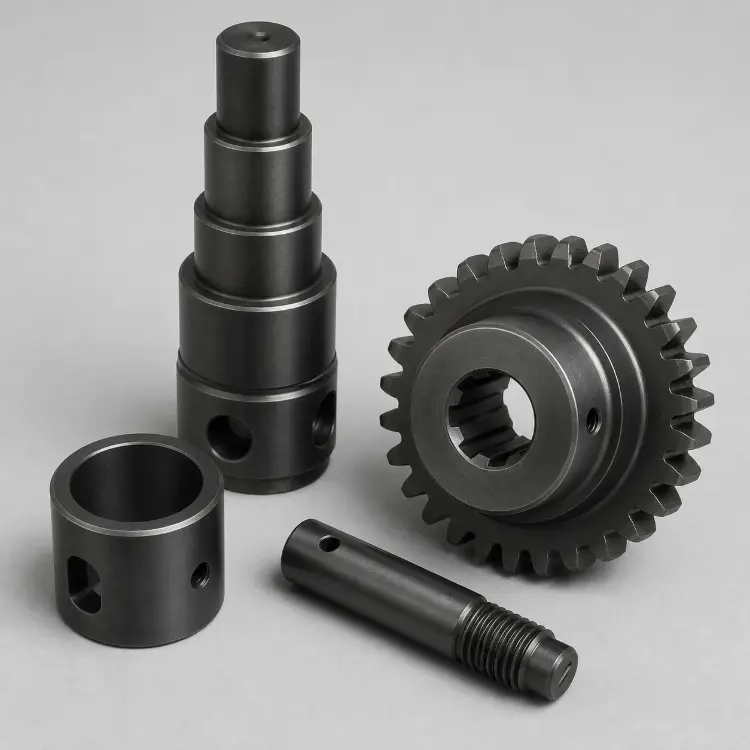
What Is Nitriding?
Nitriding is a thermochemical surface-hardening process. The workpiece is heated in an environment containing active nitrogen. Nitrogen atoms are absorbed by the metal surface and gradually diffuse into the material.
The nitriding temperature remains below the Ac₁ temperature of the steel. The steel does not undergo complete austenitization, and quenching is not required after treatment.
Nitriding mainly improves:
- Surface hardness and wear resistance
- Resistance to scuffing and galling
- Contact fatigue and bending fatigue performance
- Surface stability at elevated temperatures
- Corrosion resistance in specific environments
Nitriding hardens the surface rather than the entire cross-section. The core microstructure continues to determine the overall load-bearing capacity. The prior quench-and-temper condition and core hardness are therefore equally important.
What Is the Difference Between Nitriding and Nitrocarburizing?
Conventional nitriding primarily diffuses nitrogen into the metal surface. Nitrocarburizing introduces nitrogen and a small amount of carbon at the same time.
The term “soft nitriding” generally refers to ferritic nitrocarburizing. “Soft” does not mean that the treated surface has low hardness.
Nitrocarburizing has a shorter cycle and produces a shallower hardened case. It is suitable for carbon steels, low-alloy steels, and components subjected to light or moderate loads.
Conventional nitriding is better suited to steels containing aluminum, chromium, molybdenum, or vanadium. It can produce a deeper diffusion zone and consistent surface hardness.
Why Is Nitriding Important for Custom Parts?
Custom parts often have strict dimensional, tolerance, and surface-performance requirements. Nitriding hardens the working surfaces without through-hardening the entire component. It is suitable for precision parts that are already close to their final dimensions.
Nitriding also allows the surface and core properties to be controlled separately. The outer layer resists wear, scuffing, and contact fatigue. The core continues to withstand impact, bending, and torsional loads.
The nitriding result is closely connected to the preceding manufacturing operations. Material selection, quenching and tempering, stress relieving, dimensional compensation, and finish grinding must be planned as one process route.
When machining and nitriding are not properly coordinated, the following problems can occur:
- The previous tempering temperature is lower than the nitriding temperature
- Dimensions exceed assembly tolerances after nitriding
- Excessive post-nitriding grinding removes too much of the hardened case
- Masked areas do not match the functional surfaces
- Responsibility is unclear between the machine shop and heat-treatment поставщик
Nitriding should therefore be included in the manufacturing plan during the design and RFQ stages. It should not be treated as an unplanned additional operation after machining is complete.
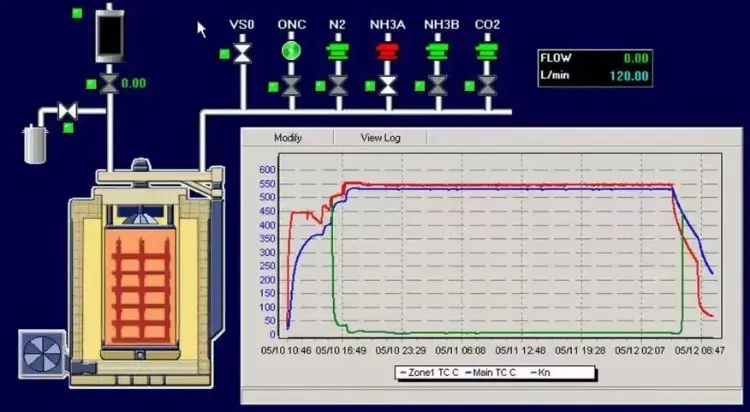
How Is a Nitrided Case Formed?
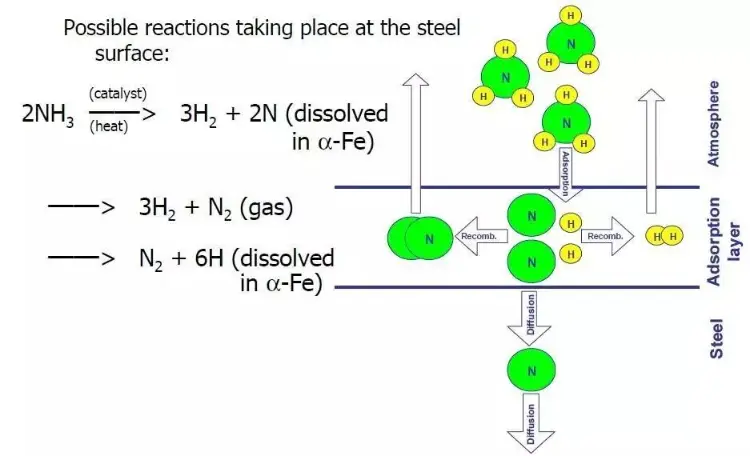
Active nitrogen is first adsorbed by the metal surface and then enters the iron matrix. As the nitrogen concentration increases, nitrogen reacts with iron and alloying elements to form nitrides.
Aluminum, chromium, molybdenum, and vanadium are effective nitride-forming elements. The fine nitrides formed by these elements restrict plastic deformation and increase surface hardness.
Nitrogen diffusion also creates residual compressive stress in the surface. This stress suppresses fatigue-crack initiation and improves service life under cyclic loading.
A nitrided surface normally consists of a compound layer and a diffusion zone.
Compound Layer
The compound layer is located at the outermost surface of the part. It is also known as the white layer. Common structures include γ′-Fe₄N, ε-Fe₂–₃N, or a mixture of both phases.
This layer mainly affects wear resistance, friction behavior, galling resistance, and corrosion resistance.
A thicker compound layer is not always better. An excessively thick white layer has greater brittleness and is more likely to crack under impact or high contact loads.
Diffusion Zone
The diffusion zone lies beneath the compound layer. It consists of nitrogen in solid solution and fine alloy nitrides.
The diffusion zone creates a hardness gradient and supports the outer compound layer. For gears, crankshafts, and spindles, diffusion depth directly affects load capacity and fatigue performance.
What Are the Main Types of Nitriding?
| Процесс | Typical Temperature | Cycle Characteristics | Основные области применения |
|---|---|---|---|
| Gas nitriding | 480–580°C | Several hours to several dozen hours | Gears, shafts, crankshafts, screws |
| Plasma nitriding | 350–580°C | Determined by material and case depth | Precision parts, molds, tools |
| Gas nitrocarburizing | 560–590°C | Typically 1–4 hours | Carbon-steel and low-alloy-steel parts |
| Salt-bath nitrocarburizing | 540–590°C | Rapid heating and short cycles | High-volume wear parts and automotive parts |
| Post-nitriding oxidation | Performed after nitriding | Adds an oxidation stage | Black wear- and corrosion-resistant parts |
The values in this table are used for preliminary process selection. Production parameters must be established according to the material, drawing, and acceptance standard.
Gas Nitriding
Gas nitriding uses a nitrogen-bearing atmosphere to generate active nitrogen at the steel surface. Modern equipment controls the result through temperature, time, and nitriding potential.
The process is suitable for volume production. It can also treat grooves, small holes, and complex surfaces. It is commonly used for gears, transmission shafts, and extruder screws that require a deeper diffusion zone.
Poorly controlled conventional processes can produce an excessively thick or brittle white layer. Controlled gas nitriding allows the compound layer and diffusion zone to be adjusted separately.
Plasma Nitriding
Plasma nitriding is also known as ion nitriding. The workpiece participates in a glow discharge inside a low-pressure nitrogen-bearing atmosphere.
Ion bombardment cleans and activates the surface. The layer structure can be adjusted through gas ratio, temperature, pressure, and electrical parameters.
Plasma nitriding is suitable for precision shafts, molds, and tools. It also makes selective masking easier. Treatment uniformity in deep blind holes and narrow grooves must be evaluated separately.
Ferritic Nitrocarburizing and QPQ
Ferritic nitrocarburizing is suitable for pins, small gears, hydraulic parts, and automotive transmission components. Its short cycle makes it suitable for shallow wear-resistant cases.
QPQ normally includes nitrocarburizing, polishing, and reoxidation. The treated surface has a dark gray or black appearance and provides good wear and corrosion resistance.
When purchasing QPQ-treated parts, cleaning, salt residue, post-oxidation, and environmental compliance requirements must be reviewed.
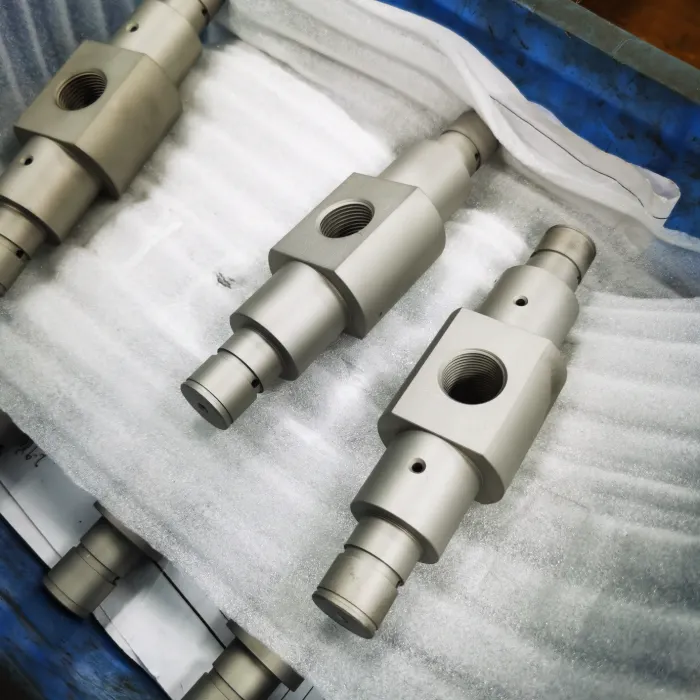
Advantages and Disadvantages of Nitriding
| Преимущество | Value to the Part |
|---|---|
| High surface hardness | Improves resistance to indentation and plastic deformation |
| Хорошая износостойкость | Reduces sliding, rolling, and abrasive wear |
| Low processing distortion | Suitable for precision parts close to final dimensions |
| Good fatigue performance | Surface compressive stress delays fatigue cracking |
| Retains core toughness | The core continues to withstand impact and structural loads |
| Supports selective treatment | Threads, mating surfaces, and weld areas can be masked |
| Недостаток | Procurement Consideration |
|---|---|
| Dependent on material composition | Plain carbon steel cannot achieve the same deep, high-hardness result as nitriding steel |
| Relatively shallow hardened case | Unsuitable for heavy-duty parts requiring deep hardening |
| Long cycle for deep cases | Greater NHD increases cost and lead time |
| Risk of brittleness | An excessively thick compound layer can crack or spall |
| Dimensional change still occurs | Precision parts require compensation and first-article validation |
| Strict requirements for stainless steel | Incorrect temperature can reduce the original corrosion resistance |
Nitriding is suitable for components that require high surface hardness, wear resistance, and dimensional stability. Carburizing and quenching or induction hardening should be reconsidered when a deep hardened case and high impact resistance are required.
Which Materials Are Suitable for Nitriding?
Material composition directly determines the hardness and case depth achieved after nitriding. Steels containing aluminum, chromium, molybdenum, and vanadium respond well to nitriding.
| Категория материала | Общие оценки | Типичные детали |
|---|---|---|
| Dedicated nitriding steel | 38CrMoAlA, 41CrAlMo7 | Gears, spindles, fuel-system components |
| Chromium-molybdenum alloy steel | 4140, 42CrMo, 4340 | Shafts, crankshafts, шестерни, structural parts |
| Hot-work tool steel | H11, H13, SKD61 | Die-casting dies, hot-forging dies, extrusion dies |
| Cold-work tool steel | D2, SKD11, Cr12MoV | Stamping dies, drawing dies, wear-resistant tools |
| Нержавеющая сталь, упрочняющаяся под воздействием осадков | 17-4PH, 17-7PH | Valves, shafts, wear-resistant parts |
| Аустенитная нержавеющая сталь | 304, 316, 316L | Parts requiring specialized low-temperature nitriding |
| Чугун | Ductile iron, gray cast iron | Guideways, liners, wear-resistant components |
| Titanium alloy | Ti-6Al-4V and others | Aerospace and specialized wear-resistant parts |
Tool Steels
Tool steels and high-speed steels are normally quenched and tempered before nitriding. The nitriding temperature must remain below the final tempering temperature. Otherwise, the core will undergo additional tempering and lose hardness.
The compound layer must be controlled around cutting edges, die radii, and sharp corners. An excessively thick brittle layer can cause edge chipping and surface spalling.
Нержавеющие стали
The chromium oxide film on 304, 316, and 316L stainless steels restricts nitrogen diffusion. Reliable surface activation is required before treatment.
When corrosion resistance must be retained, a validated low-temperature diffusion process should be used. The result must be confirmed through corrosion testing.
Conventional high-temperature nitriding promotes chromium nitride precipitation and reduces the material’s original corrosion resistance.
Plain Carbon Steels
Plain carbon steels lack strong nitride-forming elements. Conventional nitriding cannot produce the same hardening response as dedicated nitriding steels.
Nitrocarburizing is more suitable for these materials. Its main purpose is to improve shallow wear resistance, galling resistance, and corrosion resistance.
How Are Nitriding Parameters Determined?
Nitriding parameters must be established around four requirements: surface hardness, nitriding hardness depth, compound-layer condition, and dimensional tolerances.
Temperature and Time
Nitriding temperature affects diffusion rate, nitride precipitation, and core properties. Treatment time mainly determines diffusion depth.
Short nitriding cycles last from several minutes to several hours. They are suitable for tools, molds, and shallow surface hardening. Long cycles last from more than ten hours to several dozen hours and are used for gears, shafts, and heavily loaded wear parts.
The same parameters do not produce the same result in different materials. The treatment cycle must be based on the material, initial hardness, and target NHD.
Твердость поверхности
Surface hardness is determined by the material, initial microstructure, and process conditions.
The drawing should specify the micro-Vickers hardness, test load, measurement location, and sampling quantity. Conventional HRC testing is unsuitable for directly accepting a thin nitrided case.
Nitriding Hardness Depth
Nitriding hardness depth is commonly identified as NHD. It is determined from the cross-sectional hardness profile and represents the depth that provides functional hardening.
NHD and compound-layer thickness must not be used interchangeably. NHD is normally expressed in millimeters, while compound-layer thickness is normally expressed in micrometers.
Изменение размеров
Nitriding does not require quenching, so dimensional change is relatively small. Precision parts still experience slight growth or distortion.
Long shafts, thin-walled parts, and asymmetric components should be stress-relieved before nitriding. Dimensional compensation should also be verified during first-article production.
Manufacturing Process for Nitrided Parts
- Confirm the material grade and supply condition.
- Complete quenching and tempering or prehardening.
- Perform rough machining.
- Stress-relieve precision parts.
- Complete semi-finish or finish machining.
- Clean and activate the surfaces to be nitrided.
- Mask areas that must not be nitrided.
- Complete nitriding using the approved parameters.
- Cool under controlled conditions.
- Inspect hardness, NHD, microstructure, and dimensions.
- Perform light polishing, honing, or finish grinding as required.
- Complete cleaning, rust protection, and packaging.
Nitriding is normally performed when the part is close to its final dimensions. Grinding can still be performed after treatment, but the removal amount must be controlled.
Excessive grinding damages the compound layer and reduces the effective diffusion zone.
Safety and Compliance Requirements for Nitriding
Nitriding involves high temperatures, process gases, vacuum equipment, and high-voltage power supplies. Procurement personnel do not need to master furnace operation, but they should review the supplier’s safety equipment and management systems.
Gas Nitriding
Ammonia is toxic, corrosive, and flammable. Production areas require leak detection, ventilation, exhaust systems, and safety interlocks.
Gas cylinders, pipelines, valves, and pressure equipment must be inspected according to applicable regulations.
Plasma Nitriding
Plasma equipment involves vacuum, high voltage, and high temperatures. Furnace doors, gas supplies, power supplies, and cooling systems must have safety interlocks.
Equipment maintenance must be performed only after the power is isolated, pressure is released, and the equipment has cooled sufficiently.
Salt-Bath Nitrocarburizing
Molten salts present thermal-burn and chemical-exposure hazards. Traditional salt-bath processes also involve hazardous chemicals and waste-liquid management.
The supplier must maintain compliant systems for chemical storage, waste-salt disposal, and cleaning wastewater management.
Personnel and Process Management
The supplier should maintain:
- Safety Data Sheets
- Operator training records
- Ventilation and leak-detection systems
- Personal protective equipment
- Equipment maintenance and calibration records
- Emergency plans for leaks, fires, and burns
- Records for waste gas, wastewater, and hazardous-waste disposal
Areas involving hazardous gases require suitable ventilation and local exhaust systems. Exposure must be controlled in accordance with the chemical safety information.
Safety and environmental capabilities are also part of the quality system. Unstable gas and equipment control can also cause variations in hardness, case depth, and surface quality.
Which Custom Parts Are Suitable for Nitriding?
Transmission and Rotating Parts
Gears, spline shafts, crankshafts, camshafts, and spindles are subjected to contact and cyclic loads.
Nitriding increases the wear resistance of gear teeth and journals while retaining the load-bearing capacity of the core.
Molds and Tools
Die-casting dies, injection molds, hot-forging dies, and extrusion dies experience friction, adhesion, and thermal cycling.
Nitriding reduces cavity wear and delays fatigue damage around radii.
Hydraulic Parts
Valve spools, valve sleeves, piston rods, and pump shafts require stable running clearances.
Low-distortion nitriding helps retain precision dimensions and improves scuffing resistance.
Industrial Equipment Parts
Extruder screws, barrels, machine-tool guideways, and wear sleeves experience continuous sliding friction.
Nitriding slows surface wear and extends maintenance intervals.
What Are the Common Nitriding Problems?
| Проблема | Main Cause | Corrective Direction |
|---|---|---|
| Insufficient surface hardness | Unsuitable material, low initial hardness, insufficient nitriding potential | Verify material and prior heat treatment |
| Insufficient NHD | Insufficient time, low temperature, or surface oxide | Improve cleaning and adjust the cycle |
| Brittle white layer | Excessive nitriding potential or compound-layer thickness | Optimize the atmosphere and limit layer thickness |
| Uneven nitrided case | Incorrect loading or uneven gas or electrical-field distribution | Adjust loading and process planning |
| Out-of-tolerance dimensions | Residual stress, uneven cross-sections, or improper fixturing | Stress-relieve and apply dimensional compensation |
When hardness is insufficient, the treatment time should not be extended immediately. The material, core hardness, and surface condition must be checked first.
How Can Nitriding Costs Be Controlled?
Nitriding cost is determined by the material, prior heat treatment, furnace load, masking, inspection, and subsequent machining.
Specify Appropriate Hardness and NHD
A deeper diffusion zone requires a longer treatment cycle. Increasing NHD without a functional reason adds furnace time and energy cost.
Hardness and case depth should be based on the load, allowable wear, and required service life.
Select the Correct Material
Dedicated nitriding steels cost more, but they provide stable process results. They reduce the risk of testing, rework, and scrap.
Material selection should be based on total manufacturing cost rather than raw-material price alone.
Improve Furnace Utilization
Nitriding quotations commonly include a minimum furnace charge. Parts with the same material and process requirements can be treated together to reduce unit cost.
Small-volume projects should use consistent material conditions and acceptance requirements wherever possible.
Reduce Unnecessary Masking and Grinding
Deep holes, narrow grooves, and selective nitriding increase preparation costs. The design should identify the functional surfaces that genuinely require hardening.
Defining dimensional compensation and grinding allowance in advance reduces post-nitriding rework.
Set an Appropriate Inspection Scope
Critical parts require verification of hardness, NHD, and microstructure. Standard production parts can use an approved sampling plan.
Buyers should compare the complete delivered price, including machining, heat treatment, nitriding, finish grinding, and inspection.
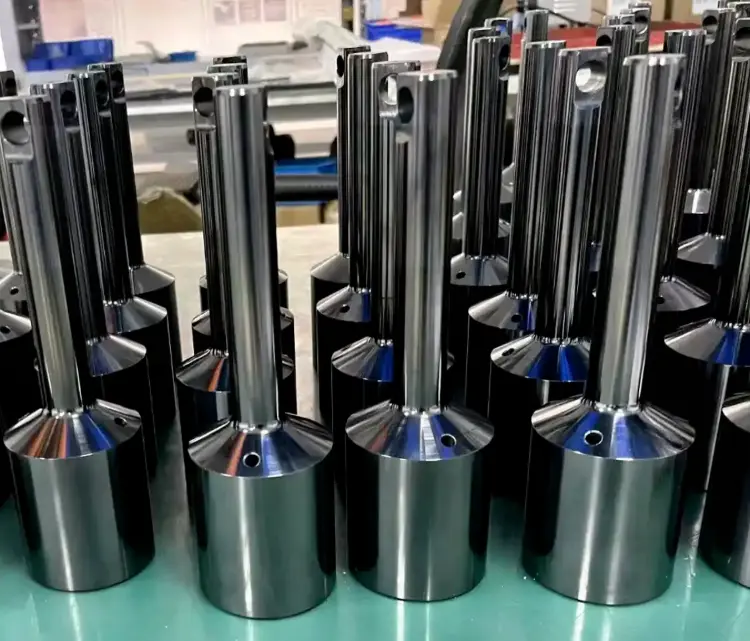
What Should Be Specified on the Drawing and RFQ?
The RFQ for a nitrided part should include at least:
- Material grade and material standard
- Initial heat-treatment condition and core hardness
- Nitriding process type
- Surface hardness and test load
- NHD and compound-layer requirements
- Masked areas and final dimensional tolerances
- Inspection documents and batch traceability requirements
- Quantity, lead time, and annual demand
This information allows suppliers to develop a stable process route and provide comparable quotations.
How Should Nitrided Parts Be Inspected?
Hardness and Case Depth
Micro-Vickers hardness testing is used to measure the surface and cross-sectional hardness profile. The report should identify the load, location, and acceptance criteria.
NHD should be measured according to the method specified on the drawing. ISO 18203 can be used to evaluate nitriding hardness depth.
Microstructure and Dimensions
A metallographic cross-section is used to inspect compound-layer thickness, porosity, continuity, and abnormal nitride networks.
Dimensional inspection should cover outside diameter, bore diameter, roundness, runout, flatness, and critical mating features.
Цвет поверхности
Steel parts after conventional gas nitriding normally appear silver-gray to dark gray. Plasma-nitrided surfaces generally have a more uniform gray or dark-gray appearance.
Nitrocarburized parts become dark gray or black when followed by oxidation. The black color produced by QPQ mainly comes from the surface oxide layer.
Color is only an appearance characteristic. It cannot replace hardness, NHD, or metallographic inspection.
How Should Nitrided Parts Be Maintained and Transported Safely?
Nitrided surfaces are hard and wear-resistant, but they still require protection from insufficient lubrication, impact, corrosion, and excessive grinding. Maintenance should focus on mating, sliding, and load-bearing surfaces.
Cleaning and Lubrication
Use a neutral cleaner to remove chips, oil, and coolant. Do not use strong acids, coarse abrasives, or aggressive blasting on precision nitrided surfaces.
Common lubricant options include:
| Тип детали | Recommended Lubricant |
|---|---|
| Enclosed gears | CLP extreme-pressure gear oil, ISO VG 150, 220, or 320 |
| Hydraulic spools and sleeves | HM/HV anti-wear hydraulic oil, ISO VG 32, 46, or 68 |
| Machine-tool guideways | CGLP anti-stick-slip slideway oil, commonly ISO VG 68 |
| Splines, pins, and low-speed loaded surfaces | NLGI 1 or 2 EP lithium grease |
| High-speed bearings | NLGI 2 bearing grease |
The final viscosity should match the load, speed, temperature, and equipment requirements. Different grease types should not be mixed without confirming compatibility.
Routine inspection should check for abnormal wear, cracks, spalling, corrosion, and changes in running clearance.
How Should a Damaged Nitrided Case Be Handled?
A part should be removed from service and isolated when damage to the nitrided case is found. After cleaning, inspect the scratches, cracks, and spalled areas. Magnetic-particle or dye-penetrant inspection should be used when required.
- Minor discoloration or contamination: Clean, protect against corrosion, and reinspect.
- Shallow surface scratches: Perform controlled polishing when permitted by the drawing, then verify dimensions and roughness.
- Damage extending into the diffusion zone: Remove the damaged area and evaluate machining allowance, core hardness, and remaining NHD before deciding whether renitriding is permitted.
- Base-metal cracks, deep indentations, or serious distortion: Replace or scrap the part.
Black touch-up, oil, and local polishing cannot restore a lost nitrided case. Renitriding requires an engineering review. Hardness, NHD, and critical dimensions must be rechecked after repair.
Storage and Transportation
Clean and dry the parts before storage. Apply a suitable rust preventive when required. VCI paper, sealed bags, and desiccants can be used for long-term storage or sea freight.
During transportation:
- Separate parts to prevent impact and rubbing.
- Protect threads, splines, edges, and precision bores.
- Support long shafts at multiple points.
- Secure heavy gears and molds in rigid containers.
- Supply inspection reports and batch-traceability documents with the shipment.
Inspect the packaging, surfaces, and critical dimensions after delivery. Parts showing impact damage, corrosion, or spalling must not be assembled before inspection.
How Does Nitriding Compare With Other Hardening Processes?
| Part Requirement | Suitable Process |
|---|---|
| High surface hardness, low distortion, shallow wear-resistant case | Азотирование |
| Deep hardened case, heavy loading, and impact | Carburizing and quenching |
| Rapid hardening of selected areas | Induction hardening |
| Rapid shallow hardening of carbon steel | Nitrocarburizing |
| Specialized friction or surface properties | PVD-покрытие |
Process selection must consider the material, load, wear mechanism, case depth, and dimensional tolerances.
How Should a Nitrided-Part Supplier Be Selected?
A reliable supplier should be able to:
- Develop a process route based on the material and load
- Control surface hardness, NHD, and compound-layer condition
- Predict and verify dimensional change
- Provide furnace, hardness, metallographic, and traceability records
- Coordinate Обработка на станках с ЧПУ, heat treatment, and precision grinding
For custom parts involving several manufacturing stages, coordinated production reduces transportation and communication costs. It also establishes clear responsibility for quality.
Заключение
The quality of a nitrided part cannot be judged by surface hardness alone. Material condition, NHD, compound layer, core properties, and dimensional stability are equally important.
Defining these requirements during the design and RFQ stages reduces testing, rework, and delivery risks.
If your gears, shafts, molds, or hydraulic parts require nitriding, submit your drawings, material, quantity, and acceptance requirements to Обработка Weldo. We will help evaluate the CNC machining, prior heat treatment, nitriding, and precision-grinding route and provide manufacturing recommendations and a котировка.
FAQ About Nitriding finish
Does Nitriding Change Part Dimensions?
Yes. Nitrogen diffusion and nitride formation cause slight dimensional growth. Precision parts should include compensation, and the actual change should be confirmed through first-article validation.
Can a Part Be Ground After Nitriding?
Yes. The grinding allowance must be controlled. The remaining surface hardness and NHD must still meet the drawing requirements after grinding.
Can Deep Holes and Blind Holes Be Nitrided?
Yes. Treatment uniformity is affected by hole diameter, depth, and process type. The surfaces inside the hole that require treatment should be identified in the RFQ.
How Long Does Nitriding Take?
Treatment time depends on the material, process type, and target NHD. Shallow nitrocarburizing normally takes several hours. Deep gas nitriding requires more than ten hours to several dozen hours.
How Can the Cost of Small-Batch Nitrided Parts Be Reduced?
Use consistent material, case-depth, and inspection requirements. Eliminate masking that has no functional purpose and combine parts with the same process requirements in one furnace load. Complex parts should undergo first-article validation before batch production.