
303 stainless steel is a chromium-nickel austenitic stainless steel developed primarily for machining applications. Sulfur is added to form manganese sulfide inclusions that promote chip separation and breakage. It is used for threaded fasteners, shafts, bushings, fittings, and instrument components.
На сайте Обработка на станках с ЧПУ, 303 is used for parts produced primarily by turning, drilling, and tapping. Material selection takes into account machining cycle time, part loads, contact media, joining methods, and surface quality requirements.
1. What Is 303 Stainless Steel?
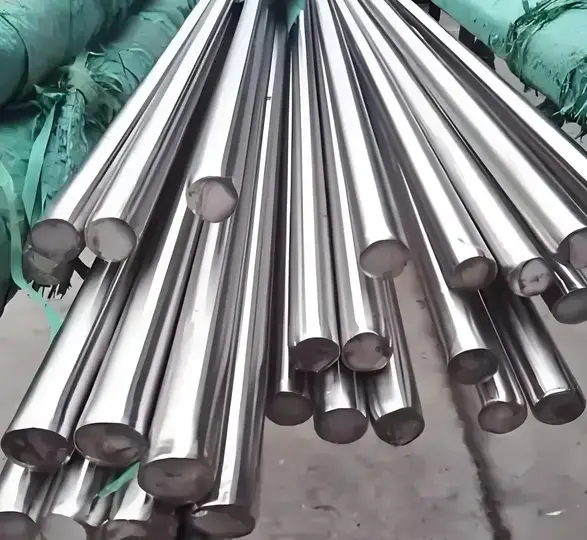
303 is a sulfur-containing, free-machining austenitic stainless steel with the U.S. UNS designation S30300. It has an iron base, with chromium and nickel as the main alloying elements and sulfur added to improve machinability.
Chromium helps form a chromium-rich passive film that provides the basis for corrosion resistance; nickel stabilizes the austenitic microstructure; and sulfur combines with manganese to form manganese sulfide (MnS) inclusions that improve chip formation and breakage.
2. What Parts Is 303 Stainless Steel Used For?
303 is primarily used for mechanical parts whose shapes, dimensions, and mating surfaces are produced by machining.
1. Threaded Fasteners
303 is used for turned screws, nuts, threaded sleeves, and threaded fittings. Round and hexagonal bars correspond to axisymmetric and hexagonal profiles, respectively, making it straightforward to plan turning, drilling, and tapping operations.
2. Shafts and Locating Components
303 is used for instrument shafts, locating shafts, and pins. Journals, shoulders, grooves, and threads can be produced by turning, with the dimensions and roughness of mating surfaces controlled to drawing requirements.
3. Bushings and Sleeves
303 is used for bushings, sleeves, and spacers. External turning, drilling, boring, or reaming produces mating surfaces that meet assembly requirements for bore diameter, wall thickness, and coaxiality.
4. Instrument and Electrical Equipment Components
303 is used for connecting posts, adjusting screws, and switchgear components. Small-diameter bar stock combined with automatic feeding equipment supports continuous production across multiple operations.
5. Machined Gears
303 is used for gears shaped by machining. Tooth profile accuracy, contact loads, hardness, and fatigue life together determine the material and machining plan for each part.
3. How Is 303 Stainless Steel Made?
Using an electric furnace, secondary refining, and continuous casting route for bar production as an example, 303 production begins with batching iron-bearing feedstock and alloying materials. After melting, refining controls the carbon, chromium, nickel, and sulfur contents while adjusting the composition, morphology, and distribution of inclusions.
The molten steel is cast into billets and then hot rolled into bars or wire rod. Solution annealing, pickling, cold drawing, turning, or grinding is then carried out according to the order requirements to achieve the specified material condition, cross-sectional dimensions, and surface quality.
Sulfur content and inclusion control together affect chip breakage and tool wear in 303; cold drawing increases strength and hardness, while solution annealing restores ductility. The production sequence is determined by the material condition specified in the order.
4. What Is the Chemical Composition of 303 Stainless Steel?
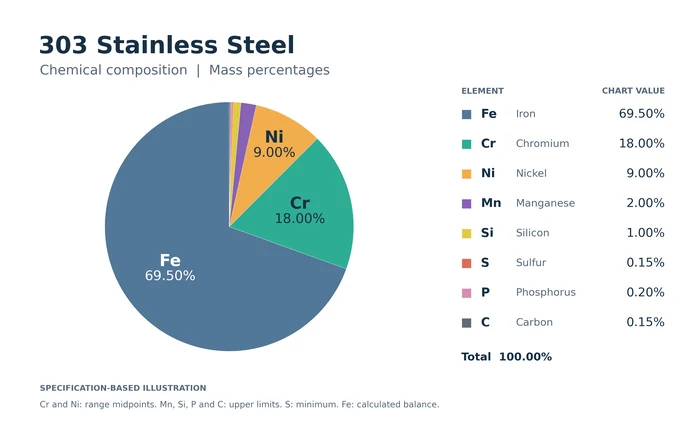
The following table lists the principal chemical composition requirements for Type 303 under ASTM A582/A582M. All contents are given as mass percentages.
| Элемент | Specified Content |
|---|---|
| Хром, Cr | 17.00%–19.00% |
| Nickel, Ni | 8.00%–10.00% |
| Сера, S | ≥0.15% |
| Марганец, Mn | ≤2,001 TP3T |
| Кремний, Si | ≤1,00% |
| Фосфор, P | ≤0,201 TP3T |
| Углерод, C | ≤0.15% |
| Iron, Fe | Баланс |
What Is the Carbon Content of 303?
Under ASTM A582/A582M, the maximum carbon content of 303 is 0.15%. For European grade 1.4305, the maximum carbon content is 0.10%. These values correspond to the requirements of their respective standards, and purchasing and acceptance should follow the standard and edition specified in the order.
What Role Does Sulfur Play in 303?
Sulfur improves machinability by forming MnS inclusions. These inclusions promote localized stress concentration in the cutting deformation zone, making chips easier to separate and break. Their size, morphology, and distribution also affect the machined surface and tool wear.
5. What Are the Properties of 303 Stainless Steel?
The key mechanical properties of 303 include tensile strength, yield strength, elongation after fracture, Brinell hardness, Young’s modulus, and shear modulus. The following table lists reference values for these six key mechanical properties of cold-drawn 303 bar at room temperature.
| Механические свойства | Эталонное значение | What It Represents |
|---|---|---|
| Tensile strength, Rm | 690 MPa | The maximum engineering stress during a tensile test |
| 0,21 TP3T предел прочности, Rp0,2 | 415 MPa | The stress corresponding to 0.2% plastic extension |
| Elongation after fracture, A | 40%, with a 50 mm gauge length | The percentage increase in gauge length after tensile fracture |
| Твердость по Бринеллю | 228 HB | Resistance to localized indentation |
| Young’s modulus, E | 193 GPa | The ratio of stress to strain within the uniaxial linear elastic range |
| Shear modulus, G | 77.2 GPa | The ratio of shear stress to shear strain within the linear elastic range |
When 303 is purchased to ASTM A582/A582M, the maximum hardness in the annealed condition is 262 HBW. The tensile strength, yield properties, and elongation required by the design should be included in the technical agreement and matched to the material condition and cross-sectional dimensions.
How Machinable Is 303?
The free-machining characteristics of 303 are reflected in chip formation and breakage. MnS inclusions work together with the tool’s chipbreaker geometry, feed rate, and depth of cut to control chips and support automatic feeding and continuous turning.
For a specific part, machinability is evaluated through machining cycle time, tool life, chip shape, and surface roughness. Once these measures are established, the machining cost per part can be compared across material options.
How Corrosion-Resistant Is 303?
303 resists corrosion through its chromium-rich surface passive film, and its service environments include dry indoor atmospheres. Surface cleaning, free iron removal, and a validated passivation treatment help the material achieve its inherent corrosion resistance.
MnS inclusions are among the initiation sites for localized corrosion. For parts exposed to liquids, cleaning agents, or chloride-containing media, corrosion performance should be verified against the medium’s composition, concentration, temperature, and contact time.
What Are the Magnetic Properties of 303?
303 has a low magnetic response in the solution-annealed condition. Microstructural changes caused by cold drawing and machining increase its magnetic response. When instrument or electrical components require controlled magnetic properties, the drawing should specify relative magnetic permeability and test conditions.
How Are the Strength and Hardness of 303 Increased?
The strength and hardness of 303 are increased through cold working, including cold drawing and cold rolling. Solution annealing restores a softened austenitic microstructure and ductility. The required part strength and hardness, together with the allowance for subsequent machining, should be considered when selecting the delivery condition.
How Should Joining Methods Be Selected for 303?
303 parts are assembled using threaded connections or interference fits verified for fit and strength. Its sulfur-containing microstructure is susceptible to weld hot cracking. For parts made using a welding route, the material grade should be established during material selection, and joint performance should be confirmed through welding procedure qualification.
6. What Are the Physical and Thermal Properties of 303 Stainless Steel?
The following table lists reference physical and thermal properties of 303 in the annealed condition.
| Physical or Thermal Property | Эталонное значение | Data Conditions |
|---|---|---|
| Плотность | 7.9 g/cm³ | Reference physical property in the annealed condition |
| Теплопроводность | 16.3 W/(m·K) | 100°C |
| Удельная теплоемкость | 500 J/(kg·K) | 0–100°C |
| Mean coefficient of linear thermal expansion | 17.3 × 10⁻⁶/K | 0–100°C |
Thermal conductivity describes the material’s ability to transfer heat, specific heat capacity describes the heat required for a temperature rise, and the coefficient of linear thermal expansion is used to calculate dimensional changes caused by temperature changes. When designing precision shafts, bushings, and mating parts, both operating and inspection temperatures should be included in the dimensional tolerance analysis.
7. What Forms Is 303 Stainless Steel Available In?
Круглый пруток
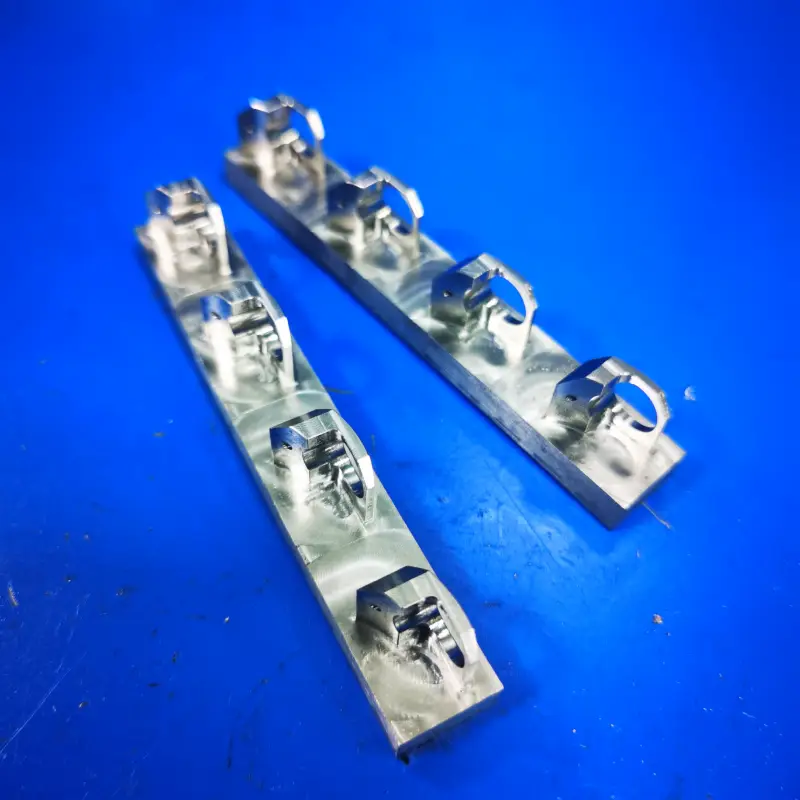
Round bar is used for shafts, pins, bushings, sleeves, and rotary unions. Its shape matches that of turned parts, supporting automatic feeding and continuous machining.
Hexagonal Bar
Hexagonal bar is used for nuts and hexagonal fittings. Selecting stock with an across-flats dimension that matches the finished part allows the hexagonal profile to be retained directly.
Square and Flat Bar
Square and flat bars are used for machined parts with flats, shoulders, or rectangular profiles. Blank dimensions are determined by the finished shape and machining allowance.
Wire and Wire Rod
Wire is used for small-diameter machined parts, while wire rod is used for subsequent drawing and wire production. Free-machining wire and wire rod purchased to U.S. standards should meet the applicable requirements of ASTM A581/A581M.
How Are Delivery Conditions Distinguished?
Annealing describes the material condition, cold drawing describes a processing method, and turning and grinding describe surface finishing methods. These items should be specified separately when purchasing, along with requirements for diameter tolerance, straightness, and surface quality.
8. What Are the Corresponding Grade Designations for 303 Stainless Steel?
| Standard or Designation System | Corresponding Lookup Designation |
|---|---|
| U.S. Type | 303 |
| U.S. UNS | S30300 |
| Chinese grade | Y12Cr18Ni9 |
| Chinese unified numerical designation | S30317 |
| Former Chinese grade | Y1Cr18Ni9 |
| Japanese JIS | SUS303 |
| European material number | 1.4305 |
| European grade | X8CrNiS18-9 |
These designations are used for material identification and technical communication. Actual orders should be based on the product standard and edition: ASTM A582/A582M for U.S.-standard free-machining bar and EN 10088-3 for European-standard long products. Chemical composition, delivery condition, and property requirements should be checked individually.
9. What Are the Advantages and Disadvantages of 303 Stainless Steel?
The advantages of 303 center on machining and the assembly of mating parts. Its key disadvantages concern corrosion performance in chloride-containing media, susceptibility to weld hot cracking, and cold formability.
Advantages of 303 Stainless Steel
1. Easy Chip Breakage
MnS inclusions promote chip separation and breakage. Combined with chipbreaker geometry, feed rate, and depth of cut, they help control chip shape and make chips easier to remove from the machining area.
2. Suited to Automated Turning Production
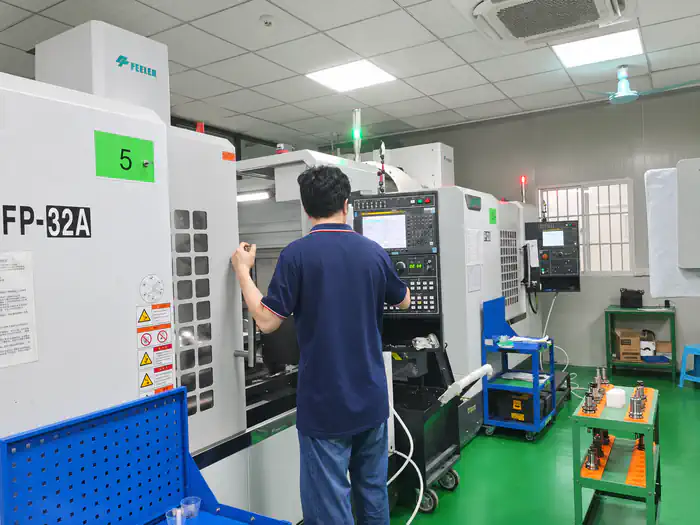
Round bar, hexagonal bar, and small-diameter wire are paired with automatic feeding equipment for turning, drilling, and tapping operations. The chip-breaking characteristics of 303 help control chip evacuation during continuous machining, making it suitable for batch production of threaded parts, shafts, and bushings.
3. Supports Control of Machined Surface Quality
The free-machining microstructure of 303 supports turning and finishing operations. Sharp cutting edges combined with the feed rate, tool nose radius, and cooling and lubrication allow the roughness and dimensions of mating surfaces to be controlled to drawing requirements.
4. Improved Galling Resistance in Mating Parts
The sulfur-containing microstructure improves galling resistance and helps with the assembly and disassembly of mating parts. Threaded and sliding fits still require design parameters to be established according to contact pressure, fit clearance, and lubrication conditions.
Disadvantages of 303 Stainless Steel
1. Susceptibility to Localized Corrosion in Chloride-Containing Media
MnS inclusions are among the initiation sites for pitting corrosion. Sulfide inclusions elongate in the rolling direction, increasing the susceptibility of the material’s cross section to localized corrosion. Parts exposed to saltwater, chloride-containing cleaning agents, or marine atmospheres require a corrosion assessment based on chloride concentration, temperature, and contact time.
2. Susceptibility to Weld Hot Cracking
Sulfur increases susceptibility to hot cracking during fusion welding. When a welding route is selected, the material grade should be established during material selection based on joint strength and corrosion resistance requirements, and joint performance should be confirmed through welding procedure qualification.
3. Cold Formability Is Affected by Inclusions
Sulfide inclusions reduce the material’s cold formability, making control of local deformation necessary during bending and cold heading. The forming plan should be validated against the material condition, bend radius, and amount of deformation. For parts produced by deep drawing or cold forming with large strains, formability should be included among the material selection criteria.
The value of 303 in machining is assessed using production records for actual parts. Raw material, machining time, tooling, surface treatment, and inspection costs together form the basis for evaluating material options.
10. What Are the Key CNC Machining Considerations for 303 Stainless Steel?
Tool selection starts with the grades and geometries recommended by the tool manufacturer for 303. Batch turning uses the corresponding coated carbide inserts, while drilling, reaming, and tapping each require high-speed steel or carbide tools matched to the operation.
Sharp cutting edges and positive rake geometry help form chips. Tool nose radius, depth of cut, and feed rate should match part rigidity, cutting loads, and the operating range of the chipbreaker geometry.
Coolant should reach the cutting zone. During drilling, through-tool coolant or a directed supply provides cooling and chip evacuation. A steady feed keeps the cutting edge forming chips continuously, while first-piece trial machining confirms dimensions, roughness, and chip breakage.
Production parameters are established from first-piece and tool-life records. Tool wear limits, tool-change criteria, and inspection frequency should be included in the process documentation.
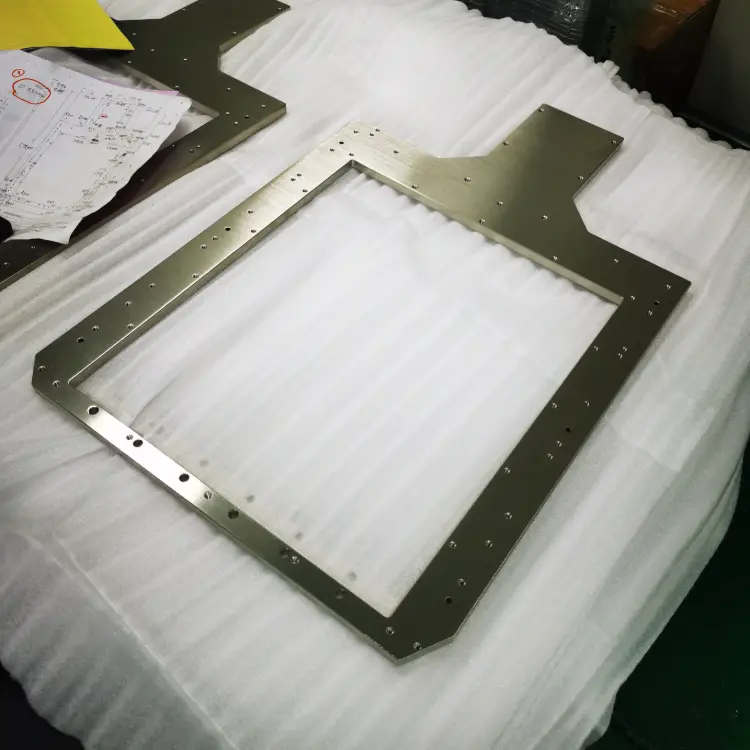
11. What Surface Treatments Are Used for 303 Stainless Steel?
Surface treatments for 303 are selected according to corrosion resistance, appearance, roughness, or coating function requirements.
| Обработка поверхности | Назначение | Key Process Validation Points |
|---|---|---|
| Cleaning and chemical passivation | Remove machining contamination and free iron so the material can achieve its inherent corrosion resistance | Validate the formulation, treatment time, rinsing, and drying process for 303 |
| Mechanical polishing and brushing | Produce the specified roughness or texture | Confirm Ra, texture direction, and dimensional changes |
| Abrasive blasting | Produce the specified matte surface | Confirm the blasting media, roughness, and appearance sample |
| Электрополировка | Electrochemically remove surface metal to modify the surface microtopography | Check roughness, surface micropores, and dimensional changes |
| Nickel or chromium plating | Provide the specified appearance and coating function | Confirm cleaning, activation, continuity of the plating process, and coating adhesion |
A clean 303 surface naturally forms a passive film when exposed to oxygen. Chemical passivation should use a process validated for sulfur-containing materials, with control of sulfide reactions and residual acid.
During electropolishing, the dissolution of surface sulfides affects the surface microtopography. Process validation is based on the surface and dimensional inspection results after treatment. Electroplating uses surface activation and a continuous plating sequence to produce a firmly adherent coating.
12. How Does 303 Compare with 304, 316, and 303Se?
303 vs. 304
303 uses a sulfur-containing composition to improve machinability, with applications centered on bar turning and machined parts. 304 combines corrosion resistance, formability, and weldability, with applications spanning sheet metal parts, vessels, pipe fittings, and equipment structures.
During material selection, the amount of turning required and the continuous production cycle time are key factors in evaluating 303; bending, deep drawing, and welding requirements are key factors in evaluating 304. The service media and loads also contribute to the final material choice.
303 vs. 316
The alloy design of 303 focuses on machining. 316 uses molybdenum additions to improve resistance to pitting and crevice corrosion and is used for equipment components with corresponding corrosion resistance requirements. 316L uses a low-carbon composition for applications requiring control of intergranular corrosion after welding.
Material selection for chloride-containing media should account for chloride concentration, temperature, crevice geometry, and contact time, with the material option validated under actual service conditions.
303 vs. 303Se
303 uses sulfur to improve machinability, while 303Se uses selenium and has the U.S. UNS designation S30323. Under ASTM A582/A582M, 303Se requires a selenium content of ≥0.15% and a maximum sulfur content of 0.060%.
The characteristics of 303Se also include hot and cold formability and machined surface quality. For parts that need to meet these requirements together, 303Se should be evaluated against stock availability, machining trials, and finished-part requirements.
13. What Information Should Be Specified When Purchasing 303 Stainless Steel?
Purchasing requirements for 303 should include the product standard and edition, grade, cross-sectional dimensions, tolerances, material condition, surface finishing method, and heat-number traceability. For parts with design requirements for strength, hardness, magnetic properties, or corrosion resistance, the required values and test methods should be included in the technical documentation.
For example, a U.S.-standard bar order can state: “ASTM A582/A582M-22, Type 303, UNS S30300, annealed condition, cold-finished round bar,” followed by the diameter, length, tolerances, property requirements, and quality certification requirements. The material certificate, incoming inspection records, and production batch records together provide the basis for material traceability.
14. FAQ
1. Is 303 Stainless Steel Food Safe?
Finished 303 products can be used for validated food-contact applications once they meet the food-contact requirements of the target market and have undergone the applicable metal migration and corrosion resistance validation. Validation should cover the food type, contact temperature, duration, and cleaning conditions.
2. Will 303 Stainless Steel Rust?
Yes. Chloride-containing media, surface iron contamination, and liquid trapped in crevices increase the risk of pitting and rusting. Keeping surfaces clean, rinsing and drying them thoroughly, and using a validated passivation process help control corrosion.
3. Is 303 Stainless Steel Expensive?
The purchase price of 303 is determined by its dimensions and specifications, delivery condition, and order quantity. For batch-turned parts, material costs, machining time, and tooling costs should be assessed together to evaluate cost-effectiveness based on the total cost per part.
4. Is 303 Stainless Steel Hard to Machine?
303 is a free-machining austenitic stainless steel. Its MnS inclusions promote chip breakage, making it suitable for turning, drilling, and tapping. Tools and cutting parameters are selected to match the material condition, operation, and part rigidity.
5. Can 303 Stainless Steel Be Heat Treated?
303 bar supplied in the solution-annealed condition can be machined directly without additional heat treatment. Conventional heat treatment of 303 consists of annealing treatments that soften the material and restore ductility; it cannot be hardened by quenching. When higher strength is required, select cold-drawn bar that meets the design requirements.